Claude Fable 5.1 Is Now Available on AWS Bringing Frontier Intelligence to Enterprise Workflows

The landscape of generative artificial intelligence reached a new milestone last week as Amazon Web Services (AWS) officially announced the availability of Claude Fable 5.1, the latest flagship model from Anthropic. This release signifies a strategic escalation in the capabilities provided to cloud-native developers, particularly for those engaged in long-running, high-stakes computational tasks that require sustained reasoning and broad contextual awareness. The integration of Claude Fable 5.1 into the AWS ecosystem is designed to bridge the gap between experimental AI applications and the rigorous demands of enterprise-grade software engineering and scientific research.
Technical Capabilities and Functional Evolution
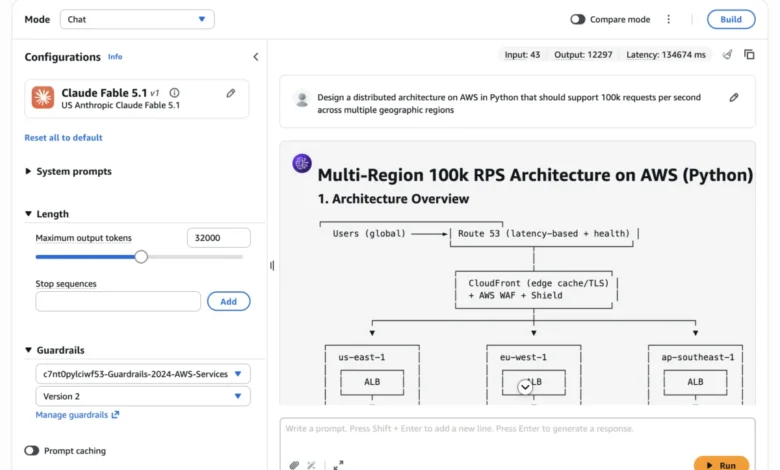
Claude Fable 5.1 distinguishes itself from its predecessors through its ability to manage prolonged, multi-stage workflows. Unlike previous iterations that were optimized for discrete query-response interactions, Fable 5.1 is engineered for extended sessions spanning several hours. This design philosophy directly addresses the needs of developers who require an AI assistant capable of managing entire software projects.
According to technical documentation provided by Anthropic, the model possesses an advanced capacity to navigate complex codebases. It is capable of independently handling feature implementation, conducting comprehensive code reviews, and executing performance optimization tasks without requiring constant human intervention or iterative prompts. This autonomy marks a shift from AI as a reactive tool to AI as an active participant in the software development lifecycle, capable of maintaining state and context across complex, multi-application environments.
The Governance Framework and Covered Model Status
Central to the deployment of Claude Fable 5.1 is its designation as a "Covered Model." This classification represents a significant shift in how high-frontier AI models are handled within regulated cloud environments. As organizations increasingly integrate generative AI into proprietary and sensitive business workflows, the necessity for stringent data governance has become paramount.
Covered Models are subject to specialized safety protocols that govern data retention, security auditing, and access control. Anthropic and AWS have instituted a 30-day data retention policy for these models, which is facilitated through the newly introduced aws_review data retention mode. Under this configuration, prompts and model outputs are retained within the secure AWS boundary for the explicit purpose of human safety review by authorized Amazon personnel.
This mechanism is distinct from legacy data-sharing models. AWS has explicitly clarified that the provider_data_share mode is now deprecated in this context, reinforcing the policy that Amazon Bedrock will not share user data with external model providers. This architectural decision is intended to reassure enterprise clients that their intellectual property remains insulated within the AWS cloud perimeter, effectively mitigating concerns regarding the exposure of sensitive training or inference data.
Enterprise Frontier Safeguards (EFS)
To further bolster security, AWS and Anthropic have introduced Enterprise Frontier Safeguards (EFS). This collaborative initiative allows eligible organizations to utilize advanced models while maintaining absolute control over their underlying cloud environment. EFS serves as a specialized governance layer that restricts data movement and ensures that the model’s operations remain compliant with the strict data residency and privacy requirements of highly regulated industries, such as financial services, healthcare, and government defense.
The implementation of EFS reflects a broader trend in the cloud industry: the shift toward "sovereign AI." By ensuring that high-stakes model inference occurs within a controlled, observable, and auditable environment, AWS is positioning itself to capture the enterprise market that has been hesitant to adopt generative AI due to potential risks involving data leakage and unauthorized model training.
Deployment Channels: Amazon Bedrock and Claude Platform
Access to Claude Fable 5.1 is currently provisioned through two primary pathways: Amazon Bedrock and the Claude Platform on AWS.
Amazon Bedrock remains the primary gateway for enterprise users. By integrating Fable 5.1 into Bedrock, AWS allows developers to deploy the model alongside a suite of other foundational models, providing a unified API interface that simplifies the management of infrastructure, scaling, and security. For developers who require a more specialized environment, the Claude Platform on AWS offers a tailored experience that aligns with the specific lifecycle management needs of Anthropic’s flagship models.
Both platforms are supported by comprehensive model cards, which provide transparent metrics on performance, limitations, and intended use cases. These resources are critical for IT departments performing due diligence, as they provide a factual basis for determining whether Fable 5.1 meets the specific compliance and performance requirements of their respective applications.

Broader Industry Implications
The introduction of Claude Fable 5.1 occurs during a period of intense competition among the "Big Three" cloud providers—AWS, Microsoft Azure, and Google Cloud—each of which is racing to provide the most robust infrastructure for AI deployment.
The emphasis on "long-running, high-stakes" work suggests that the industry is moving past the initial excitement surrounding simple chatbots and toward the automation of cognitive labor. If Fable 5.1 succeeds in reliably managing entire software projects, the implications for developer productivity and software engineering economics could be profound. Analysts anticipate that if this model can reduce the manual labor required for code maintenance and performance debugging, it could significantly lower the cost of technical debt for large-scale enterprises.
Furthermore, the focus on human-in-the-loop safety reviews represents a mature approach to AI risk management. By incorporating a structured review process into the cloud infrastructure, AWS is essentially formalizing the "safety-first" paradigm. This approach acknowledges that while the speed of AI development is accelerating, the stability and reliability of enterprise systems remain the ultimate priority for cloud adoption.
Looking Ahead
The deployment of Claude Fable 5.1 is not an isolated event but rather a strategic indicator of where the AWS-Anthropic partnership is headed. As the model’s capabilities continue to evolve, the focus will likely shift toward increasing the efficiency of inference at scale and expanding the scope of the EFS program to cover a wider range of industry-specific compliance standards.
For developers and organizations, the immediate task is the evaluation of their existing workflows to identify areas where sustained, high-context AI reasoning can be applied. As the ecosystem matures, the integration of such models is expected to become a standard component of the modern DevOps stack, fundamentally altering how applications are built, maintained, and secured in the cloud.
The arrival of Claude Fable 5.1 serves as a reminder that the utility of generative AI is increasingly defined by the strength of the underlying infrastructure. By prioritizing data sovereignty, security, and integration, AWS is aiming to ensure that the next generation of AI-driven applications is not only powerful but also sustainable within the strict confines of corporate and regulatory environments. As developers begin to explore the capabilities of this new model, the industry will be watching closely to see how effectively these "frontier intelligence" tools can be translated into tangible operational improvements.