Introducing Amazon ECS Gateway: Streamlining Ingress Networking for Containerized Workloads at Scale

For platform engineering teams managing high-density container environments, the operational overhead of configuring network ingress has long been a significant friction point. When deploying applications on Amazon Elastic Container Service (Amazon ECS), every new microservice typically necessitates a complex chain of supporting infrastructure: Application Load Balancers (ALBs), AWS Certificate Manager (ACM) records, AWS WAF web access control lists, and precisely tuned security groups. This manual or semi-automated provisioning process often leads to configuration drift, increased security risks, and, ultimately, a deceleration of development velocity. To address these systemic bottlenecks, Amazon Web Services has unveiled Amazon ECS Gateway, a new account-level resource designed to automate and centralize the lifecycle management of ingress infrastructure.
The Evolution of Container Networking
The history of container orchestration is marked by a shift from manual infrastructure management to increasingly abstracted control planes. In the early days of microservices, developers were often responsible for the entire networking stack, which frequently resulted in inconsistent security postures and inefficient resource utilization. As organizations scaled to hundreds or thousands of services, the burden of maintaining individual load balancers for every application became untenable.

Industry analysts have noted that "ingress sprawl"—the uncontrolled proliferation of load balancers—not only increases cloud spend but also complicates compliance auditing. By introducing a centralized gateway architecture, AWS is moving toward an "infrastructure-as-a-service" model for networking, where the platform layer abstracts the complexity of traffic routing away from individual application developers. This development follows a multi-year trend of AWS simplifying its container services to mirror the ease-of-use found in serverless environments like AWS Fargate, while retaining the deep configuration capabilities required by enterprise-grade infrastructure teams.
Operational Mechanics and Architecture
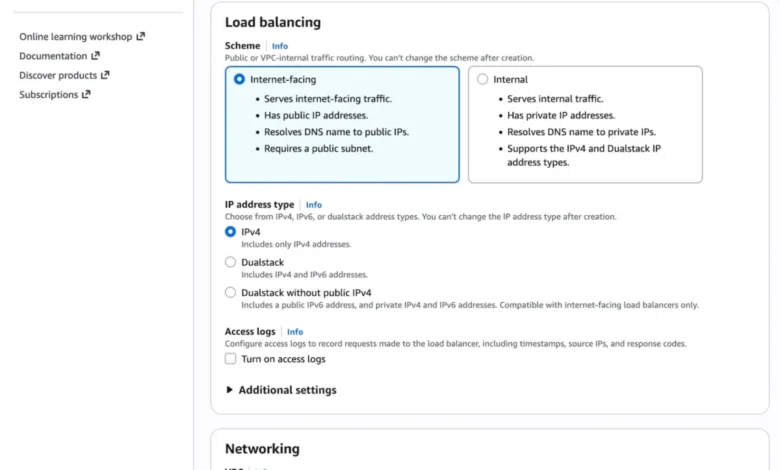
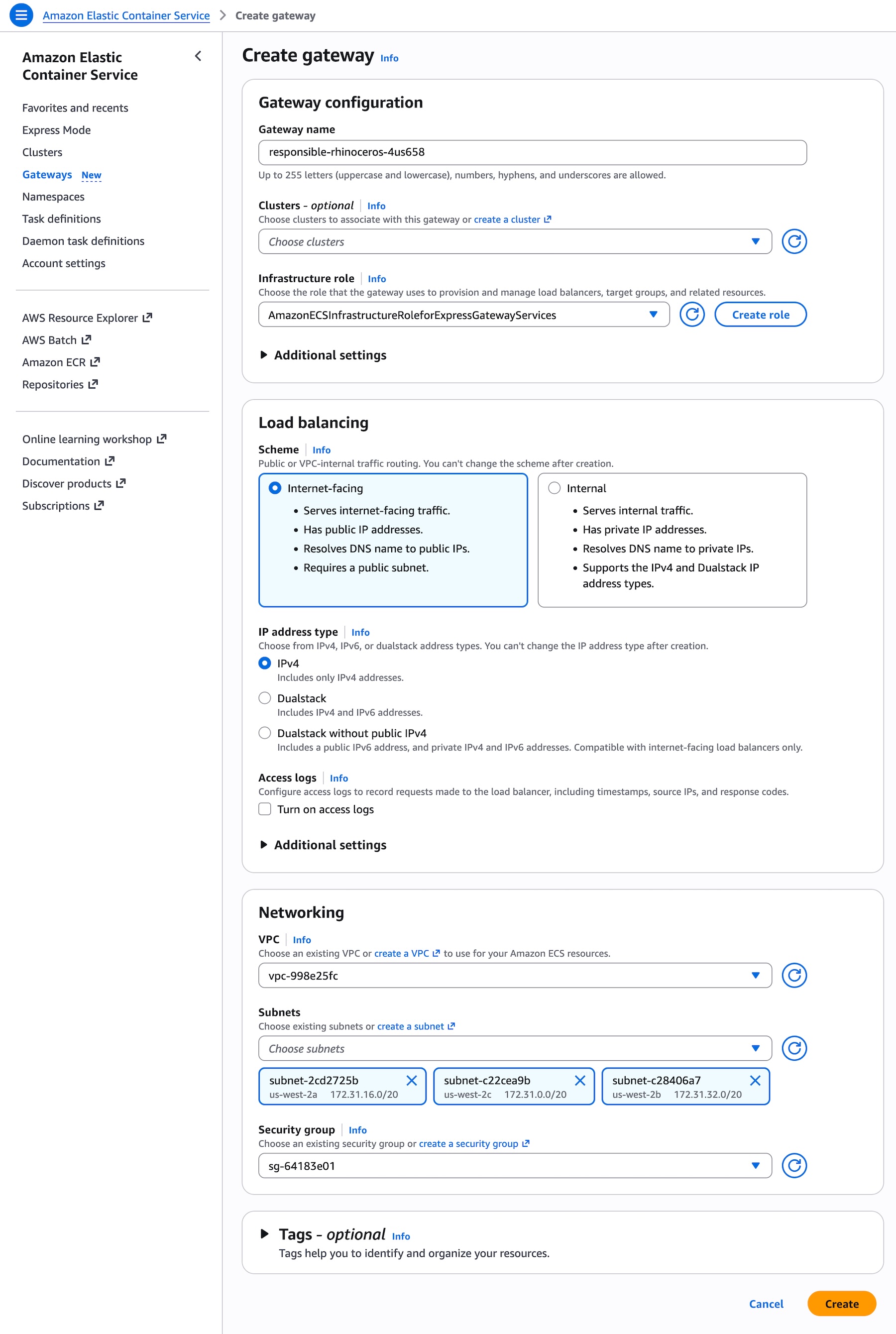
The core innovation behind Amazon ECS Gateway lies in its ability to decouple the ingress configuration from the service definition itself. When a platform team creates a gateway, they establish a foundational template for traffic management within their VPC. This includes defining the load balancing scheme (public or internal), security policies, and listener configurations.
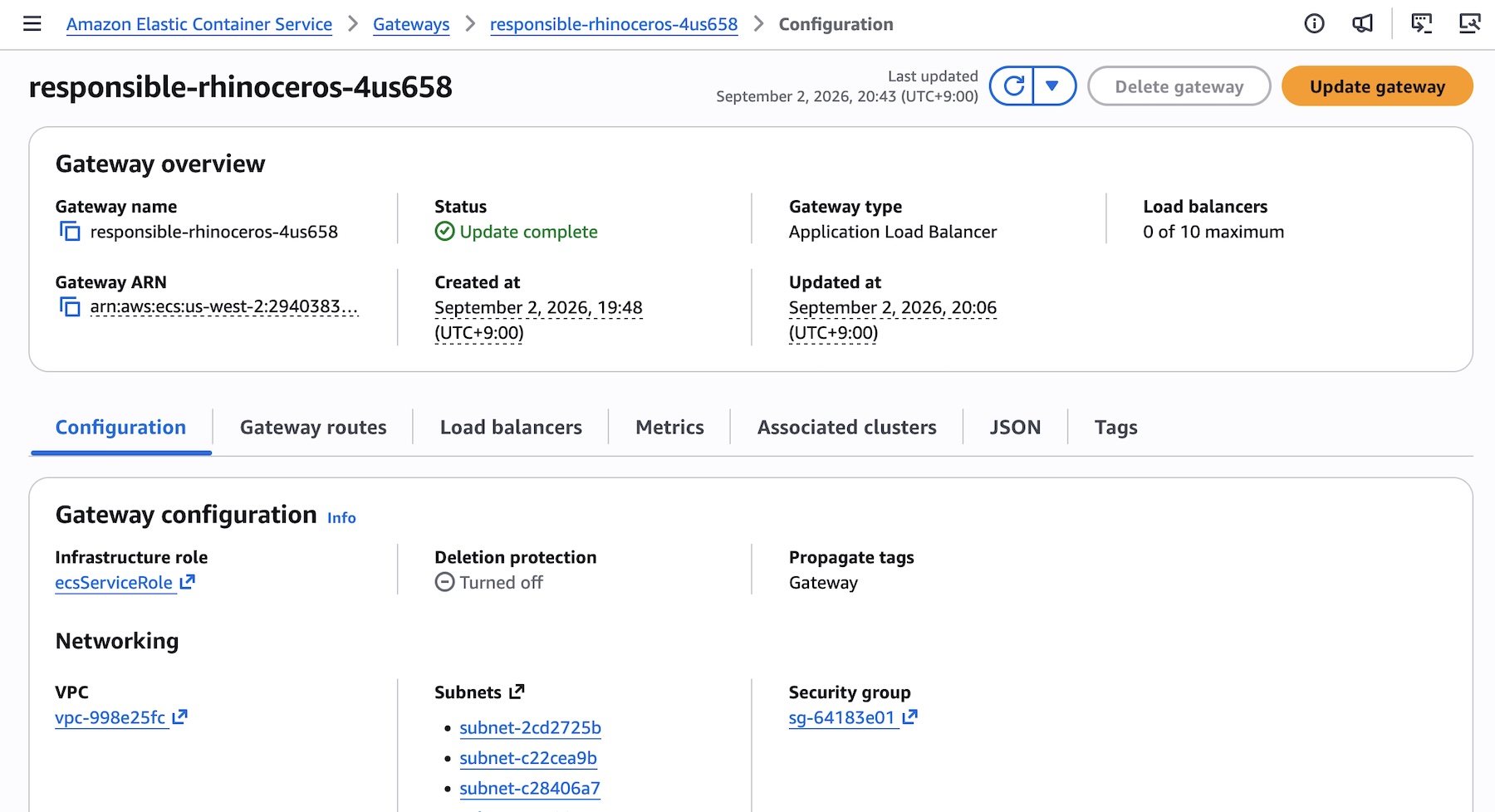
Once established, the gateway acts as a managed intermediary. The system supports a many-to-many relationship, where a single gateway can serve up to 10,000 ECS clusters, and conversely, a cluster can be associated with multiple gateways. This flexibility allows organizations to maintain strict segmentation, such as having separate gateways for public-facing APIs versus internal-only administration services.

From a resource utilization standpoint, the gateway introduces host-based routing that allows up to 25 unique services to share a single Application Load Balancer. This consolidation is a substantial departure from the traditional one-to-one mapping, which often resulted in underutilized load balancers and higher-than-necessary costs. As service density increases, the ECS Gateway automatically scales by provisioning additional load balancers, ensuring that the infrastructure grows dynamically with the application’s needs.
Implementation and Workflow
The deployment process for ECS Gateway is designed to be integrated into existing CI/CD pipelines. Using the AWS Command Line Interface (CLI) or the AWS Management Console, platform engineers define the gateway using an infrastructure role—a specific IAM role that grants the ECS control plane the necessary permissions to manage ALBs, certificates, and security groups on the user’s behalf.
The workflow for an application team is simplified significantly. When a developer creates or updates a service, they include a "gateway connector" in their service definition. This connector acts as a request to the gateway, specifying parameters such as port names and health check configurations. The ECS control plane then handles the heavy lifting:
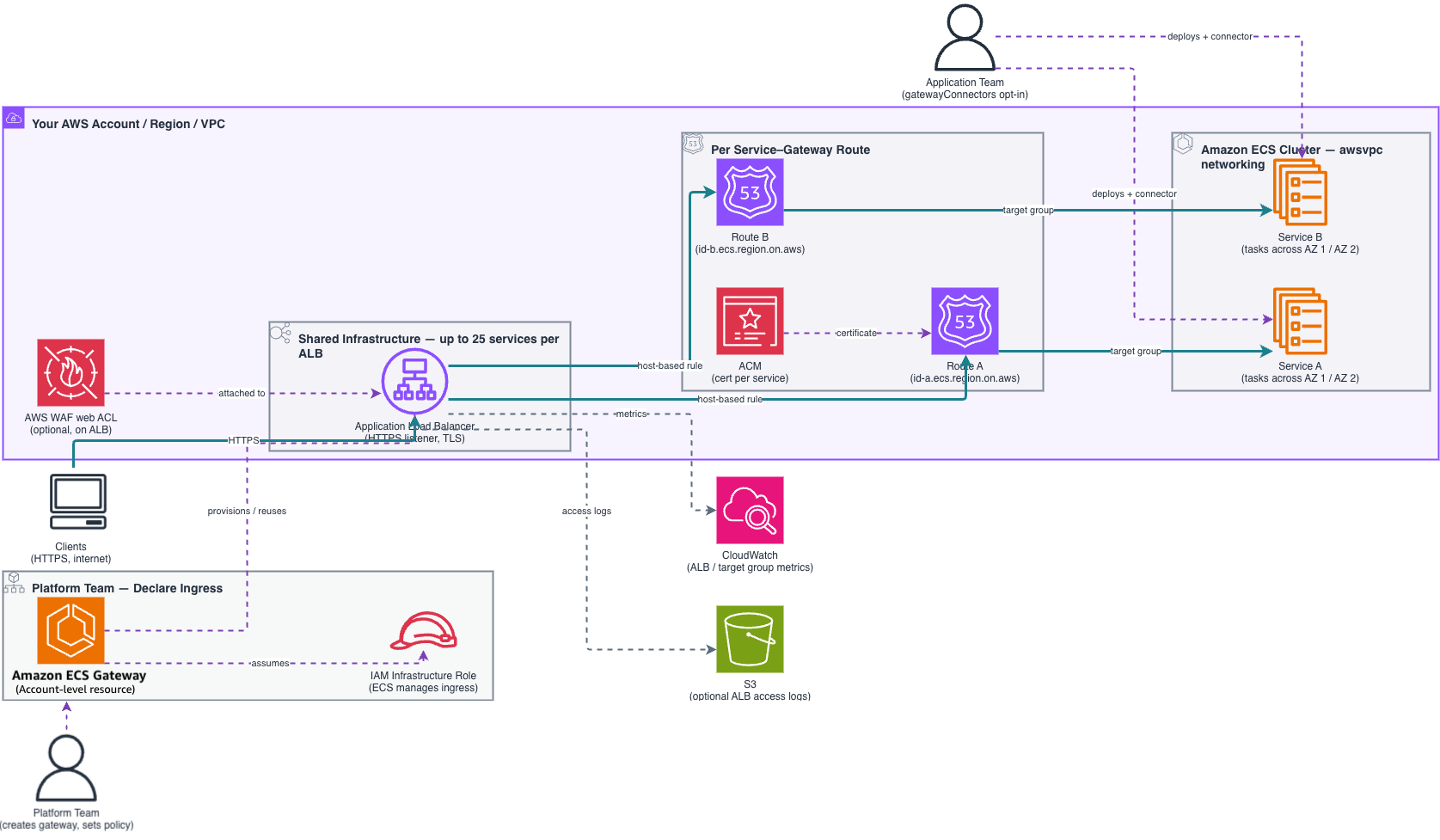
- Verification: The system checks if the service meets the gateway’s compatibility requirements (VPC, availability zones, and access type).
- Provisioning: If compliant, the system automatically provisions an ACM certificate and a unique DNS hostname.
- Routing: It configures the listener rules and updates the security groups to ensure that traffic is permitted only from the load balancer to the service.
- Lifecycle Management: When a service is decommissioned or updated, the gateway cleans up the associated ingress resources, preventing "orphaned" infrastructure.
Strategic Implications for Platform Teams
The introduction of this feature is expected to have a profound impact on the "Platform Engineering" discipline, which emphasizes providing self-service capabilities to developers while maintaining guardrails. By centralizing the management of ingress, platform teams can enforce consistent security policies—such as the mandatory application of specific WAF rules or TLS versions—across all services without requiring individual developers to become experts in networking configuration.
Furthermore, the capability for incremental adoption is a critical feature for large-scale enterprises. Organizations with existing legacy load balancers can connect their services to the new gateway without tearing down their current traffic flows. This allows for a "side-by-side" validation period, during which traffic can be gradually shifted to the new infrastructure, minimizing the risk of downtime or configuration errors.
Economic and Performance Considerations
While the Amazon ECS Gateway is offered at no additional charge, the underlying infrastructure costs remain. However, the architectural efficiency gain is substantial. By sharing ALBs, organizations can reduce the fixed hourly costs associated with running numerous idle or low-traffic load balancers.
Data from early testing suggests that the consolidation of ingress resources can lead to significant cost savings in environments where dozens of small microservices were previously tied to individual ALBs. Additionally, the automation of certificate management through ACM, combined with the automatic synchronization of security groups, reduces the "human-in-the-loop" time—a metric often cited by DevOps leaders as a primary driver of operational expense.
Future Outlook and Integration
The release of the ECS Gateway also underscores the increasing role of AI-assisted infrastructure management. AWS has explicitly highlighted the compatibility of the gateway with the AWS MCP (Model Context Protocol) Server, which allows developers to use AI coding assistants to generate infrastructure definitions and query gateway configurations. This integration signals a broader shift toward "Natural Language Infrastructure," where the gap between business requirements and technical implementation is further narrowed.
Looking ahead, industry observers anticipate that this model of managed ingress will become the standard for Kubernetes-based and ECS-based architectures. As applications grow in complexity, the ability to abstract the "plumbing" of the network will become a critical differentiator for cloud providers. The ECS Gateway represents a mature step in this direction, offering a scalable, secure, and developer-friendly approach to one of the most persistent challenges in cloud computing.
For organizations currently struggling with the burden of maintaining thousands of load balancer configurations, the ECS Gateway provides a path toward greater architectural simplicity. By shifting the responsibility of ingress management from the service level to the cluster and account levels, Amazon is empowering teams to focus less on network plumbing and more on the delivery of business value through their applications. As the service reaches general availability across all commercial AWS regions, the industry will likely see a rapid adoption of this pattern, particularly among enterprise users looking to optimize their operational footprint and enhance their security posture in increasingly complex, distributed environments.
Related posts: