AWS Announces Major Overhaul of Well-Architected Framework to Separate Cloud Foundations from Workloads and Incorporate Generative AI Guidance

Amazon Web Services (AWS) has officially unveiled a comprehensive restructuring and update to its flagship AWS Well-Architected Framework, introducing significant architectural refinements across all six of its core pillars: Operational Excellence, Security, Reliability, Performance Efficiency, Cost Optimization, and Sustainability. This major overhaul marks one of the most substantial evolutions of the framework since its inception more than a decade ago. Designed to address the rapidly changing technological landscape of modern cloud computing—characterized by the pervasive integration of generative artificial intelligence, multi-account enterprise structures, and automated compliance checking—the updated framework fundamentally decouples account- and organization-wide best practices from individual workload architecture.
By cleanly separating organizational guardrails from application-specific design patterns, AWS aims to drastically accelerate the review process for engineering teams, reduce administrative overhead, and facilitate automated architecture audits conducted by artificial intelligence agents. As enterprises increasingly scale their cloud operations to hundreds or thousands of individual accounts, the newly introduced architecture ensures that foundational rules are evaluated uniformly at the environment level, while individual workload reviews remain laser-focused on application logic, performance, and risk management.
Background Context and Evolution of the Framework
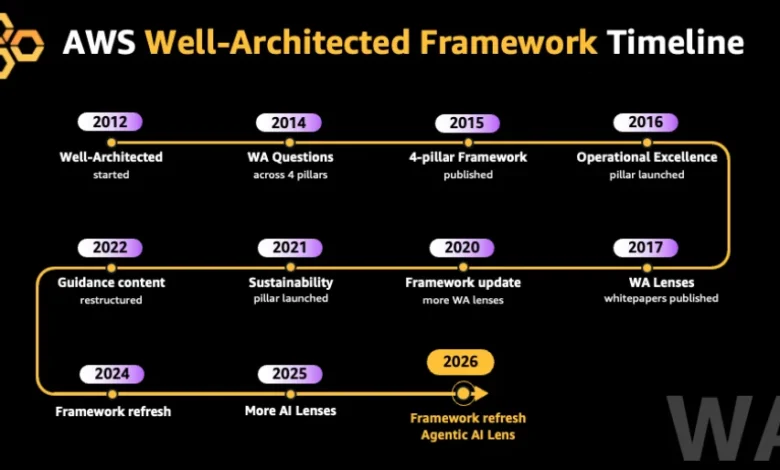
The AWS Well-Architected Framework originated in 2012 as a foundational whitepaper designed to help organizations of all sizes evaluate and improve their cloud architecture. Over the ensuing fourteen years, the initiative expanded from a singular set of prescriptive guidelines into an extensive body of architectural knowledge spanning multiple industries and technology stacks.
The chronology of the framework reflects the maturation of enterprise cloud adoption. In its early years, guidance was consolidated into general architectural best practices. As cloud computing matured into enterprise-critical infrastructure, AWS introduced the Operational Excellence pillar, followed by a continuous series of pillar-specific whitepapers and specialized Well-Architected Lenses tailored to specific technologies, compliance frameworks, and industry verticals. In subsequent updates, best practices became the core unit of guidance, and Sustainability was formally integrated as the sixth pillar in response to growing global emphasis on environmental accountability and green computing. Most recently, the rapid emergence of generative and agentic artificial intelligence necessitated the creation of dedicated lenses to guide organizations through safe and efficient AI deployment. The 2026 update represents the next logical step in this continuum, aligning the framework with modern, highly automated, and AI-driven operating models.
Structuring the New Framework: Foundations Versus Workloads
Historically, best practices governing account-level configurations, multi-account hierarchies, and centralized security controls were interspersed throughout the framework pillars, requiring engineering teams to re-evaluate enterprise-wide decisions during every individual workload review. This approach introduced redundancy and prolonged the review cycle.
To resolve this inefficiency, AWS has restructured the framework into two distinct, highly focused operational domains: Well-Architected Cloud Foundations and Well-Architected Cloud Workloads.
Well-Architected Cloud Foundations is engineered to govern environment-wide decisions that apply universally across an entire corporate cloud estate. This includes multi-account structures, foundational identity and access management policies, central observability, resource inventory controls, security baselines, cloud financial governance, and enterprise networking. By establishing these guardrails at the foundational tier, organizations create a secure perimeter and operational baseline that all downstream workloads automatically inherit.
Conversely, Well-Architected Cloud Workloads is dedicated strictly to the architectural decisions required to design, build, and operate individual applications and services. By stripping out account-wide concerns, the total number of best practices within the workload tier has been streamlined from 307 down to 216. Crucially, AWS emphasizes that this reduction in count represents zero loss in technical coverage; rather, overlapping guidance was consolidated, non-technical strategic guidelines were retired, and macro-level concerns were successfully migrated to the new Foundations tier.
Technical Refinement and the Shift Toward Automation
A notable philosophy driving the 2026 update is the strict focus on technical architecture and machine-actionable guidance. In previous iterations, the framework included best practices centered on high-level business strategy, human resources, organizational processes, and corporate culture. While valuable for general enterprise management, AWS discovered through customer feedback that these human-centric elements depend heavily on qualitative judgment, contextual nuance, and subjective evaluation—factors that cannot be validated via automated telemetry or infrastructure-as-code configurations.
With the rising adoption of AI agents and automated tools to conduct continuous architectural reviews, AWS has refined the framework so that every remaining best practice addresses a concrete technical decision. These are parameters that can be programmatically verified against configuration logs, API calls, and telemetry data. Furthermore, AWS conducted a thorough hygiene pass across the entire body of guidance, systematically removing references to cloud services that have reached end-of-support or are no longer accepting new customers, while seamlessly integrating architectural patterns for newer cloud services launched in recent years.
Pillar-by-Pillar Breakdown of Workload Updates
Within the Well-Architected Cloud Workloads domain, each of the six pillars has received targeted updates reflecting modern engineering demands:
Operational Excellence has adopted a lifecycle-driven approach encompassing observation, insight generation, change flow management, deployment strategies, support mechanisms, incident response, and continuous evolution. Notably, the pillar introduces explicit guidance on managing external dependency rollouts and expands instructions on leveraging generative AI assistants to draft operational dashboards, instrument telemetry, and investigate live incidents, always paired with strict baseline validation and named human ownership.
Security has successfully offloaded macro-level perimeter defenses—such as root account protection, emergency access protocols, sign-in mechanisms, and forensic readiness—into the Cloud Foundations domain. Within application workloads, the Security pillar introduces rigorous new best practices covering centralized workload permissions management, advanced detection metrics, visual security dashboards, and modern secure coding guidelines.
Reliability shifted foundational networking topologies, such as hub-and-spoke models and IP subnet allocations, into the Cloud Foundations networking capability. For individual workloads, the Reliability pillar establishes a vital new best practice focused on cyber resilience for backup data, helping organizations harden their disaster recovery pipelines against sophisticated ransomware attacks and immutable data corruption threats.
Performance Efficiency migrated policy-level architectural reference models to the Foundations tier. The workload guidance now concentrates tightly on validating application requirements against empirical key performance indicators (KPIs). Furthermore, redundant practices were merged, such as integrating compute configuration directly into overall compute selection and combining load testing methodologies with ongoing workload performance evaluation.
Cost Optimization transferred account-wide financial governance, billing structures, and cost attribution tools to the Cloud Financial Management capability within Cloud Foundations. At the workload level, the pillar streamlined resource decommissioning into a unified resource lifecycle management standard and introduced fresh guidance on harnessing generative AI tools to drive operational efficiencies and reduce infrastructure waste.
Sustainability has undergone a structural modernization, translating former general guidelines into measurable best practices spanning resource provisioning, impact monitoring, and data processing optimization. The pillar introduces mandates for selecting resource-efficient computational approaches, such as deploying smaller, specialized machine learning models or less intensive algorithmic methods when they adequately fulfill business requirements. Additionally, the framework deepens integration with the AWS Sustainability Console, API endpoints, and AWS Data Exports, enabling teams to correlate infrastructure telemetry with precise carbon emissions baselines over time.
Implications and Industry Analysis
Industry analysts view the restructuring of the AWS Well-Architected Framework as a timely and necessary adaptation to the maturation of enterprise cloud computing. As cloud environments expand from experimental sandboxes into sprawling, multi-cloud and multi-account corporate infrastructures, manual governance models have become unsustainable.
By delineating operational responsibilities between enterprise cloud foundations and isolated application workloads, AWS provides Chief Information Security Officers (CISOs), Cloud Center of Excellence (CCoE) leads, and DevOps engineers with a clearer mechanism for continuous compliance. The explicit pivot toward machine-verifiable best practices lays the groundwork for widespread adoption of autonomous AI agents capable of continuously auditing cloud environments against recognized architectural standards without human latency.
Moreover, the formalization of generative AI guidelines across operational efficiency, secure coding, and sustainability metrics reflects the immediate realities facing modern development teams. Organizations are no longer simply tasked with building systems that are secure and cost-effective; they must now architect applications that responsibly leverage artificial intelligence while meeting stringent carbon reduction targets.
Availability and Implementation
The newly updated AWS Well-Architected Framework is available immediately through the official AWS documentation portal. To support its global customer base, AWS has announced plans to translate the modernized framework into eleven languages, including English, Spanish, French, German, Italian, Japanese, Korean, Indonesian, Brazilian Portuguese, Simplified Chinese, and Traditional Chinese.
Enterprise technology leaders are encouraged to review the updated Foundations guidelines to establish or audit their multi-account guardrails, subsequently transitioning their application engineering teams to execute streamlined, highly focused Well-Architected reviews for individual workloads. Through this disciplined, automated, and continuous approach to architecture governance, organizations can better insulate themselves against security vulnerabilities, operational failures, and fiscal inefficiency in an increasingly complex digital economy.