OpenAI Unveils New Business Hub to Transform ChatGPT into a Premier Consumer Discovery Engine

In a strategic pivot aimed at redefining the intersection of artificial intelligence and commercial discovery, OpenAI has officially launched its Business Hub, a new suite of features designed to grant enterprises granular control over their presence within the ChatGPT ecosystem. This development marks a significant evolution in OpenAI’s roadmap, shifting from a focus on direct e-commerce transactions toward a sophisticated, search-oriented model that mirrors the foundational business profile systems utilized by industry titans like Google and Yelp. Currently in its beta phase, the Business Hub allows companies to claim, verify, and curate official profiles, ensuring that users interacting with the AI receive accurate, authorized information regarding products and services.
The Evolution of the ChatGPT Commercial Ecosystem
The launch of the Business Hub follows a period of intense experimentation at OpenAI, characterized by both ambitious expansion and necessary course correction. For much of the past two years, the company has sought to establish ChatGPT as a utility that goes beyond generative text, moving into the realm of actionable consumer tools.
Historically, OpenAI’s efforts were directed toward a more aggressive e-commerce play. In 2025, the company rolled out a series of features aimed at turning ChatGPT into a comprehensive shopping assistant, complete with a proprietary "checkout cart" and commission-based fee structures. The vision was to compete directly with platforms like Amazon, allowing users to browse, compare, and purchase goods without ever leaving the ChatGPT interface. However, by March 2026, the company conceded that the project had failed to gain meaningful traction among both consumers and merchants. The friction involved in managing payment gateways and supply chain logistics proved to be a significant barrier to adoption.
Learning from these challenges, OpenAI has recalibrated its approach. Instead of attempting to act as the retailer, the company is now positioning ChatGPT as the primary intelligence layer through which consumers conduct pre-purchase research. By facilitating direct connections between businesses and users, OpenAI is betting that its value lies in acting as a sophisticated discovery engine rather than a digital storefront.
Mechanics of the Business Hub and Specialized Agents
Central to the new Business Hub is the ability for eligible organizations to launch specialized "business agents." These custom-configured AI interfaces function as an evolution of the traditional FAQ page or customer service chatbot. Unlike generic AI responses, which may pull from fragmented data across the internet, these specialized agents are tethered to the verified information provided by the businesses themselves.
When a user inquires about a product—for example, asking for the specifications of a new appliance or the store hours of a local franchise—the ChatGPT business agent provides information derived directly from the company’s verified profile. This ensures a level of accuracy that has historically plagued Large Language Models (LLMs), which are prone to "hallucinations" when tasked with providing real-time, company-specific data.
To maintain the integrity of this information, OpenAI has implemented a verification process. While the company has kept the specific technical requirements for verification under wraps, Benji Shomair, OpenAI’s Vice President of Monetization, noted that the company is employing a multi-layered verification strategy tailored to different market segments and business types. This suggests a rigorous approach, likely involving domain ownership verification, corporate credentialing, and potentially physical location authentication for brick-and-mortar businesses.
Data Analytics: The Path to Monetization
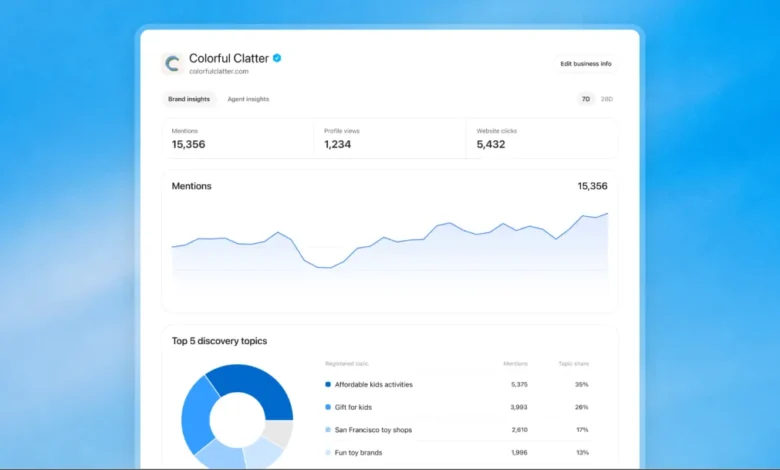
Perhaps the most significant aspect of the new Hub is the introduction of business-facing analytics. In a move that aligns ChatGPT with the industry standard set by Google Analytics, businesses will now be provided with a dashboard of performance metrics. These insights include:

- Profile Engagement: The number of times a business profile has been surfaced in response to a user query.
- Interaction Depth: Data on how users engage with the AI regarding a specific product, including follow-up questions and comparisons.
- Conversion Signals: Tracking website clicks and external traffic referrals generated by the ChatGPT interface.
- Brand Mentions: Analysis of how often a brand is discussed in the context of specific consumer needs.
For businesses, this represents a significant shift in the value proposition of partnering with OpenAI. Rather than merely being a passive subject of an AI’s training data, companies now have a stake in the output. By providing these metrics, OpenAI is essentially building a "Search Engine Marketing" (SEM) model for the age of generative AI, where visibility and influence are determined by the quality of the business agent’s interactions rather than traditional keyword density.
Implications for the Competitive Search Landscape
The broader impact of this initiative cannot be overstated. Since the inception of the commercial internet, Google has maintained a near-hegemonic grip on the "middle of the funnel"—the period between a consumer identifying a need and making a purchase. By allowing companies to verify their information and providing them with diagnostic data, OpenAI is signaling an intent to reclaim a significant portion of this search traffic.
Analysts note that the transition from a "link-based" search experience to an "answer-based" experience is the primary driver of this shift. If a user can obtain a comprehensive, verified, and reliable answer about a product within ChatGPT, their incentive to perform a traditional search query on Google diminishes.
However, the challenge for OpenAI lies in scale and trust. Google’s ecosystem has been refined over two decades, bolstered by a massive network of third-party reviews, local map data, and a mature advertising ecosystem. For ChatGPT to succeed, it must prove that its business agents can handle the complexity of global commerce without sacrificing user experience. If the platform becomes flooded with low-quality, over-optimized business agents, it risks the same degradation of trust that has affected traditional web search results.
Industry Reaction and Looking Ahead
Industry observers generally view this move as a pragmatic maturation of OpenAI’s business model. "OpenAI is effectively building the yellow pages of the AI era," says one analyst familiar with the rollout. "By formalizing the relationship between the business and the model, they are solving the ‘trust gap’ that has limited the use of LLMs in professional and commercial settings."
Furthermore, the shift from a direct e-commerce model to a platform-enabler model is viewed as a safer, more sustainable path toward profitability. By focusing on data, analytics, and verification, OpenAI can build a recurring revenue stream through enterprise subscriptions or premium placement features, avoiding the volatility and thin margins associated with direct retail sales and order fulfillment.
As the Business Hub enters its beta phase, the industry will be watching closely to see how businesses respond. Will companies view this as a necessary investment for their digital marketing strategy, or will they be wary of ceding control of their customer relationships to yet another massive tech intermediary?
The timeline for a full, public rollout remains uncertain, but the current deployment of the Business Hub suggests that OpenAI is committed to a long-term integration of commerce within the chat interface. For the average user, this means that the future of shopping will likely be conversational, highly personalized, and increasingly mediated by a single, powerful AI interface. Whether this ultimately leads to a more efficient marketplace or a new, more opaque form of digital advertising will depend on how OpenAI balances the interests of its business partners with the utility and transparency expected by its millions of global users.
As of late 2026, the company continues to refine its tools, with further updates to the Business Hub expected to roll out in the coming quarters. These future updates will likely include more robust integration with CRM (Customer Relationship Management) platforms and expanded capabilities for localized, small-to-medium-sized businesses, further entrenching ChatGPT as a central nervous system for modern consumer discovery.
Related posts: