Salesforce and NVIDIA Unveil Koa: A New Era of Agentic Enterprise CRM Reasoning

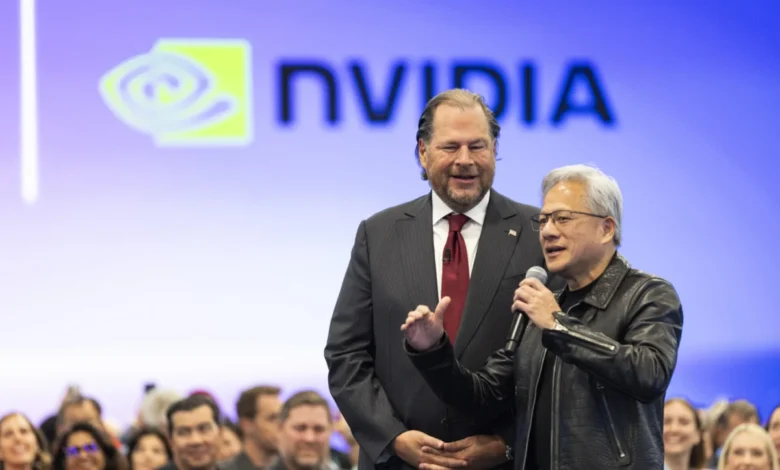
The landscape of enterprise software underwent a significant transformation this week at Dreamforce, Salesforce’s annual marquee conference in San Francisco. During a highly anticipated keynote at the Moscone Center, Salesforce CEO Marc Benioff and NVIDIA founder and CEO Jensen Huang unveiled "Koa," the first reasoning model purpose-built for Customer Relationship Management (CRM). This collaboration marks a pivotal shift in how global enterprises utilize artificial intelligence, moving beyond simple generative text toward complex, agentic decision-making processes.
The announcement represents the culmination of a deep technical partnership between the world’s leading provider of CRM solutions and the primary architect of the current AI infrastructure boom. By leveraging NVIDIA’s Nemotron 3 Super model, Salesforce has engineered a specialized tool designed to navigate the nuanced, high-stakes requirements of enterprise business operations.
The Evolution of the Agentic Enterprise
Jensen Huang’s appearance at Dreamforce was more than a technical demonstration; it was a philosophical discourse on the progression of technological utility. Drawing parallels between the advent of electricity and the internet, Huang framed AI as the new foundational infrastructure layer for the global economy.
"With electricity, we could power everything. With the internet, you can find anything. And now, with artificial intelligence as an infrastructure layer across the planet, we can know everything and do anything," Huang told the thousands of attendees at the Moscone Center.
This vision of the "agentic enterprise"—a company where autonomous AI agents handle complex workflows—is the core objective behind the development of Koa. Unlike general-purpose large language models (LLMs) that prioritize conversational breadth, Koa is built on a proprietary synthetic dataset derived from thirty years of enterprise CRM deployments. This ensures the model is grounded in the specific logic of business transactions, case routing, and opportunity management.
Technical Architecture and Data Sovereignty
A critical component of the Koa announcement was the emphasis on data security and architectural transparency. Because NVIDIA Nemotron is an open-weight model, Salesforce was able to host, fine-tune, and deploy the model entirely within its own private cloud infrastructure. This approach addresses one of the primary concerns for enterprise adoption of AI: data leakage.
Rohan Kumar, Salesforce’s President of Platform and Engineering, emphasized the integrity of the training process, stating, "Not a single byte of customer data was used" in the training of the model. By utilizing a synthetic corpus covering 14 industries—including healthcare, manufacturing, financial services, and travel—Salesforce avoided the privacy risks associated with training on live customer records.
The technical foundation of Koa relies on NVIDIA’s suite of NeMo tools, including NeMo RL (Reinforcement Learning), NeMo Gym, and NeMo AutoModel. These tools allowed Salesforce engineers to apply supervised fine-tuning to ensure the model adheres to the rigid requirements of CRM tasks. In internal testing using "CRM Bench"—a proprietary suite of real-world operational tasks—Koa demonstrated a significant competitive advantage, matching or exceeding the performance of industry-leading models while reporting three times fewer errors in execution.
Addressing the AI Safety Paradigm
During their onstage discussion, the topic of AI safety took center stage. In response to concerns regarding the speed of AI deployment, Huang provided a pragmatic perspective. He rejected the notion that innovation and safety are mutually exclusive, characterizing the safety debate as an engineering challenge rather than a moral or existential dilemma.
"Safety is paramount in a lot of ways. It’s job one," Huang remarked. "However, safety is an engineering problem. We’re developing computing systems, after all. If you build a product or a service and you’re not confident in its functionality, capability, or safety, then don’t release it."
Huang’s stance reflects a broader industry trend toward "responsible innovation." He encouraged enterprises to maintain a rapid pace of development but advised that if an organization feels it is losing control of its systems, it should exercise the discipline to pause. This approach aims to build institutional trust, which is necessary for the widespread integration of AI agents into core business functions.
A Chronology of Collaboration
The partnership between Salesforce and NVIDIA has matured rapidly over the last 18 months. Following the initial surge of generative AI interest in early 2023, Salesforce began integrating NVIDIA’s accelerated computing stack to support its "Einstein" platform.
- Early 2023: Salesforce begins pilot programs for LLM integration into its CRM ecosystem.
- Late 2023: NVIDIA reports that open-model usage among enterprises grows significantly, rising from roughly 30% to over 70% of the market.
- Mid-2024: Salesforce utilizes NVIDIA NeMo tools to begin synthetic data generation and reinforcement learning for the Koa project.
- September 2024 (Dreamforce): Official public unveiling of Koa and the announcement of a phased pilot rollout.
- October 2024: Commencement of customer pilots for Agentforce, including partners like Formula 1, UChicago Medicine, and Baxter Credit Union.
- Winter 2026 (Projected): General availability for U.S. regions.
Implications for the Workforce
A significant portion of the discourse at Dreamforce was dedicated to the future of the human workforce in an age of automation. Both Benioff and Huang pushed back against the narrative that AI serves as a replacement for human labor. Instead, they framed AI as a "productivity multiplier" that allows employees to focus on high-level strategic tasks rather than administrative drudgery.
"As a result of our ambition, and with the productivity boost we get from AI, the sky’s the limit," Huang stated. "Engage AI. Don’t get left behind."
Benioff echoed this sentiment, highlighting the company’s "Trailblazer" community—the developers and customers who utilize Salesforce products. He suggested that AI technology is designed to partner with these individuals, empowering them to perform their jobs in "incredible new ways."
Market Analysis and Broader Impact
The launch of Koa signifies a maturation of the AI market. For the past year, the industry has been defined by "chatbot-first" applications. However, the introduction of specialized reasoning models marks the beginning of the "agent-first" era.
By building a model that understands the specific taxonomy of a CRM—such as how to prioritize a support case, how to move a lead through a sales funnel, or how to identify a customer risk—Salesforce is creating a moat around its ecosystem. Furthermore, the move toward hosting proprietary, fine-tuned models on private infrastructure is likely to become the gold standard for large-scale enterprise AI adoption.
For competitors in the CRM space, the Koa announcement sets a high benchmark for accuracy and safety. As Salesforce moves toward the general availability of Koa in 2026, the success of early pilots with major entities like Xero and Engine will be critical in demonstrating the ROI of autonomous agentic workflows.
Conclusion: The Road Ahead
The collaboration between Salesforce and NVIDIA serves as a microcosm of the current trajectory of the technology sector. As enterprises shift from the excitement of "generative AI" to the pragmatic requirements of "agentic AI," the focus has moved toward reliability, data integrity, and specialized reasoning.
By positioning themselves at the forefront of this shift, Salesforce is betting that the future of business will not be defined by which company has the largest LLM, but by which company can best integrate intelligent, safe, and autonomous agents into the fabric of daily work. As Jensen Huang succinctly noted, the transformation is inevitable: every software company is becoming an AI company, and every enterprise is on the path to becoming an agentic enterprise. With the rollout of Koa, the timeline for that transition has significantly accelerated.
Related posts: