Engineering Teams Adopt Automated Traffic Replay Frameworks to Prevent Production Regressions in High-Stakes Cloud Systems

In modern enterprise software engineering, high-stakes operations such as financial transactions, large-scale order processing, and complex algorithmic eligibility decisions demand uncompromising reliability. Traditional integration testing methods, while foundational, frequently struggle with brittle, unreliable external dependencies that trigger costly false positives and bottleneck continuous integration and continuous deployment (CI/CD) pipelines. To eliminate these vulnerabilities, engineering organizations are increasingly deploying automated regression testing architectures that simulate real-world conditions by replaying production traffic against pre-production environments.
The architectural paradigm shift relies on capturing actual live requests and their corresponding responses—rather than relying on synthetic mocks or hardcoded test fixtures—and routing them through isolated code branches. By comparing the resulting outputs against baseline production metrics, development teams can systematically validate code modifications before final deployment. This strategy bridges the critical gap between post-deployment monitoring, which only flags issues after customers are impacted, and synthetic testing, which rarely captures the chaotic edge cases of live traffic.
Architectural Anatomy and Modular Integration
At the core of these simulation frameworks is a modular, minimally invasive design that interfaces seamlessly with existing system components without requiring sweeping rewrites of underlying business logic. Stateless architectures, in particular, can adopt the framework with virtually zero alterations. Meanwhile, stateful systems incorporate lightweight checks that recognize replayed execution streams to gracefully suppress side effects such as duplicate database writes or unauthorized outbound notifications.
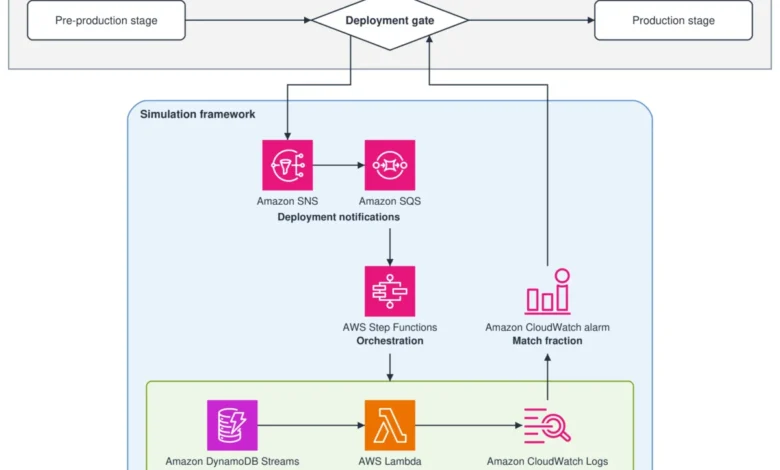
The overarching architecture relies heavily on managed cloud services to minimize operational overhead. When a deployment pipeline reaches a designated release gate, an event triggers an automated sequence managed by AWS Step Functions, orchestrated via Amazon Simple Notification Service (Amazon SNS) and Amazon Simple Queue Service (Amazon SQS).
The workflow coordinates a traffic replay function that reads captured production data—traditionally sourced from high-throughput streams such as Amazon DynamoDB Streams—and feeds it directly into a pre-production target environment. Every replayed payload is stamped with a unique simulation identifier and flag, allowing downstream services to distinguish test traffic from live user interactions.
Core Component Mechanics and Safety Protocols
Implementing a robust traffic simulation framework requires meticulous coordination across four foundational components: traffic capture, the replay engine, the comparison analyzer, and the CI/CD orchestration layer.
- Traffic Capture: Rather than generating artificial test cases, systems capture actual production inputs, including request bodies, custom headers, user session states, and environmental context. This comprehensive dataset ensures that the simulation exercises the exact complexity and edge cases encountered by live users.
- Replay Engine: The engine consumes batched records from the storage stream, injects simulation metadata markers, and invokes test APIs. By appending specific properties like
isSimulation: trueand a uniquesimulationId, the architecture prevents accidental modifications to production databases and external API integrations. - Comparison Engine: This component isolates core business logic from extraneous noise, such as dynamic timestamps, formatting discrepancies, or third-party variations. Responses are normalized and compared, generating structured JSON log entries that record a binary match value (1 for identical, 0 for divergent). CloudWatch Logs Insights processes these entries to calculate a cumulative match fraction for the simulation run.
- Orchestration Layer: Integrated directly into CI/CD pipelines, orchestration tools manage the lifecycle of the simulation—starting the data stream polling, waiting for sufficient sample sizes, shutting down the replay stream, evaluating results, and driving automated deployment gates via Amazon CloudWatch alarms.
To safeguard test environments from accidental resource exhaustion, engineering teams implement strict safety controls. Typical deployments restrict traffic replay to a modest fraction of live volume—commonly between 1 to 5 percent—while throttling execution concurrency using reserved resources.
Furthermore, for systems containing complex stateful dependencies or randomized algorithms—such as A/B testing assignments or session-dependent shopping workflows—engineers utilize deterministic randomization techniques. By seeding random number generators with hashes derived from the unique simulation ID, systems ensure that replayed requests remain entirely reproducible.
Industry Impact and Proven Production Metrics
Data compiled from long-term production deployments underscore the efficacy of automated simulation frameworks. Organizations utilizing traffic replay pipelines have reported catching multiple critical code regressions prior to production release—errors that successfully bypassed static analysis and standard unit testing suites.
Crucially, these frameworks achieve high detection accuracy while maintaining negligible false-positive rates, ensuring that valid code promotions are not unjustifiably blocked. Industry benchmarks indicate that teams frequently configure deployment quality gates to demand a 99.9 percent match fraction between production and simulation outputs. When match fractions dip below acceptable thresholds, integrated alarms automatically halt pipeline progression, preserving release velocity without sacrificing software quality.
Financially, the operational economics of serverless simulation frameworks remain highly favorable. Because resource consumption is tied directly to active simulation windows—typically lasting only a few minutes per deployment—the direct infrastructure cost per simulation run is measured in fractions of a cent. For example, processing five percent of 100,000 daily requests over a standard test cycle incurs negligible cloud computing expenses. When weighed against the substantial engineering hours saved during manual validation phases and the mitigation of costly production outages, the return on investment is immediate.
Broader Implications for Enterprise Software Delivery
The widespread adoption of production traffic replay for regression testing marks a maturing approach to software quality assurance in distributed cloud environments. As microservices architectures grow increasingly complex, static test environments struggle to mirror the unpredictability of production ecosystems. By treating live user traffic as a dynamic, reusable test suite, engineering teams can validate refactoring efforts, dependency upgrades, and feature-flagged deployments with mathematical precision.
Industry analysts note that this capability is particularly vital for organizations undergoing rapid digital transformation or migrating legacy monolithic architectures to cloud-native microservices. By establishing automated, objective quality gates that operate independently of human intervention, enterprises can accelerate their release cadences while drastically reducing systemic risk.
For engineering leaders looking to implement similar frameworks, industry best practices recommend a phased rollout. Teams typically begin by targeting a single, stateless computation-heavy component—such as a pricing engine or regulatory validation pipeline—before expanding the architecture to multi-Region pipelines and more complex stateful workflows. As automated simulation becomes an industry standard, the era of relying solely on synthetic pre-production testing for high-stakes software deployments is rapidly coming to a close.