Securing AI Agent Workloads with OpenShell and Kubernetes Native Governance

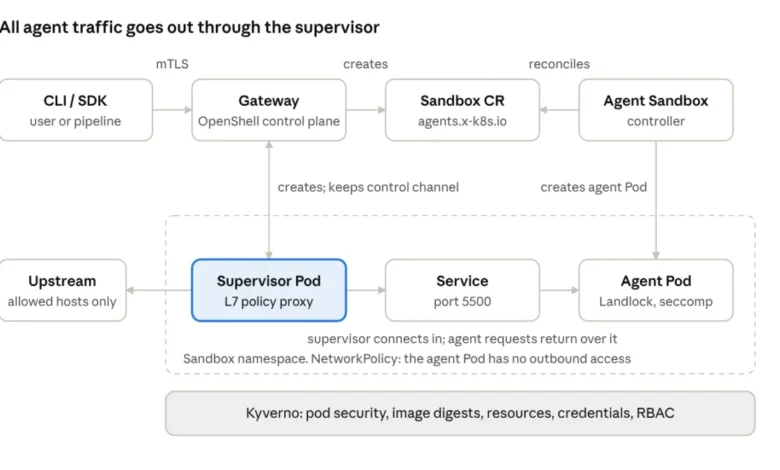
As AI agents transition from experimental tools to critical enterprise infrastructure, the security challenges they present have moved to the forefront of cloud-native development. These autonomous entities perform complex tasks—executing shell commands, installing software packages, reading sensitive files, and establishing network connections—often while holding high-privilege credentials. Because agents frequently process external data pulled from the internet, they represent a significant attack surface: essentially untrusted code operating within trusted environments. To address this, the Cloud Native Computing Foundation (CNCF) has introduced OpenShell, a sandbox runtime designed to govern agent behavior, alongside existing alternatives like Agent Substrate.
The emergence of OpenShell as a CNCF Sandbox project marks a pivotal shift in how organizations manage AI-driven workloads. Unlike traditional container security, which focuses on broad perimeter defense, OpenShell enables granular, per-request policy enforcement. By integrating with the Kubernetes ecosystem through the SIG Apps Agent Sandbox project, it allows administrators to apply familiar operational paradigms to the dynamic and unpredictable nature of AI agents.
The Security Dilemma of Autonomous Agents
The primary security risk of AI agents lies in their dual nature: they require significant autonomy to be useful, yet this autonomy is inherently dangerous when applied to internal systems. Traditional Kubernetes NetworkPolicies are designed for static services. A typical policy might permit a Pod to communicate with api.github.com on port 443, but it lacks the context to distinguish between benign traffic and a malicious process attempting to exfiltrate data.
OpenShell solves this by interposing a trusted supervisor between the agent and the outside world. This supervisor monitors every request in real-time, allowing administrators to dictate not just whether a connection can be made, but specifically which binary may initiate the request and what actions it is permitted to perform—such as allowing a process to read repository issues while denying it the authority to create them. This rule set can be updated dynamically, providing a level of agility that static firewall configurations cannot match.
Chronology and Development Timeline
The integration of agent security into the CNCF ecosystem has accelerated rapidly throughout 2026. The journey began in earnest as organizations realized that standard sandboxing was insufficient to contain the lateral movement risks posed by AI-driven automation.
- September 2026: Both OpenShell and Agent Substrate were officially accepted into the CNCF Sandbox. This dual acceptance highlighted the industry’s recognition of the two distinct approaches to the problem: OpenShell’s focus on policy-driven isolation and Substrate’s focus on high-density, low-latency execution.
- September 10, 2026: RFC 0012 was merged into the OpenShell project, effectively decoupling the isolation backend from the policy-enforcement supervisor. This modular approach opened the door for future integrations with other technologies, including gVisor.
- September 21, 2026: The project merged pull request #3366, which removed the strict requirement for Landlock or seccomp evidence in the shared contract, significantly lowering the barrier for integrating alternative backend runtimes.
- November 11, 2026: The official documentation and community highlight of these tools solidified their place in the cloud-native toolkit, providing administrators with the resources necessary to implement these patterns in production.
Comparative Analysis: OpenShell versus Agent Substrate
While both projects share the goal of securing AI agents, they address different architectural pain points. OpenShell, originating from NVIDIA, treats each agent as an individual workload, leveraging the Agent Sandbox resource. This makes it highly transparent for Kubernetes administrators, as agents appear as standard Pods, PVCs, and Services.
Conversely, Agent Substrate, developed at Google, is engineered for extreme scale. It utilizes an "actor" model where multiple agents share a single worker Pod. By suspending idle agents and snapshotting their state to object storage, Substrate minimizes the cost of running thousands of agents simultaneously.
| Feature | OpenShell | Agent Substrate |
|---|---|---|
| Primary Goal | Per-request policy & credential control | High-density, cost-efficient scaling |
| Resource Unit | One Sandbox/Pod per agent | Actor-based snapshots in shared workers |
| Kubernetes Integration | Uses SIG Apps Agent Sandbox | Uses proprietary WorkerPool CRDs |
| State Management | PVC-based persistence | RAM/Filesystem snapshots |
| Maturity | v0.1.x | Pre-1.0 |
For enterprise IT teams, the choice between the two often comes down to the nature of the workload. If the priority is deep visibility, auditing, and fine-grained control over credential usage for production-grade systems, OpenShell is the preferred path. If the requirement is to support a massive fleet of ephemeral, bursty, and largely idle assistants, the cost-efficiency of Substrate is more compelling.
The Role of Policy Engines in Agent Governance
A critical component of the modern agent security stack is the use of admission controllers, such as Kyverno, to enforce guardrails on how sandboxes are created. Even with robust runtime security, the initial configuration of an agent environment must be validated to prevent misconfigurations that could lead to privilege escalation.

Kyverno policies can ensure that:
- Pod Security: All containers run as non-root, drop all capabilities, and disable privilege escalation.
- Image Hygiene: Sandboxes must use immutable sha256 digests rather than mutable tags, preventing supply chain attacks.
- Credential Protection: Kubernetes secrets are not injected directly into the sandbox; instead, agents must use approved providers to retrieve credentials.
- Network Boundaries: Workload egress is strictly restricted to prevent unauthorized data exfiltration.
By applying these policies at the Kubernetes admission layer, organizations create a "defense-in-depth" strategy. Even if a developer attempts to deploy a misconfigured agent, the cluster rejects the request before the Pod is even scheduled.
Implications for Enterprise Operations
The adoption of OpenShell and similar CNCF-backed tools signifies a maturation in the lifecycle management of AI. Enterprises are moving away from ad-hoc agent deployments toward a structured, policy-governed model. This shift has three major implications for platform engineering teams.
First, Separation of Concerns becomes easier to maintain. Developers can focus on the logic and capability of their AI agents, while security teams maintain the underlying infrastructure policies. Because OpenShell allows developers to declare controls in YAML, the security requirements are baked into the deployment process, ensuring that compliance is not an afterthought.
Second, Operational Visibility is significantly enhanced. By routing agent traffic through a supervisor and integrating with eBPF-based monitors for processes that exist outside the gateway, administrators can finally achieve an audit trail for AI behavior. This is vital for industries with strict regulatory requirements, such as finance or healthcare, where every decision made by an automated agent must be traceable.
Third, Future-Proofing through Modularity is increasingly important. The ongoing work to allow OpenShell to use Substrate as an isolation backend is a landmark development. It suggests a future where users can combine the granular policy enforcement of OpenShell with the high-density execution capabilities of Substrate. This convergence would allow organizations to maintain strict security standards without sacrificing the performance gains needed to scale AI operations across the enterprise.
Moving Forward: Practical Implementation
To begin securing AI agent workloads, organizations are encouraged to start with small-scale testing using the established demo repositories. The workflow involves cloning the demonstration environments, deploying a local cluster (such as kind), and applying the security policies in an "Enforce" mode to observe how they intercept unauthorized actions.
As the ecosystem matures, the focus is expected to shift toward standardized interfaces for cross-project communication. While some features—such as a unified lifecycle operation that preserves agent memory during suspension—remain in the proposal or development phase, the roadmap is clear. The CNCF’s commitment to these projects ensures that Kubernetes will remain the standard platform for the next generation of AI-enabled applications, providing the necessary infrastructure to manage, secure, and scale these powerful tools with confidence.
For cluster administrators, the takeaway is decisive: AI agents are no longer just software components; they are privileged actors that require the same level of rigorous oversight, identity management, and network segmentation as any other critical microservice. By leveraging OpenShell and Kyverno, teams can build a secure, observable, and policy-compliant environment that turns the potential risks of AI into a manageable and scalable asset.