Adyen Joins Cloud Native Computing Foundation as Platinum End User to Shape Future of Global Fintech Infrastructure

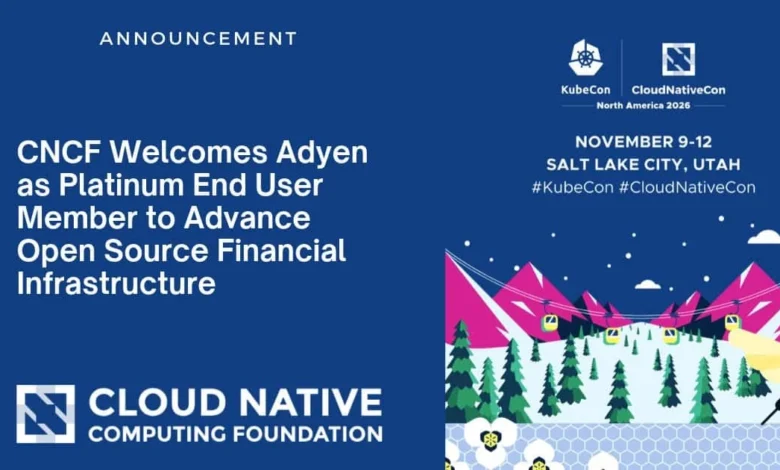
SALT LAKE CITY — The Cloud Native Computing Foundation (CNCF), the industry body responsible for cultivating sustainable ecosystems for cloud-native software, officially announced today at KubeCon + CloudNativeCon North America that Adyen, the global financial technology platform, has joined the organization as a Platinum End User. This strategic alignment underscores a deepening convergence between high-frequency financial services and open-source infrastructure, as organizations increasingly move away from proprietary, vendor-locked stacks in favor of community-driven, transparent technologies.
Adyen’s ascension to the Platinum membership tier is not merely a symbolic gesture; it represents a significant infusion of operational expertise into the CNCF. Managing a global financial infrastructure that processed €1.39 trillion in volume in 2025, Adyen operates more than 100 Kubernetes clusters. By securing a seat on both the CNCF Governing Board and the End User Technical Advisory Board, the fintech giant intends to advocate for the specific security, scalability, and auditability requirements that define modern, regulated financial environments.
The Growing Influence of Open Source in Finance
The decision to join the CNCF follows a broader trend identified in the FINOS (Fintech Open Source Foundation) 2025 State of Open Source in Financial Services Report. The data reveals that 87% of financial institutions now acknowledge a clear, measurable business value derived from open-source participation. For a company like Adyen, which sits at the heart of global commerce, the transition toward open-source infrastructure is a matter of strategic necessity rather than technical preference.
In the past, financial services firms were often hesitant to adopt open-source solutions due to concerns over long-term support and security vulnerabilities. However, as cloud-native technologies like Kubernetes, Prometheus, and Cilium have reached enterprise-grade maturity, these firms have pivoted. Adyen’s move is part of a larger, ongoing transition where the world’s largest banks and payment processors are shifting from legacy monolithic architectures to modular, containerized ecosystems that allow for faster iteration and better uptime.
Strategic Motivations: Control, Security, and Scale
For Adyen, the primary driver for this partnership is the mitigation of vendor lock-in. When a platform processes billions of transactions, its reliance on specific cloud provider APIs or proprietary middleware can become a significant point of failure.
“Investing in the CNCF helps us to maintain full control of our technology,” said Pedro Oliveira, VP of Infrastructure at Adyen. “When you operate at our scale, vendor lock-in isn’t an option, and having a seat at the table matters. Bringing our real-world experience to the community lets us help shape the tools we rely on every day, making them more reliable for us and for the broader ecosystem.”
By participating in the governing processes of the CNCF, Adyen ensures that the trajectory of critical infrastructure projects aligns with the rigorous compliance and security standards demanded by financial regulators. This is particularly important for tools like kubectl-rexec, an open-source utility developed by Adyen to introduce stricter auditability to Kubernetes container-access workflows. By sharing such tools with the broader community, Adyen is essentially helping to standardize secure management practices across the fintech sector.
A Timeline of Cloud-Native Maturation
The evolution of Adyen’s infrastructure strategy mirrors the maturation of the CNCF itself. The chronology of this integration can be viewed through the lens of recent industry shifts:
- 2020–2022: Early Adoption. Financial firms began experimenting with Kubernetes, moving non-critical workloads to cloud-native environments to test scalability and reliability.
- 2023–2024: The Shift to Production. As CNCF projects like Envoy and OpenTelemetry became industry standards, companies like Adyen began migrating core transaction-processing engines into containerized environments, necessitating a higher level of involvement in project development.
- 2025: Regulatory and Security Maturity. With the publication of the FINOS report, the industry reached a tipping point where open source became the default for new infrastructure builds.
- November 2026: Formal Integration. Adyen joins the CNCF as a Platinum End User, formalizing its influence on the future roadmap of cloud-native governance.
The Role of the Platinum End User
Membership at the Platinum level is reserved for organizations that demonstrate a significant commitment to the cloud-native ecosystem. As a governing board member, Adyen will exercise budget oversight and influence the strategic direction of the foundation. More importantly, as a participant in the End User Technical Advisory Board, Adyen will act as a bridge between the community of developers and the requirements of global financial markets.
“End users are the operational backbone of the cloud native ecosystem, and Adyen represents the pinnacle of high-scale, zero-downtime engineering,” noted Jonathan Bryce, executive director of the CNCF. “Operating over 100 Kubernetes clusters at a global scale gives Adyen unique technical insights. We are thrilled to welcome them as a Platinum End User and look forward to their leadership.”
Implications for the Cloud-Native Ecosystem
The inclusion of a high-volume financial player like Adyen has several downstream implications for the CNCF and its member projects.
First, there is the focus on "Hardened" Infrastructure. Financial services require high availability and strict audit trails. Adyen’s influence is expected to accelerate the development of features within Kubernetes and surrounding projects that support multi-tenancy, zero-trust security, and immutable audit logs.
Second, there is the issue of developer velocity versus security. One of the greatest challenges for regulated entities is maintaining the speed of innovation (developer velocity) without compromising the security of the financial data being processed. Adyen’s contribution of tools like kubectl-rexec demonstrates a commitment to solving this paradox, providing a model for other enterprises to follow.
Third, the move signals a shift in the power dynamics of software development. By participating in the CNCF, Adyen and its peers are effectively taking ownership of their technical stack. This reduces the dependency on third-party vendors who may change pricing models or deprecate features that are critical to the firm’s operations.
Looking Ahead
As the industry moves toward 2027 and beyond, the collaboration between Adyen and the CNCF is likely to yield new best practices for running high-scale, mission-critical financial infrastructure in the cloud. The challenge for the CNCF will be to integrate these high-level requirements without making the projects overly complex for smaller, less-regulated startups.
For Adyen, the partnership is a long-term hedge against technical obsolescence. By fostering a vendor-neutral, collaborative environment, the company ensures that its underlying technology remains agile and robust, regardless of market shifts or changes in the vendor landscape.
The Cloud Native Computing Foundation, now supported by nearly 800 members, continues to act as the central hub for this transition. With the addition of Adyen, the foundation gains not just another member, but a partner with a deep understanding of the unique pressures of the modern financial economy. As financial technology continues to permeate every aspect of global business, the lessons learned and the tools created within the CNCF will undoubtedly define the infrastructure of the next generation of global commerce.
For more information regarding membership or the various technical projects overseen by the CNCF, stakeholders are encouraged to engage with the foundation’s governance documentation or visit the official website to review current project roadmaps and community guidelines. The ongoing success of this ecosystem rests on the active participation of organizations that, like Adyen, recognize the value of shared, open-source innovation in a rapidly evolving technological landscape.