Dynata Accelerates Software Delivery Velocity by 70 Percent Through AI-Driven Development Lifecycle Implementation

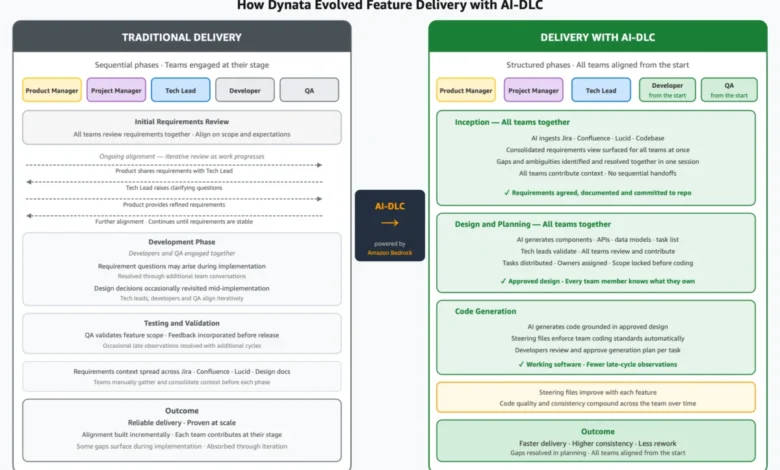
Dynata, globally recognized as the premier first-party data and insights provider, has successfully compressed its multi-sprint feature delivery cycles into a single sprint. Rather than relying solely on incremental improvements in raw coding speed, the engineering organization achieved this breakthrough by fundamentally reimagining the entire software development lifecycle (SDLC) through artificial intelligence. By integrating cutting-edge AI methodologies with their existing toolchains—spanning Jira, Confluence, Lucidchart, GitHub, and Figma—Dynata transitioned from localized developer assistance to a comprehensive, enterprise-wide paradigm known as the AI-Driven Development Lifecycle (AI-DLC).
The challenge of coordinating complex, distributed product engineering at scale is a familiar hurdle for modern enterprise organizations. Across Dynata’s global portfolio, multiple autonomous engineering teams work concurrently to evolve proprietary platform capabilities, maintain deep integrations with partner ecosystems, and ship features on continuous delivery schedules. Historically, aligning product intent, user experience design, software engineering, and quality assurance across these distributed units required extensive sequential communication. While thorough review cycles are inherently necessary for enterprise-grade software, the traditional handoff-heavy model frequently introduced friction, delayed requirement validation, and compounded the cost of scope adjustments made late in the implementation phase.
Background and Strategic Evolution
Dynata’s journey toward full-lifecycle artificial intelligence adoption did not happen overnight; it was executed through a deliberate, three-stage progression designed to build operational confidence and internal AI fluency. The initiative began with foundational code-level generation, evolved into a deeply integrated knowledge ecosystem, and ultimately culminated in the adoption of AWS-backed AI-DLC methodologies utilizing the AI-native Kiro integrated development environment (IDE).
In the first stage, Dynata’s developers deployed Amazon Q Developer to accelerate everyday coding tasks, automate boilerplate writing, and assist with unit test generation. The productivity gains were immediately observable. Engineers generated cleaner, more consistent code volumes while spending significantly less time on repetitive architectural scaffolding. This initial deployment cultivated genuine AI literacy across the engineering organization, paving the way for more sophisticated integrations.
Building upon this baseline, the engineering leadership integrated their AI tooling with core enterprise knowledge repositories, including Jira, Confluence, and Lucidchart. This crucial step provided the AI models with contextual visibility into active tickets, system specifications, and architectural diagrams. Consequently, technical leads and senior architects began leveraging AI not merely for script generation, but as a real-time architectural decision-support engine. The AI could evaluate proposed design choices against existing system topologies, detect potential component conflicts, and validate pattern alignment at the individual developer level.
The final architectural leap involved the discovery and adoption of the AI-Driven Development Lifecycle (AI-DLC) methodology powered by Amazon Bedrock and implemented primarily through Kiro IDE. Unlike traditional code assistants that operate exclusively within the text editor during the implementation phase, AI-DLC structures the entire software delivery pipeline—spanning requirements capture, ambiguity resolution, architectural design, task breakdown, and final code generation—while preserving human governance, review, and approval at every critical juncture.
Methodology and Implementation Strategy
Recognizing that sweeping procedural changes risk organizational resistance, Dynata adopted a staged implementation strategy. The initiative commenced with a tightly controlled internal pilot involving a self-selected group of highly motivated developers. Operating within Kiro IDE, these pioneers utilized structured requirements-through-tasks pipelines, custom team steering files that codified engineering standards, and automated quality-checking hooks.
The pilot revealed that AI-DLC offered qualitative advantages far exceeding standard code autocompletion. The methodology actively guided structured iterations, proactively surfaced edge-case ambiguities during the inception phase, and built institutional confidence in system designs before a single line of production code was written. Crucially, Dynata discovered that AI-DLC is inherently IDE-agnostic; while Kiro provided native workflow support, parallel teams achieved equal success utilizing alternative environments such as Cursor configured with Claude foundation models.
Following the successful pilot, Dynata formalized a three-day feature workshop model designed to bridge cross-functional divides. Prior to launching these workshops, leadership ensured session readiness by briefing product managers, project owners, and engineers on the AI-DLC framework, assembling comprehensive input documentation, and refining steering files to reflect precise enterprise coding conventions.
During the subsequent structured three-day workshops, the traditional multi-week planning cycle was compressed into a single synchronized event:
- Day 1: Dedicated to requirements gathering and inception alignment. The AI tool systematically analyzed project briefs, interrogated stakeholders regarding missing edge cases, and generated a finalized, repository-committed requirements specification.
- Day 2: Focused on architectural design and task distribution. The team mapped dependencies, established parallel workstreams, and secured unanimous cross-functional sign-off on the execution plan.
- Day 3: Encompassed rapid code generation, iterative peer demonstration, and working software validation.
Quantitative Impact and Performance Metrics
The implementation of AI-DLC delivered immediate, measurable transformations across Dynata’s software delivery metrics. Comparative analysis against traditional sequential delivery models demonstrated a profound reduction in time-to-market.
| Metric | Traditional Delivery Model | AI-DLC Implementation Model |
|---|---|---|
| Development Phase Duration | Baseline (3 to 4 Sprints) | ~70% Reduction (~1 Sprint) |
| Requirements Alignment Timeline | Days to weeks of iterative meetings | Day 1 of structured workshop |
| Blocker Identification Phase | Discovered during implementation | Resolved during pre-design planning |
| Scope Change Cost | Escalates exponentially with progress | Neutralized during architectural design |
| Cross-Team Collaboration | Sequential handoffs | Simultaneous, continuous alignment |
| Post-Production Defects | Higher incidence of hidden gaps | Minimized via upfront ambiguity resolution |
Broader Implications and Industry Analysis
Industry analysts observing Dynata’s transformation note that the enterprise software sector is undergoing a structural shift regarding artificial intelligence. While early enterprise AI adoption focused narrowly on developer efficiency metrics—such as lines of code generated per hour—forward-thinking organizations are increasingly recognizing that the true bottleneck in enterprise software engineering lies in cross-functional alignment, requirements clarity, and architectural coordination.
By shifting the identification and resolution of requirement ambiguities from the implementation phase to the inception phase, Dynata has effectively lowered the cost of software iteration. The elimination of downstream blockers ensures that engineering teams can maintain high velocity without compromising code quality or architectural integrity. Furthermore, the systematic use of repository-stored steering files ensures that institutional knowledge is preserved and uniformly enforced across distributed teams, insulating the enterprise from developer turnover and onboarding friction.
Future Outlook and Strategic Expansion
Encouraged by these empirical results, Dynata is actively expanding AI-DLC methodologies across additional product lines and scaling the framework to handle increasingly complex platform integrations and cloud infrastructure workloads. The organization is currently refining its steering files to incorporate automated compliance and security checks via IDE hooks.
Looking ahead, Dynata is preparing to participate in the rollout of AI-DLC V2.0, an evolution designed to support modular, phase-specific invocation. This upcoming iteration will empower teams to selectively deploy artificial intelligence for targeted tasks—such as standalone inception analysis or isolated design validation—without requiring adherence to a rigid end-to-end pipeline.
Through its pioneering deployment of AI-DLC, Dynata has established a replicable blueprint for enterprise software engineering. By aligning product management, design, engineering, and quality assurance around a single, AI-verified source of truth before development commences, the company has demonstrated that velocity and precision are not mutually exclusive, but rather mutually reinforcing pillars of modern technical execution.