Atlassian Modernizes Global Observability Infrastructure Through Strategic Adoption of OpenTelemetry

For nearly a decade, Atlassian’s global observability framework relied on gostatsd, a self-maintained, open-source implementation of the StatsD protocol. Operating across 14 geographical regions and supporting approximately 100,000 hosts, this infrastructure functioned as the backbone for the company’s internal metrics pipeline, maintaining a 99.95% service level objective (SLO). However, as the software landscape evolved, the limitations of a legacy, UDP-only architecture became increasingly apparent. In September 2026, Atlassian engineering leads Iris Grace Endozo, Farzad Vazirnia, and Albert Kerr announced the completion of a major architectural overhaul, transitioning the company’s massive-scale metrics pipeline to an OpenTelemetry-native foundation.
The Evolution of the Metrics Pipeline
The decision to pivot away from gostatsd was driven by a fundamental shift in industry standards. While gostatsd served Atlassian’s needs for years, it lacked inherent support for modern observability telemetry, specifically distributed traces and logs. Furthermore, the rising dominance of OpenTelemetry (OTel) meant that the external services feeding into Atlassian’s pipeline were increasingly emitting OTLP data that the legacy system could not ingest natively.
For an organization of Atlassian’s scale, the challenge was not merely technical but operational. The observability pipeline is wired into thousands of bespoke services. A "rip-and-replace" strategy—which would have required every internal team to re-instrument their applications using new SDKs—was deemed a "pipe dream" due to the high risk of data loss and potential for widespread service disruption. The engineering team identified a specific requirement: the system needed a total engine replacement that maintained complete compatibility with existing interfaces, effectively turning a company-wide migration into a focused platform-team initiative.
Chronology of the Transition
The migration followed a methodical, phase-based approach designed to minimize risk while maximizing infrastructure efficiency.
Phase 1: Collection and Sidecar Consolidation
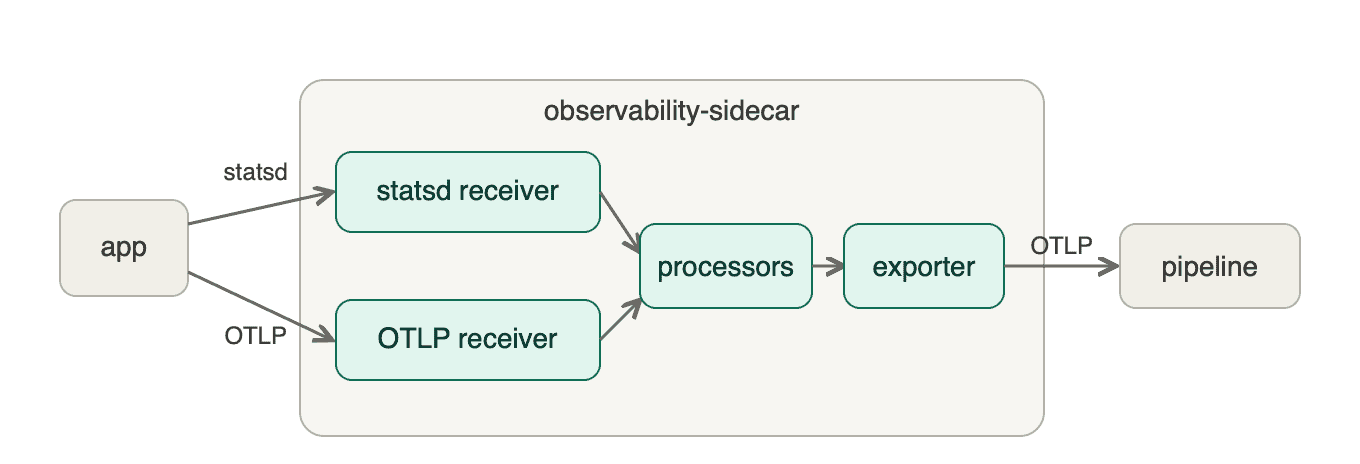
The first step involved replacing the gostatsd sidecar with a purpose-built OpenTelemetry Collector distribution. Crucially, the interface remained unchanged; applications continued to emit StatsD data over UDP. By folding metrics collection into the existing tracing sidecar, Atlassian eliminated the need to run redundant sidecars on every host. This consolidation resulted in a 3.9% reduction in CPU overhead per service, representing a significant 30% cut in sidecar costs at the fleet level.
Phase 2: Modernizing Ingestion via Load Balancing
Atlassian’s legacy ingestion relied on an in-house proxy named "nomad" to hash traffic by (service, environment) pairs. This caused significant operational issues, as metrics load is rarely uniform. Large services created "hot shards," leading to uneven resource utilization. The team implemented the OpenTelemetry loadbalancingexporter, which enables hashing by streamID—the unique identifier of an individual time series. This change ensured that even the most traffic-heavy services were smeared evenly across the cluster, leading to a flat, predictable CPU distribution and more efficient autoscaling.
Phase 3: Aggregation and Efficiency
The aggregation tier represents the most critical bottleneck, processing approximately 4.8 billion data points per minute and condensing them into 220 million for long-term storage—a reduction rate of 96%. To handle this volume, the team developed and open-sourced a custom delta aggregation processor under the atlassian-labs GitHub organization. By offloading the parsing of StatsD to the collector layer, the aggregation tier saw its CPU requirements slashed by half, while simultaneously benefiting from community-driven performance tuning.
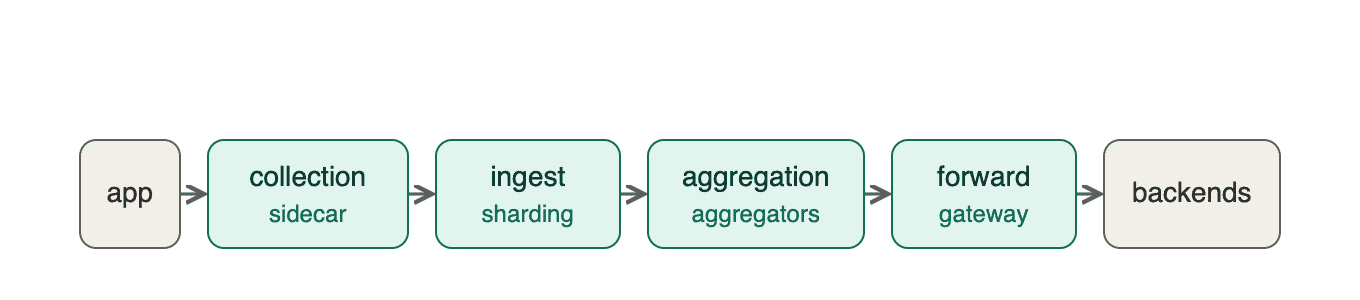
Phase 4: Forwarding and Serverless Support
The final hop in the pipeline was transitioned into a stateless "metrics-gateway" distribution. This allows Atlassian to integrate with various backends, such as Amazon S3 or SignalFx, simply by updating a configuration file rather than building custom integrations. Additionally, for serverless environments where sidecars are not feasible, the team developed an OTel Lambda extension that mimics the original gostatsd interface, allowing for a seamless transition without code modifications.
Supporting Data and Infrastructure Impact
The financial and operational implications of this transition are substantial. At the project’s inception, the legacy gostatsd aggregators and the "nomad" proxy accounted for approximately 38% of total CPU requests across Atlassian’s metrics clusters, with the proxy alone responsible for 13% of total resources.
By moving to an end-to-end OpenTelemetry architecture, the company has not only achieved direct cost savings through reduced resource consumption but has also improved the reliability of its alerting systems. The ability to perform data drop-offs at the ingestion layer—the most cost-effective stage of the pipeline—ensures that only high-value data is processed and stored. This optimization is vital for maintaining fiscal responsibility while managing massive telemetry volume.
Industry Context and Strategic Implications
The shift toward OpenTelemetry reflects a broader trend among major technology firms to standardize on vendor-neutral observability protocols. The Cloud Native Computing Foundation (CNCF), which oversees the OpenTelemetry project, has seen rapid adoption as companies seek to avoid "vendor lock-in" and unify disparate monitoring silos.
For Atlassian, the adoption of OpenTelemetry is not just a migration but a strategic posture. By aligning with the OTel ecosystem, the company can now contribute to and benefit from the collective work of the global developer community. Adding new features or destinations to the pipeline has moved from a complex service-deployment project to a simple configuration task.
"We have now unblocked our users on moving metrics instrumentation over to OpenTelemetry," the engineering team noted in their official project summary. "The next move is to shift left: get the instrumentation itself onto the OpenTelemetry SDK and off the vendor and in-house clients we’ve carried for years."
Future Outlook
With the core infrastructure successfully modernized, Atlassian is now positioned to leverage the full breadth of the OpenTelemetry ecosystem. The team has signaled that their future efforts will focus on three key areas:
- SDK Migration: Moving application-level instrumentation away from legacy Datadog/DogStatsD and proprietary libraries toward native OTel SDKs.
- Community Contribution: Active participation in the OTel project to address large-scale observability challenges, feeding Atlassian’s unique operational insights back into the upstream codebase.
- Expanded Observability: Exploring advanced capabilities within the OTel ecosystem to solve complex, cross-platform visibility problems that were previously unattainable with the gostatsd architecture.
The success of this transition highlights a critical lesson for large-scale engineering organizations: infrastructure modernization does not always require a "big bang" approach. By prioritizing interface stability and modularizing the pipeline into distinct collection, ingestion, aggregation, and forwarding stages, Atlassian was able to execute a mission-critical migration without compromising its 99.95% SLO. As the industry moves toward standardized, cloud-native observability, the Atlassian model provides a blueprint for how legacy systems can be systematically replaced to support the next decade of operational scale.
Related posts: