Sixty-six million years ago, a colossal asteroid measuring approximately 10 kilometers in diameter struck the Yucatan Peninsula with the force of billions of Hiroshima-sized atomic bombs. The resulting Chicxulub impact is widely recognized as the primary catalyst for the Cretaceous-Paleogene (K-Pg) extinction event, an ecological collapse that eliminated approximately 75 percent of all species on Earth, most notably the non-avian dinosaurs. While the immediate aftermath of the strike was characterized by global tsunamis, wildfires, and a multi-year “impact winter” caused by atmospheric debris, new geological research suggests that the crater itself became a localized engine for biological resilience.
A study published in the journal Communications Earth & Environment reveals that the massive release of kinetic energy during the collision triggered a subterranean hydrothermal system that remained active for at least 8 million years. This discovery challenges previous estimates, which had suggested a much shorter lifespan for the crater’s geothermal activity, and provides a compelling argument for how life may have persisted in the extreme, hostile conditions following such a cataclysm.
The Mechanics of a Subterranean Oasis
The Chicxulub impact did not merely alter the surface of the Earth; it fundamentally reorganized the crust to a depth of 35 kilometers. The intense heat generated by the collision melted vast quantities of rock, creating a massive, fractured zone. As the surrounding ocean water infiltrated the porous, superheated rock, it initiated a complex hydrothermal circulation system.
In this environment, cold, mineral-rich seawater was drawn deep into the Earth’s crust, where it was heated by the residual energy of the impact. The water then rose back toward the surface, leaching minerals from the fractured rock and creating a nutrient-dense fluid. These hydrothermal vents, similar to those found today along mid-ocean ridges, provided a stable, heat-rich environment sheltered from the chaotic conditions of the post-impact surface.
Geologists have long known that impact craters create hydrothermal systems, but confirming their duration has historically been difficult. Lead researcher Annemarie Pickersgill of the University of Glasgow’s SUERC Center for Isotope Sciences utilized precision radioisotopic dating to map the timeline of the Chicxulub system. By analyzing feldspar samples retrieved from a 1-kilometer-deep borehole drilled at the site in 2016, the team was able to measure the decay of potassium-40 into argon-40. Because argon gas escapes molten rock and only begins to accumulate once the rock cools and solidifies, this method acts as a precise geological clock.
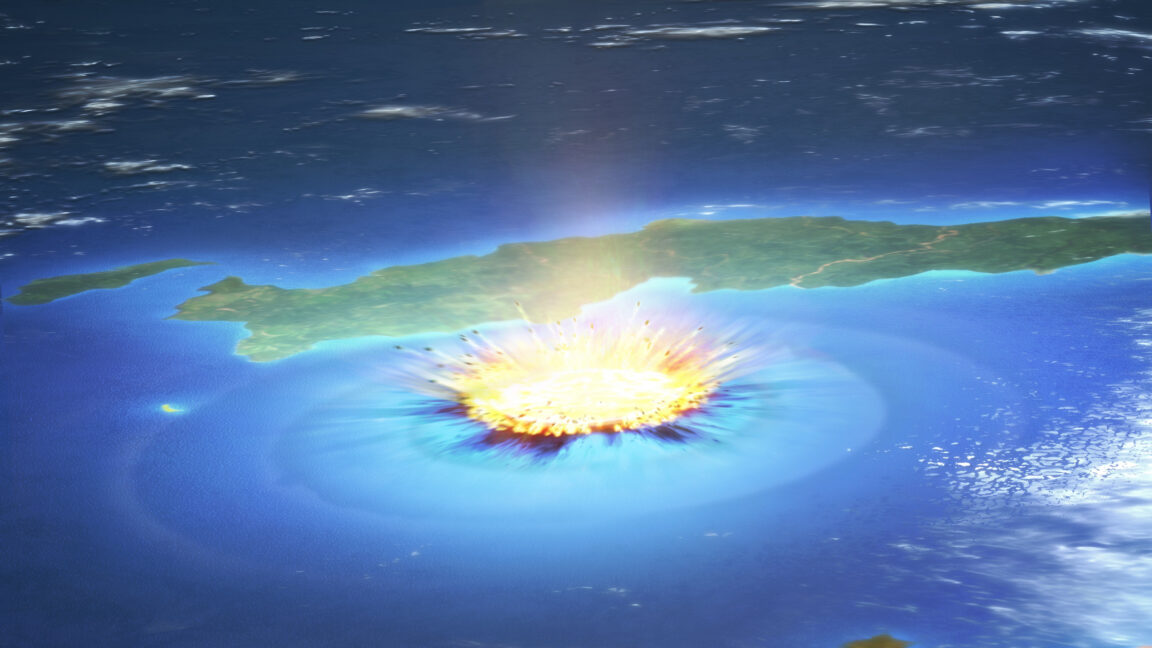
The findings indicate that the hydrothermal system remained thermally active from the moment of impact 66 million years ago until approximately 58 million years ago. This 8-million-year window provided an extensive period for microorganisms to colonize, adapt, and evolve, independent of the devastated surface ecosystems.
Chronology of a Post-Impact Ecosystem
The trajectory of the Chicxulub hydrothermal system can be divided into distinct phases of cooling and stabilization:
- Year 0 (66 million years ago): The initial impact vaporizes rock and creates a crater roughly 150 kilometers wide and 20 kilometers deep. The subsurface is fractured to a depth of 35 kilometers, allowing for massive fluid circulation.
- Years 1–2 million: Temperatures in the primary hydrothermal zones are extreme, likely exceeding 200°C. While too hot for most life, the peripheral zones begin to stabilize.
- Years 2–5 million: As the crust cools, temperatures in the circulating fluids drop into a range suitable for thermophilic (heat-loving) bacteria and archaea. The environment reaches an optimal “habitable window.”
- Years 5–6 million: The hydrothermal flow begins to wane as the residual heat of the impact is finally dissipated into the surrounding crust.
- Year 8 million (58 million years ago): Hydrothermal activity officially ceases. The subterranean system returns to ambient crustal temperatures.
Computer simulations conducted by the research team support the isotopic findings, showing that the cooling process was gradual enough to maintain temperatures below 50°C for up to 5 million years, which is well within the tolerance range for diverse microbial colonies.
The Search for Ancient Life
While the data confirms that the Chicxulub crater possessed the necessary physical and chemical parameters for habitability—namely heat, water, and chemical energy—it does not provide direct fossil evidence of life. Detecting microbial signatures from 66 million years ago is notoriously difficult, particularly in volcanic or impact-altered rock.
However, the team’s findings provide a critical piece of the puzzle regarding how life recovers after a mass extinction. Previous research into the 70 known underwater impact craters on Earth has shown that, while many develop hydrothermal systems, only a small fraction show definitive evidence of biological colonization. The Chicxulub study suggests that the longevity of the system is the deciding factor. The longer a system remains active, the higher the probability that surrounding microbial populations will discover the site, colonize it, and diversify.
“Longer periods of hydrothermal activity will generate extended windows of opportunity for prebiotic chemical reactions to occur, life to develop, and micro-organisms to thrive and propagate beyond their point of origin,” Pickersgill noted in the study.

Implications for Astrobiology and Early Earth
The discovery of an 8-million-year-long hydrothermal system at Chicxulub has profound implications for our understanding of planetary evolution. Early in Earth’s history, the planet was subjected to a period known as the Late Heavy Bombardment, during which it was struck by numerous large asteroids. If a "modest" 10-kilometer asteroid could sustain a habitable zone for 8 million years, the larger impacts seen on the early Earth—and on other planetary bodies like Mars or Europa—may have sustained life-supporting environments for significantly longer.
This research reinforces the theory that impacts are not solely agents of destruction; they are also potential incubators for life. By creating isolated, energy-rich environments, these craters may have served as "refugia" where life could persist during global climate shifts, eventually emerging to recolonize the planet.
Scientific Context and Peer Reception
The study has been received with interest by the broader geological and astrobiological communities. By providing a concrete, isotopic timeline for a major impact event, Pickersgill’s team has set a new benchmark for how researchers evaluate the habitability of crater sites.
The use of potassium-argon dating on feldspar crystals is a rigorous standard in geochronology, making the 8-million-year figure highly credible. While the team remains cautious about asserting that life was definitely present, the conclusion that the site was capable of supporting life for nearly a tenth of the time since the dinosaurs went extinct is a significant advancement in the field.
As the scientific community continues to explore the intersections of planetary science and biology, the Chicxulub crater stands as a primary case study. It suggests that the path to recovery after a global catastrophe is not merely a matter of surface temperatures stabilizing, but also of the Earth’s own internal heat providing the necessary conditions for biological survival in the dark, hidden depths of the crust. The research opens new avenues for exploring how impact-driven hydrothermal activity might have influenced the early development of life on Earth and potentially continues to influence the search for life elsewhere in the solar system.