Thermo Fisher Scientific Modernizes Clinical Trial Recruitment with AWS Cloud Architecture and Patient Match AI

Clinical trial recruitment has long been recognized as one of the most complex bottlenecks in pharmaceutical research and medical device development. Traditionally framed as a simple patient-matching challenge, recruitment is, in reality, an intricate operational ecosystem. Patient recruitment teams must continuously evaluate participant progression through a multifaceted journey, assess the operational performance of individual clinical sites, pinpoint geographically viable recruitment opportunities, and ensure that diverse cohorts meet increasingly stringent study criteria. Historically, the data required to answer these fundamental questions remained siloed across disparate legacy systems, external surveys, clinical questionnaires, electronic consent records, marketing engagement platforms, and manual operational workflows.
For Thermo Fisher Scientific, a global leader in serving science, transforming this experience demanded much more than deploying a surface-level application. It required a comprehensive re-engineering of the underlying data architecture, establishing a scalable, cloud-native foundation designed to seamlessly convert fragmented recruitment records into immediate, actionable insights. By leveraging Amazon Web Services (AWS), Thermo Fisher developed a sophisticated patient recruitment data foundation that unifies, standardizes, and curates diverse datasets for advanced analytics and artificial intelligence (AI) applications. Built directly on this robust foundation are two powerful, proprietary capabilities: the Central Insights Hub (CIH), which delivers comprehensive operational visibility and recruitment analytics, and Patient Match AI, an innovative tool enabling self-service patient searches, feasibility assessments, and cohort discovery through natural-language processing.
The evolution of this technological ecosystem represents a paradigm shift for clinical operations. Complex cohort discovery queries that historically required days or even weeks of iterative analysis, technical intervention, and constant back-and-forth communication with specialized database administrators can now be explored, refined, and validated in mere minutes. This dramatic acceleration empowers recruitment teams to transition rapidly from an initial clinical hypothesis to a targetable, compliant patient population. As these capabilities approached their production milestones, Thermo Fisher collaborated closely with AWS Countdown Premium—an elite, engineer-led support service—to fortify operational readiness, optimize system performance, streamline launch activities, and systematically mitigate technical risks during a high-stakes corporate transformation.
The Structural Challenges of Legacy Clinical Recruitment
Over decades of growth and operational expansion, Thermo Fisher’s patient recruitment data accumulated across multiple independent systems and specialized use cases. Core patient health profiles, structured surveys, intricate questionnaires, funnel engagement metrics, digital marketing interactions, regulatory consent records, and site-specific operational logs frequently existed in isolated formats without a unified schema or consistent identifier.
This data fragmentation imposed severe operational friction across the organization. Clinical recruitment teams required significantly faster methodologies to identify, filter, and refine relevant patient populations from massive volumes of historical and real-time records. Furthermore, leadership needed a transparent, real-time macro view of recruitment performance spanning diverse therapeutic studies, global clinical sites, and distinct geographic regions. Concurrently, the enterprise aimed to integrate cutting-edge AI capabilities into daily operations without compromising data integrity, patient privacy, regulatory governance, or strict compliance standards.
Under the legacy operational model, routine business and clinical questions relied heavily on specialized technical intermediaries. Translating a clinical recruitment requirement into a database query, extracting the appropriate datasets, validating the output against strict criteria, and iteratively repeating the cycle whenever parameters shifted created immense latency. While straightforward inquiries were manageable, complex cohort discovery involving intersecting clinical parameters, geographic boundaries, demographic profiles, and nuanced consent constraints frequently evolved into protracted, multi-week endeavors. Thermo Fisher was thus confronted with a dual imperative: modernize its foundational patient recruitment data environment while simultaneously democratizing data access, enabling non-technical business users to intuitively explore, query, and act upon critical insights.
Constructing a Modernized Data Foundation on AWS
Rather than treating artificial intelligence as a superficial veneer added to legacy architectures, Thermo Fisher’s engineering teams adopted a data-first philosophy. The enterprise established a modern, cloud-native patient recruitment data foundation on AWS designed to aggregate, standardize, and curate data from historically disconnected domains, priming it for downstream analytics and intelligent workloads.
The modern data foundation systematically ingests and normalizes information from patient profiles, behavioral surveys, recruitment funnel metrics, marketing campaigns, consent databases, and site operations. Advanced data transformation pipelines generate clean, consistent structures and highly reusable datasets specifically tailored for dependent applications. This architecture establishes a vital operational separation of concerns: source systems continue to execute their primary transactional duties uninterrupted, while dedicated, curated datasets are optimized exclusively for high-performance analytics, executive reporting, and AI-driven processing.
For business stakeholders, this structural overhaul delivers a highly reliable, trustworthy, and reusable repository of recruitment intelligence. For engineering teams, it introduces an elastic, scalable foundation capable of supporting numerous concurrent software products, eliminating the need to construct redundant, custom data pipelines for every emerging use case.
Central Insights Hub: Driving Operational Visibility and Performance
Among the prominent capabilities enabled by this infrastructure modernization is the Central Insights Hub (CIH), an in-house custom user interface layer constructed using robust open-source technologies. CIH functions as a centralized clinical trial recruitment analytics platform, offering enterprise-wide visibility into how active recruitment initiatives perform across global studies.
Utilizing interactive dashboards and dynamic visualizations, authorized personnel can monitor the complete patient recruitment journey. The platform tracks participants from initial brand engagement through critical milestones, including pre-screening, clinical site referral, formal consent, final enrollment, and randomization. By synthesizing patient progression, site activity, recruitment timelines, and geographic performance metrics into a single pane of glass, CIH empowers leadership to evaluate operational efficiency continuously.
Subsequent iterations of the platform have significantly expanded its analytical scope to include comprehensive tracking of recruitment expenditures, participant demographic breakdowns, disqualification trends, site-patient engagement dynamics, and marketing-channel ROI. Consequently, recruitment managers possess a unified environment to diagnose bottlenecks, compare site-level performance across international borders, reallocate resources proactively, and make timely, data-driven operational decisions.
Patient Match AI: Revolutionizing Cohort Discovery Through Natural Language
Complementing the macro-level analytics of the Central Insights Hub, Patient Match AI addresses a distinct yet equally critical operational challenge: streamlining the process of determining which specific patient populations align with complex protocol requirements.
Historically, defining a patient cohort required submitting technical requests to database teams. Patient Match AI radically transforms this workflow by enabling users to articulate their requirements in natural language. A clinical researcher can initiate a query by requesting an aggregate count of patients matching a broad pathological condition. They can then progressively narrow and refine that population using granular filters encompassing age, geographic location, specific diagnoses, treatment histories, demographic traits, and active consent or contactability parameters.
The user experience follows a streamlined, iterative trajectory:
COUNT → REFINE → TARGETED LIST → EXPORT
This self-service model eliminates traditional organizational handoffs, converting cohort discovery into an interactive, real-time exploration. Complex feasibility workflows that previously required days or weeks of manual analysis can now be executed and iterated in minutes. Researchers can test various inclusion and exclusion criteria on the fly, immediately observing how parameter adjustments impact the viable patient pool without restarting the analytical lifecycle.
Crucially, Patient Match AI incorporates aggregate insights and visualizations, allowing users to inspect the composition of a cohort prior to initiating governed workflows where personally identifiable information (PII) is accessed. Strict privacy controls, data governance frameworks, consent tracking, and regulatory compliance standards are natively embedded within the design architecture, ensuring that the tool accelerates productivity without ever bypassing established legal and ethical safeguards.
Cloud-Native Architecture and Technical Implementation
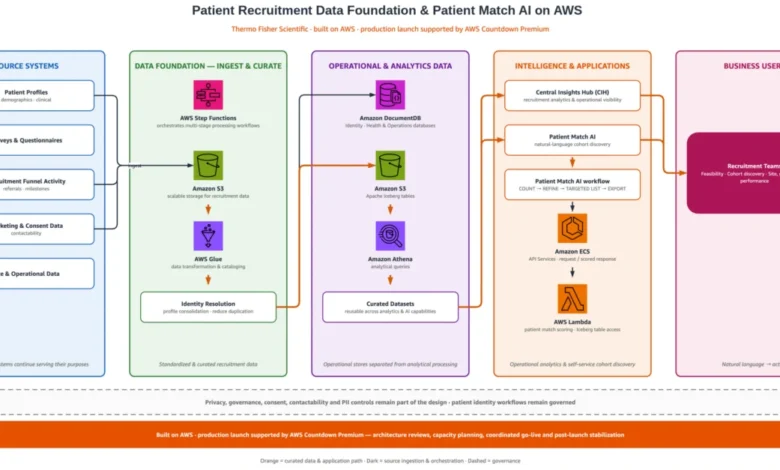
The underlying technological framework utilizes a highly scalable, cloud-native AWS architecture that seamlessly orchestrates data storage, transformation, governance, analytics, and AI model execution. Amazon Simple Storage Service (Amazon S3) provides resilient, elastic storage for raw and processed recruitment datasets, while AWS Glue manages automated data cataloging and complex ETL transformations. AWS Step Functions orchestrates multi-stage data processing pipelines, and Amazon Athena executes high-speed analytical queries across curated records.
A cornerstone of the analytical layer is the implementation of Apache Iceberg tables on Amazon S3. This open table format provides exceptional flexibility for large-scale analytical workloads, effortlessly accommodating exponential growth in data volume and enterprise use cases. Furthermore, the architecture maintains a strict segregation between operational application workloads and heavy analytical processing, ensuring that complex cohort and eligibility queries execute across vast repositories of patient profiles without impacting transactional database performance.
Advanced identity resolution and profile consolidation algorithms reconcile records originating from disparate source systems, successfully minimizing data duplication and establishing a single, golden record for every participant. Ingested data sources—including patient profiles, survey responses, funnel telemetry, and marketing logs—flow through AWS Step Functions and AWS Glue before being routed to two specialized data stores. Amazon DocumentDB (with MongoDB compatibility) securely manages identity, health, and operational data, serving as a managed equivalent to the organization’s legacy MongoDB deployments. Concurrently, Apache Iceberg tables on Amazon S3, queried via Amazon Athena, power the analytical data store.
The intelligence tier leverages this curated data to feed the Central Insights Hub and Patient Match AI. An API layer hosted on Amazon Elastic Container Service (Amazon ECS) manages incoming requests, while AWS Lambda executes sophisticated patient match scoring algorithms. Throughout this entire architectural pipeline, rigorous PII controls, governance guardrails, and consent verifications remain active.
Fortifying Production Readiness with AWS Countdown Premium
Constructing advanced software architecture represents only a fraction of a large-scale corporate transformation. Migrating a mission-critical clinical recruitment platform into a live production environment requires absolute confidence in system stability, capacity planning, operational runbooks, and support infrastructure. To achieve this, Thermo Fisher engaged AWS Countdown Premium from the initial testing phases through the official go-live milestone.
AWS Countdown Premium is an elite, engineer-led advisory service that provides dedicated technical expertise, architectural guidance, and proactive risk mitigation during critical cloud deployment phases. For Thermo Fisher, this collaboration targeted four critical areas:
-
Designated Engineering Expertise: A specialized AWS expert served as a dedicated technical point of contact, acquiring deep familiarity with the Patient Match AI architecture. This continuity eliminated the need to repeatedly onboard support personnel during complex troubleshooting phases. Notably, during a pre-launch pipeline design review, the AWS specialist collaborated with Thermo Fisher engineers to optimize patient scoring logic. The team eliminated inefficiencies that previously required retrieving every record prior to ranking, parallelized pipeline sorting and querying operations, and adopted the "wait-for-callback" pattern within AWS Step Functions for long-running external calls, ensuring the enterprise incurs costs exclusively for active state transitions rather than idle wait time.
-
Operational Readiness and Proactive Planning: The engagement prioritized proactive risk identification. Comprehensive pre-launch reviews, rigorous capacity planning, and detailed operational runbooks validated system resilience under peak loads. An AWS Glue specialist conducted an exhaustive audit of non-production ETL pipelines, delivering actionable written recommendations prior to deployment, alongside strategic guidance on querying Apache Iceberg tables through the AWS Glue Iceberg REST endpoint and integrating AWS Glue Studio visual jobs into corporate source control systems.
-
Go-Live Support and Troubleshooting: During the official launch window, coordinated AWS engineering support provided an immediate escalation path and real-time technical coverage, ensuring a seamless deployment for systems supporting active clinical trials.
-
Post-Launch Stabilization: Support extended well beyond the initial deployment, offering critical operational continuity as engineering teams monitored production telemetry, resolved minor edge-case anomalies, and transitioned smoothly into standard enterprise operations.
Broader Implications and Strategic Outlook
The successful modernization of Thermo Fisher Scientific’s patient recruitment infrastructure extends far beyond the deployment of individual software applications. By establishing a unified, curated patient recruitment data foundation, the enterprise has unlocked an extensible architecture capable of supporting diverse digital experiences—ranging from the operational telemetry of the Central Insights Hub to the natural-language cohort discovery of Patient Match AI. This shared data foundation enables Thermo Fisher to continuously expand and evolve its recruitment capabilities without repeatedly re-engineering underlying data plumbing.
Most importantly, this transformation redefines how clinical research teams interact with data. By dismantling traditional technical silos and replacing manual handoffs with intuitive, self-service tools, Thermo Fisher has empowered clinical professionals to directly interrogate trusted datasets.
Operational dashboards deliver immediate clarity regarding recruitment velocity, while natural-language AI interfaces unlock unprecedented agility in exploring clinical feasibility.
By strategically combining advanced cloud-native architecture, robust analytics, generative AI capabilities, and white-glove engineering support through AWS Countdown Premium, Thermo Fisher Scientific has established a new benchmark for solving complex, high-stakes challenges in clinical trial recruitment—ultimately accelerating the path from clinical insight to life-saving medical action.