Multi-region disaster recovery for Amazon API Gateway WebSocket APIs | Amazon Web Services

Modern web applications increasingly rely on real-time, bidirectional communication to deliver seamless user experiences. From financial trading platforms streaming live order books and collaborative document editing suites to multiplayer gaming leaderboards and Internet of Things (IoT) sensor monitoring dashboards, persistent connections powered by the WebSocket protocol are foundational to the contemporary digital landscape. Unlike standard HTTP request-response cycles, WebSockets maintain an open, active transmission control channel between clients and servers, allowing data to flow freely in both directions with minimal latency.
However, this persistent architectural model introduces unique and complex vulnerabilities, particularly regarding regional cloud outages. Because standard WebSocket connections are inextricably bound to a specific physical geographic zone or cloud region, any localized infrastructure failure instantly severs active communication links. For standard applications, a dropped connection is a minor inconvenience requiring a simple refresh. For stateful collaborative tools or live auction platforms where session context, uncommitted drafts, or ephemeral variables reside entirely within the connection boundary, a regional failure threatens data integrity and causes a total loss of user context.
To address this critical architectural bottleneck, Amazon Web Services (AWS) has released a comprehensive engineering blueprint and reference implementation detailing a multi-Region disaster recovery design pattern. Utilizing Amazon API Gateway WebSocket APIs, Amazon Route 53, and Amazon DynamoDB Global Tables, the new framework enables automated client reconnection, traffic failover, and persistent state restoration without requiring manual user intervention.
The Structural Challenge of Stateful Real-Time Failover
To understand the magnitude of the engineering problem solved by the new design pattern, industry analysts point to the fundamental tension between persistent connection architecture and high-availability design. In a traditional stateless HTTP setup, load balancers can effortlessly shift traffic from a failing region to a healthy secondary region mid-request. The client’s browser handles temporary errors transparently through automated retries.
WebSockets, conversely, present an asymmetric state management puzzle. When a client establishes a WebSocket connection, the API Gateway backend assigns a unique connection identifier and holds that socket open indefinitely. If the underlying AWS Region experiences degraded performance or a catastrophic outage, the persistent channel breaks. Furthermore, any application state accumulated during that session—such as a running tally in a live bidding application—often resides in local memory or ephemeral caches. If a failover mechanism simply routes the client to a new region without synchronizing underlying database records or preserving user authorization context, the user is forced to log back in, rebuild their workspace, or lose critical operational data.
Engineering an Active-Passive Multi-Region Topology
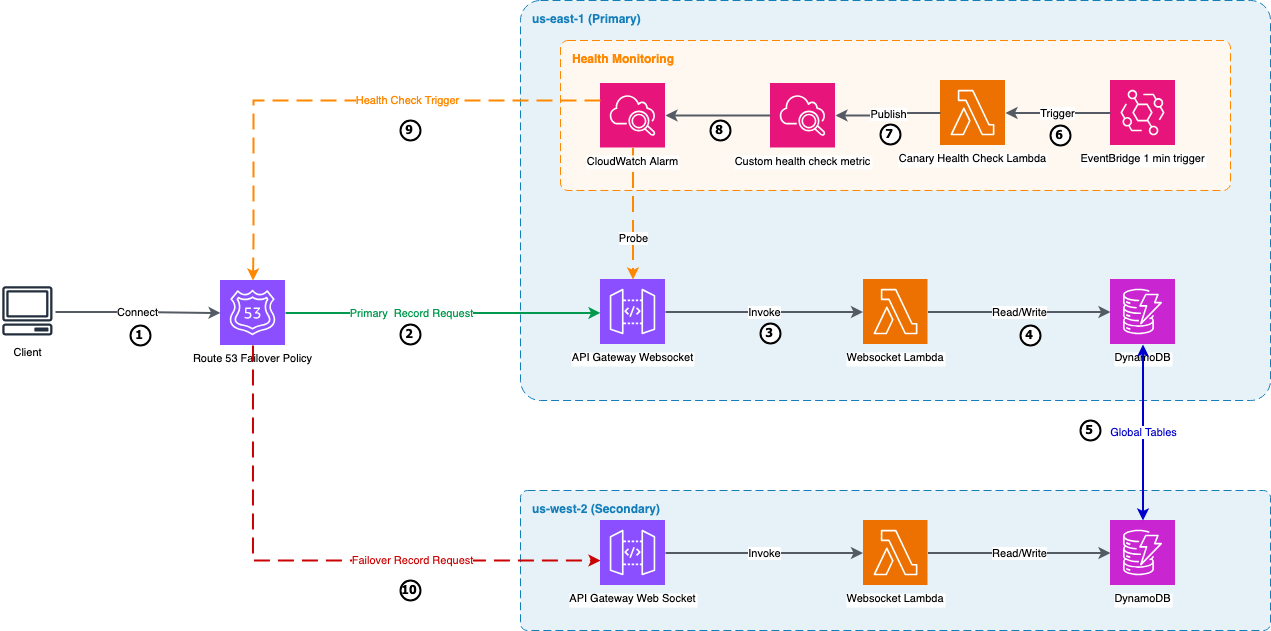
The newly published AWS architecture solves this challenge by cleanly separating the ephemeral connection layer from the underlying persistent application state. The solution relies on an active-passive multi-Region topology deployed identically across two distinct geographic zones, designated as the primary and secondary Regions.
At the edge of this architecture sits Amazon Route 53, utilizing its sophisticated DNS-based failover routing policies. Under normal operating conditions, Route 53 directs all incoming WebSocket connection requests exclusively to the primary Region. Both Regions, however, maintain fully provisioned API Gateway WebSocket APIs, AWS Lambda backend compute handlers, and synchronized data layers.
To maintain continuous data parity between the primary and secondary locations, the architecture leverages Amazon DynamoDB Global Tables. This fully managed multi-Region, multi-active database service replicates data asynchronously across geographically separated AWS Regions, typically achieving sub-second replication latency. While this asynchronous window means that write operations executed milliseconds before a regional disaster might occasionally experience minor replication delays, the timeframe is short enough to satisfy the recovery point objective (RPO) requirements of the vast majority of real-time workloads.
Automated Failure Detection via Proactive Canary Probes
A cornerstone of any robust disaster recovery strategy is the speed and accuracy of its failure detection mechanisms. Traditional DNS health checks frequently struggle with complex application-level failures, where infrastructure endpoints technically respond to basic ping requests while the underlying application logic is completely non-functional due to throttling, memory exhaustion, or database locks.
To eliminate false positives and ensure rapid detection of true application degradation, the AWS reference architecture implements an automated canary health probe. Deployed as a dedicated AWS Lambda function within the primary Region, the canary continuously executes active synthetic transactions against the WebSocket endpoint. Every minute, the probe opens a live WebSocket connection, dispatches an application-level heartbeat message conforming to standard protocol specifications, and listens for the expected acknowledgment token.
The canary publishes its diagnostic findings as a custom metric to Amazon CloudWatch. If the primary Region’s application stack fails to respond properly, or if telemetry data is missing entirely, a CloudWatch alarm triggers after two consecutive failed probe intervals. This alarm directly flips the status of the associated Route 53 health check, forcing the DNS routing policy to mark the primary endpoint as unhealthy and automatically redirect all subsequent connection requests to the secondary Region. By setting an aggressive evaluation window for failure while maintaining a more cautious threshold for failback, system architects can prevent erratic traffic flapping in the event of intermittent regional instability.
Client-Side Resilience and Exponential Backoff Strategies
While server-side infrastructure failover handles DNS redirection, client applications must be equally intelligent in how they manage dropped connections. If thousands of clients simultaneously experience a regional outage and instantly flood a secondary Region with reconnection requests without coordination, the resulting "thundering herd" phenomenon can easily overwhelm the newly designated backup infrastructure.
To mitigate this risk, the reference client implementation—built using modern React design patterns—incorporates a sophisticated client-side reconnection state machine. Both the server and the client utilize application-level heartbeats to continuously monitor connection health. If no valid response arrives within a predefined timeout window, or if consecutive heartbeat failures indicate a degraded backend, the client force-closes the socket.
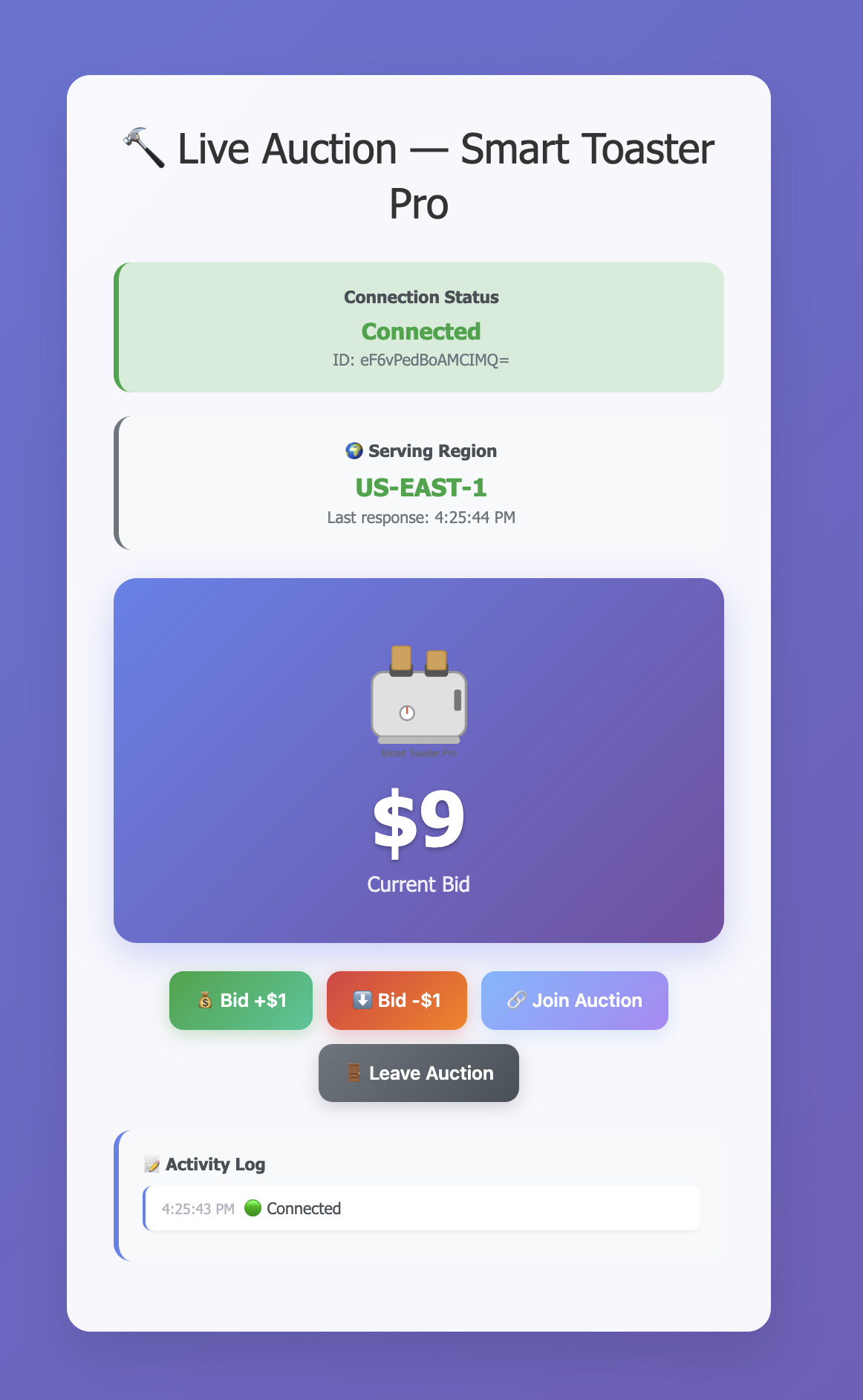
Upon identifying a severed connection, the client initiates an automated reconnection protocol governed by an exponential backoff algorithm integrated with full jitter. As detailed in foundational AWS architecture documentation, exponential backoff doubles the waiting interval between successive retry attempts, while full jitter introduces a randomized delay variable into that window. This mathematically disperses client retry attempts across a broader timeline, protecting secondary regional resources from sudden request spikes.
Upon successfully reconnecting through the standardized custom domain name—which Route 53 seamlessly resolves to the healthy secondary Region—the client executes a state-recovery routine. By transmitting a retrieval message to the backend, the client queries the secondary Region’s DynamoDB Global Table replica, pulls the user’s latest session data, and updates the local user interface without dropping a beat.
Industry Implications and Implementation Considerations
Enterprise cloud architects analyzing the new design pattern highlight its broad applicability across industries where real-time synchronization is paramount. Financial institutions operating high-frequency trading dashboards, healthcare providers monitoring remote patient telemetry, and enterprise software vendors building collaborative document platforms can all adapt these patterns to satisfy stringent corporate disaster recovery and business continuity mandates.
Industry experts emphasize, however, that organizations implementing this pattern must carefully evaluate their specific recovery time objective (RTO) and RPO requirements. While serverless components like API Gateway and Lambda scale instantly during failover, applications relying on relational data stores must account for replication mechanics. For instance, environments utilizing Amazon Aurora Global Databases achieve robust sub-second replication, though promoting a regional read replica to primary during a disaster recovery event typically introduces a brief administrative window that must be accounted for in automated orchestration scripts.
Furthermore, security engineers must ensure that authorization mechanisms are symmetrically deployed. Because WebSocket APIs authenticate clients during the initial connection handshake phase via Lambda authorizers, identical authorizer configurations must exist in both the primary and secondary Regions to ensure uninterrupted security validation during failover events.
Availability and Deployment Resources
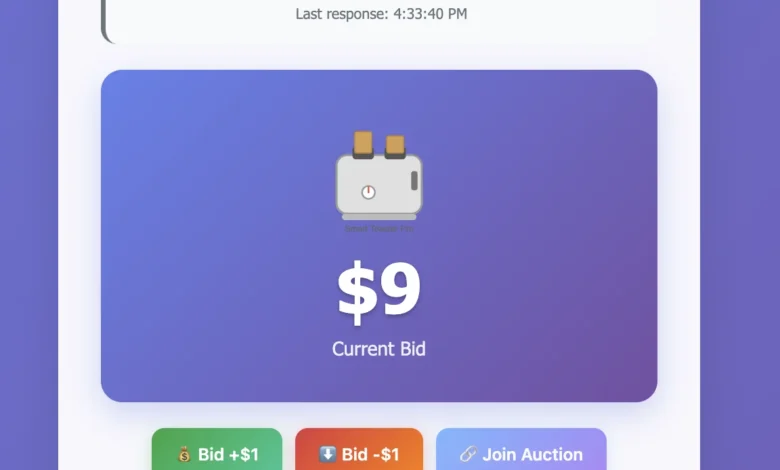
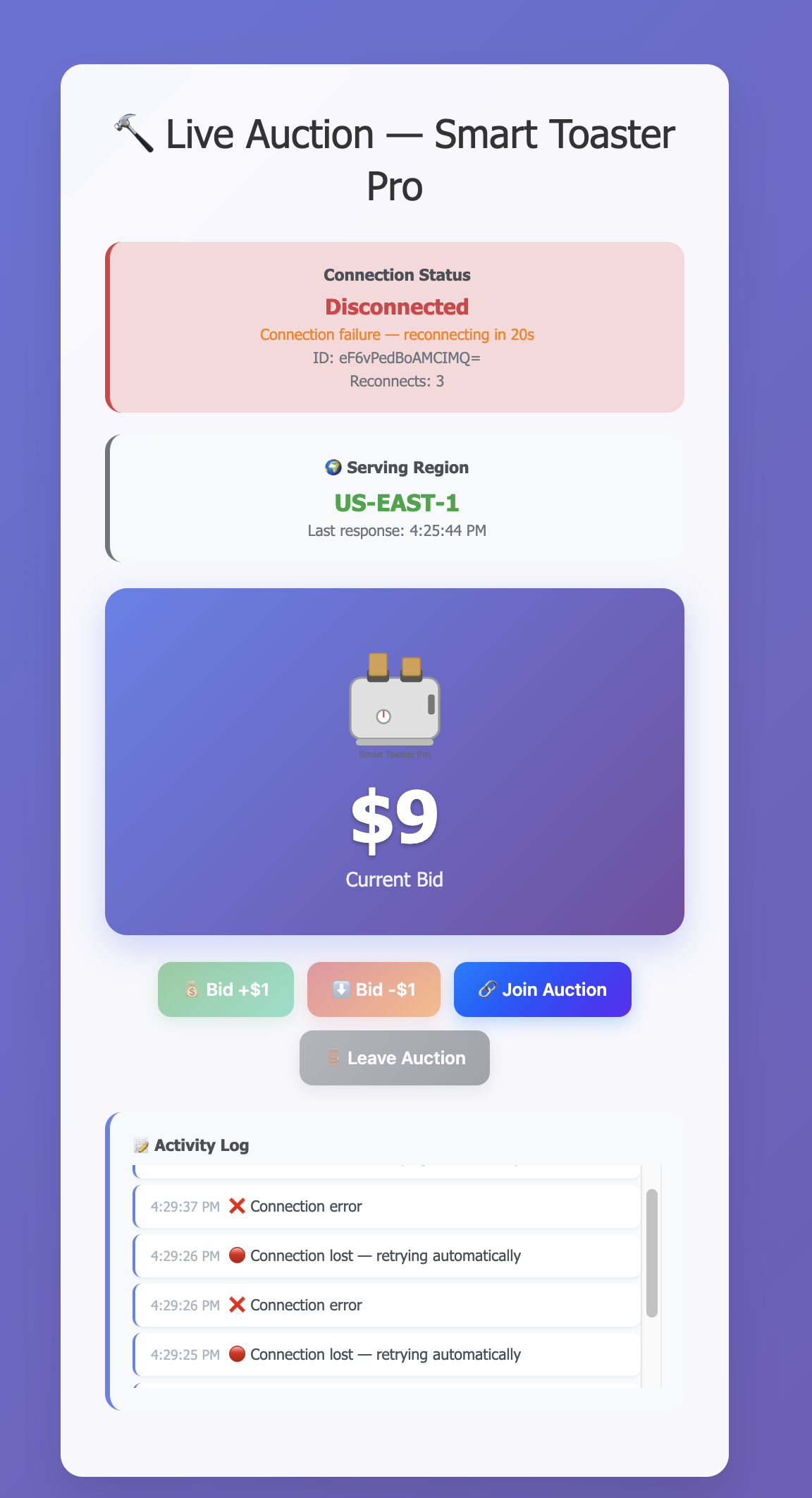
To accelerate adoption and ease implementation friction, AWS has released the complete, production-ready source code, AWS CloudFormation infrastructure templates, and a fully functional React-based reference application via its public GitHub repository. The sample project models a real-time online auction environment, complete with visual indicators displaying the active serving Region, connection health status, and live bid counters, allowing development teams to safely simulate regional outages and observe automated failover behaviors in staging environments.
As businesses increasingly migrate mission-critical, interactive workloads to cloud environments, frameworks that bridge the gap between high-availability infrastructure design and resilient client-side application logic will remain vital to maintaining uninterrupted digital experiences in the face of unforeseen infrastructure failures.
Related posts: