Self-service regional failover with Amazon Application Recovery Controller Region Switch and centralized ingress controls | Amazon Web Services

In heavily regulated sectors such as financial services, healthcare, and public administration, robust digital security is an absolute prerequisite. Regulatory frameworks mandate stringent, defense-in-depth security strategies designed to inspect, sanitize, and validate all incoming network traffic against rigorous security policies before it ever interacts with core business applications. To satisfy these compliance requirements, enterprise organizations traditionally deploy centralized ingress proxy fleets. These hardened, perimeter-defending entry points consistently enforce authentication, granular authorization, real-time threat detection, and comprehensive audit logging across hundreds of distinct workloads.
However, this conventional architecture introduces significant friction when critical enterprise applications attempt to establish resilient, multi-Region disaster recovery (DR) strategies. Mission-critical systems must routinely demonstrate active failover capabilities not only to guarantee continuity of operations, but also to satisfy strict auditor expectations for tested, repeatable recovery procedures. Yet, under centralized ingress governance models, the engineering teams directly accountable for Recovery Time Objective (RTO) metrics frequently lack the permissions required to independently execute a regional failover. Instead, they remain tethered to centralized infrastructure teams who are often managing a high volume of concurrent administrative requests across the entire enterprise.
This operational bottleneck introduces severe coordination overhead, extends recovery timelines during testing or live outages, and fundamentally contradicts the core DevOps philosophy of ownership: "you build it, you run it." When scaled across dozens of interdependent microservices and enterprise applications, this compounding coordination failure leaves organizations vulnerable. Individual team recovery capabilities are essential, but without coordinated, portfolio-level disaster recovery orchestration, the enterprise remains exposed to systemic failure. The central engineering challenge facing modern enterprises is no longer whether to implement defense-in-depth security controls—which remain non-negotiable—but rather how to preserve application team autonomy, enable self-service regional failover within rigid enterprise guardrails, and seamlessly orchestrate coordinated recovery across the entire application portfolio.
The Evolution of Enterprise Disaster Recovery Orchestration
Historically, managing multi-Region application recovery required organizations to author, test, and maintain complex, home-grown automation scripts independently. These disparate scripts frequently suffered from configuration drift, poor visibility, and regional synchronization failures, rendering them unreliable precisely when they were needed most. Recognizing these systemic vulnerabilities in enterprise resiliency operations, cloud infrastructure providers have increasingly invested in purpose-built, highly available orchestration platforms.
A major milestone in this technological evolution occurred in August 2025 with the official launch of Amazon Application Recovery Controller (ARC) Region Switch. Purpose-built to eliminate the undifferentiated heavy lifting of disaster recovery operations, ARC Region Switch functions as a fully managed, highly available failover orchestrator. Operating independently within each AWS Region outside the immediate blast radius of localized infrastructure impairments, the service addresses three primary pain points that have historically plagued enterprise DR plans: configuration drift, slow detection and decision-making, and divergent regional recovery logic.
Unlike static recovery scripts that quickly fall out of date as permissions change and infrastructure scales, ARC Region Switch executes continuous plan evaluations. Multiple times every hour, the service automatically validates configuration parameters, AWS Identity and Access Management (IAM) permissions, and standby resource readiness, surfacing potential blocking issues well in advance of a live failover or scheduled test. Furthermore, by integrating with native telemetry services such as Amazon CloudWatch alarms, recovery workflows can be triggered automatically, effectively eliminating human detection latency and decision-making delays from an organization’s effective RTO. Teams preferring human oversight can selectively incorporate manual approval checkpoints, while the underlying workflows remain fully codifiable through AWS CloudFormation, the AWS CLI, and standard APIs. This ensures recovery logic is version-controlled and deployed via continuous integration and continuous delivery (CI/CD) pipelines right alongside the application code it protects.
Architectural Foundation: Centralized Networking with Decentralized Control
To achieve true self-service regional failover without bypassing centralized security policies, enterprises must adopt a hybrid governance model rooted in a shared responsibility framework. In this architecture, infrastructure and application teams exercise strict control over distinct layers of the technology stack, establishing clean technical boundaries that eliminate cross-team coordination during emergency events.
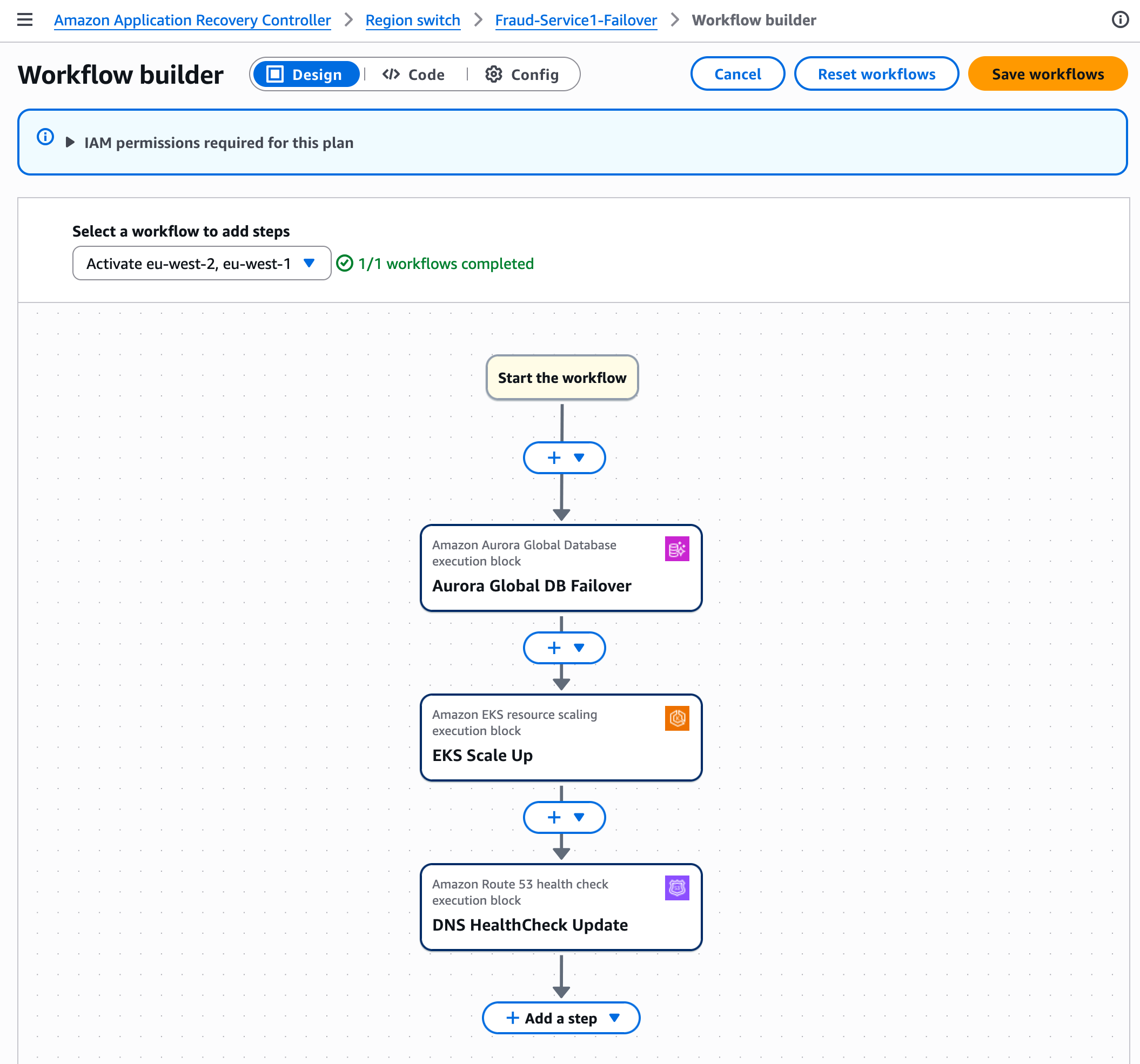
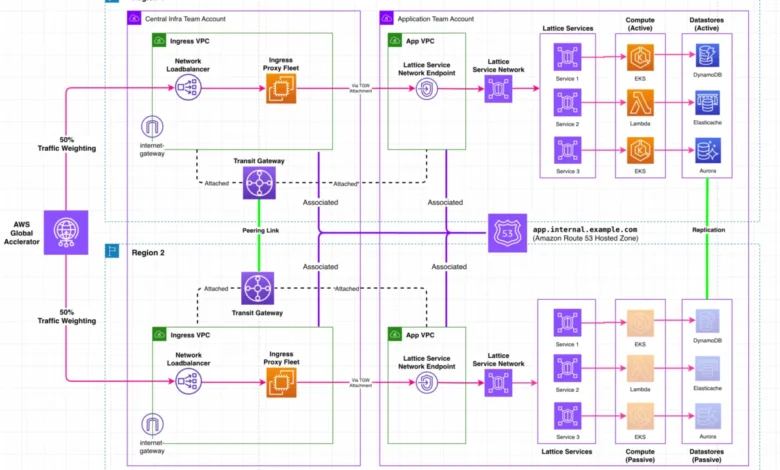
The foundational networking layer relies on centrally managed AWS Transit Gateways deployed across multiple AWS Regions, featuring cross-Region peering connections. A centralized infrastructure team owns and operates this Transit Gateway fleet, providing secure Virtual Private Cloud (VPC) attachments to each application team’s designated account. This ensures that all incoming traffic from the secure ingress proxy solution flows through authorized, inspected channels.
Conversely, the application team retains total autonomy over the Domain Name System (DNS) layer by owning and managing an Amazon Route 53 Private Hosted Zone (PHZ). This PHZ is explicitly associated with four distinct VPCs: the central infrastructure team’s ingress proxy fleet VPCs and the application team’s primary and standby application VPCs across both Regions. Within this PHZ, application teams maintain failover record sets that dictate where incoming traffic is routed.
This structural separation ensures clear operational boundaries. The infrastructure team provisions and secures the underlying networking fabric, while the application team controls the routing logic of their specific workloads. Neither team requires manual intervention or real-time coordination from the other during a failover event. To handle global routing, AWS Global Accelerator provides static anycast IP addresses for the centralized ingress proxy fleet. Utilizing a balanced traffic weighting model, the platform accommodates multi-tenant enterprise designs where proxy fleets concurrently serve multiple application teams across active-active or active-standby deployment topologies.
Fine-Grained Failover Control via Amazon VPC Lattice
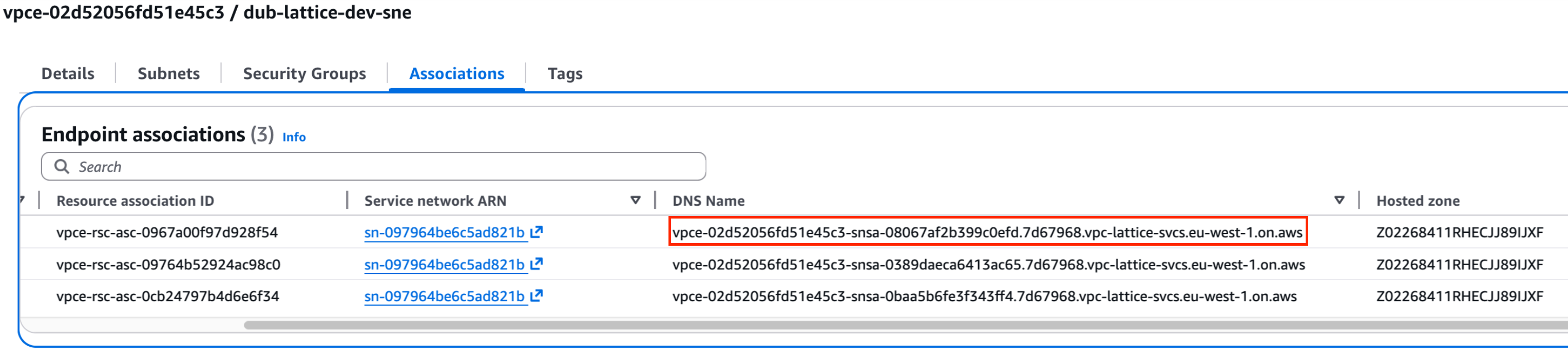
While foundational regional failover patterns successfully decouple infrastructure and application workflows, advanced implementations leverage Amazon VPC Lattice service network endpoints to achieve granular, component-level failover control. A service network endpoint acts as a unified aggregation point capable of hosting multiple distinct VPC Lattice services.
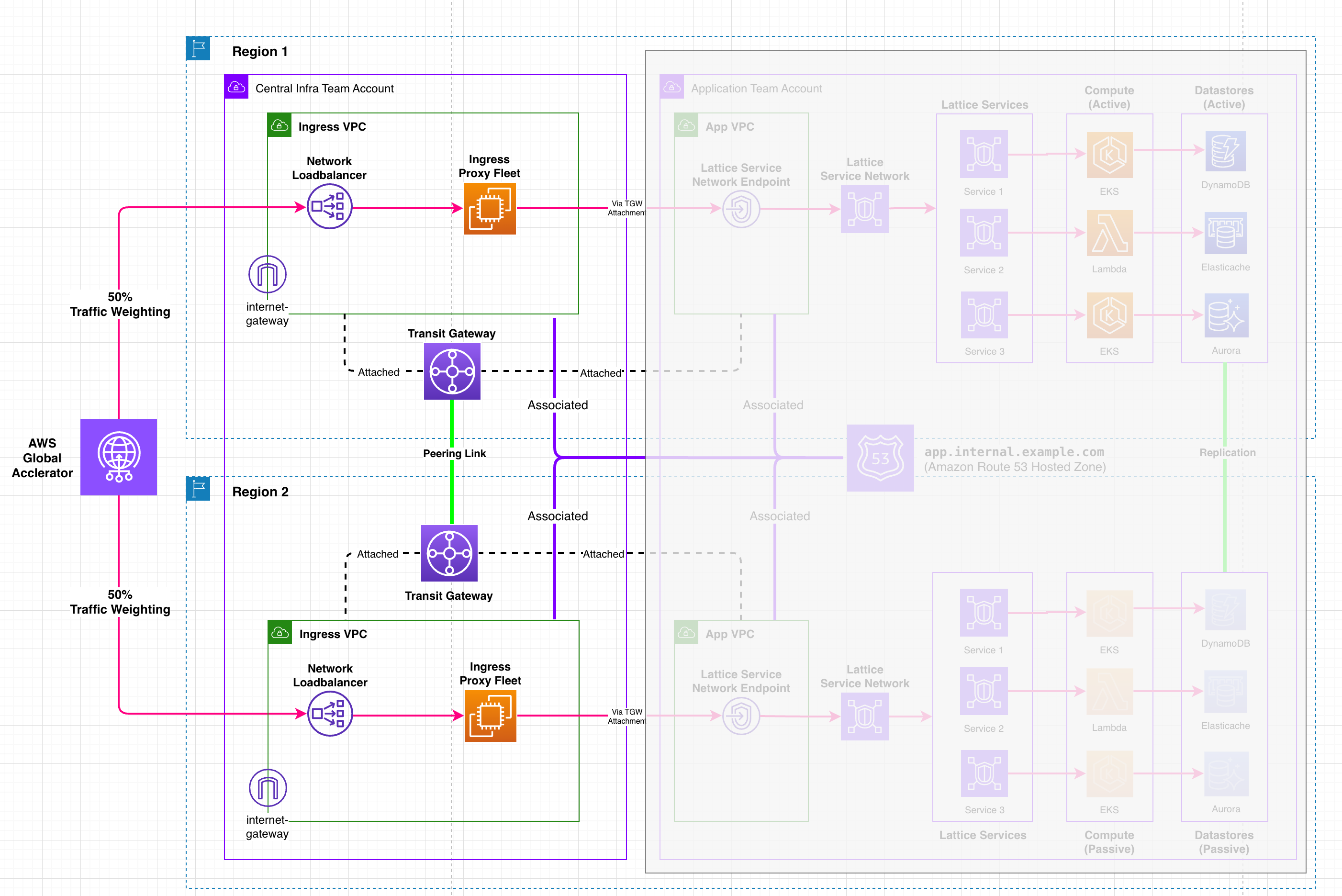
When an application microservice is associated with a service network endpoint, it is assigned a unique regional DNS name. For instance, an enterprise application comprising separate authentication, payment processing, and inventory services can map each microservice behind the same consolidated endpoint to its own distinct DNS name. Each per-service DNS name maps directly to an independent Route 53 Private Hosted Zone failover record set.
This architectural nuance yields significant operational flexibility: application teams can fail over individual microservices sequentially rather than being forced to execute a monolithic, all-or-nothing regional flip. An engineering team can validate failover readiness for their authentication service during one maintenance window, test the payments subsystem the following week, and evaluate inventory management thereafter. Because each service maintains a dedicated failover record set, these validations occur safely in isolation without disrupting other components running in the primary Region.
However, industry architects advise caution regarding this fine-grained approach, noting that it introduces the risk of bi-modal operational behavior. When components are split across multiple Regions, workloads may experience altered response times and networking latencies as services communicate across cross-Region boundaries. Consequently, component-level failover is best suited for mature engineering organizations with high architectural confidence, while a coarser-grained, whole-application approach remains preferable for simpler workloads. Regardless of the granularity chosen, the operational boundary remains pristine: ingress proxies continue resolving through standard service network endpoints, while application teams independently manipulate health checks within their private DNS zones.
The Mechanics of Self-service Regional Failover Execution
When an application team initiates an ARC Region Switch plan—whether for routine compliance auditing, scheduled disaster recovery drills, or in response to a live production incident—the transition unfolds as a deterministic, automated workflow.
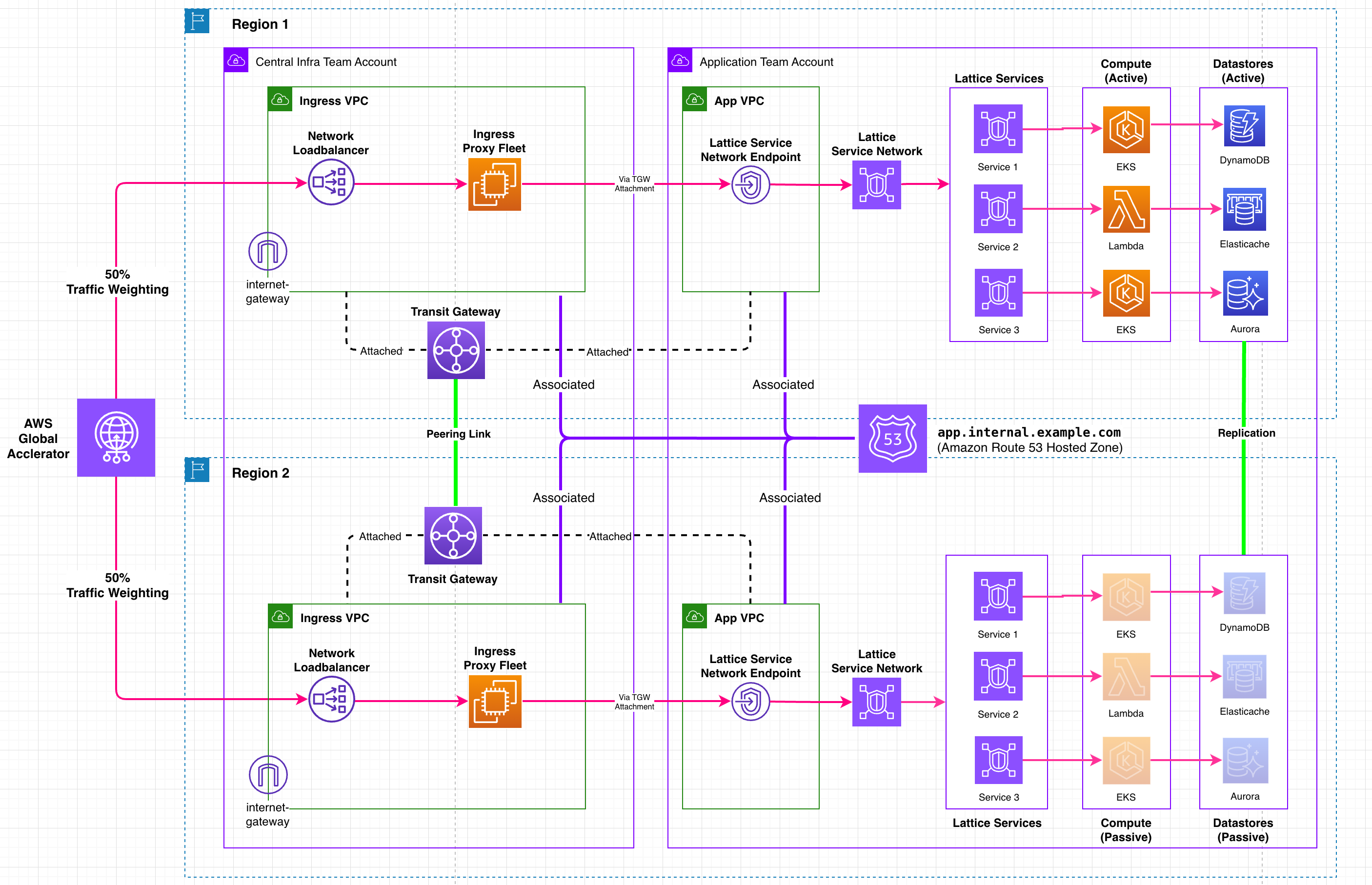
The execution sequence follows a strict, step-by-step validation model:
- Plan Initiation: The engineering team triggers the recovery plan via the AWS CLI or API. CloudWatch alarms can be configured to initiate this process automatically, or human-in-the-loop manual approval blocks can be inserted to gate critical execution phases. Best practices dictate bypassing graphical management consoles during live incidents to minimize external service dependencies in the critical path.
- Database Failover: The initial execution block manages the underlying data layer, promoting the standby Region’s database replica to become the primary read-write instance. ARC Region Switch natively supports automated switchovers and failovers for Amazon Aurora Global Databases, Amazon RDS cross-Region read replicas, and Amazon DocumentDB clusters, while custom AWS Lambda functions handle specialized database engines like Amazon DynamoDB global tables.
- Application Stack Scaling: Subsequent execution blocks automatically scale out compute capacity in the recovery Region—adjusting Amazon EC2 Auto Scaling groups, Amazon Elastic Kubernetes Service (EKS) pods, or Amazon Elastic Container Service (ECS) tasks—and invoke Lambda functions to pre-warm application caches, ensuring the standby environment is fully optimized before accepting production loads.
- DNS Health Check Manipulation: Once the application stack is verified as healthy, ARC Region Switch marks the primary Region’s Route 53 health check as unhealthy or toggles an ARC routing control block. This action triggers Route 53’s automated failover record logic, cleanly redirecting traffic to the standby Region without requiring any manual reconfiguration of the centralized ingress proxy fleet.
Failback operations follow an identical, symmetric workflow in reverse, ensuring that returning production traffic to the original primary Region is just as automated, repeatable, and audit-friendly as the initial failover.
Transitioning to Coordinated Portfolio-Level Recovery
While independent, application-level failover empowers individual engineering squads, enterprise architectures invariably feature complex dependencies between disparate business services. A customer-facing portal relies on backend inventory APIs, which in turn depend on centralized authentication and payment gateways. When a major disaster strikes, these interdependent systems must recover in strict, deterministic dependency order. Historically, organizations attempted to manage these intricate relationships through static documentation, wikis, and high-stress command center conference calls—methods notorious for failing under pressure.
To solve portfolio-level orchestration challenges without sacrificing team autonomy, enterprises utilize AWS Resource Access Manager (AWS RAM) to share ARC Region Switch plans securely across multiple AWS accounts. Individual application teams maintain ownership of their respective "child plans" within their spoke accounts and share them with a centralized hub account. In the hub, these shared workflows are incorporated as execution steps within a overarching "parent plan."
Utilizing the Region Switch plan execution block, the central parent plan invokes dependent child plans in precise, programmatic dependency order. For example, the parent plan can execute a core authentication child plan first; only upon verifying its successful completion will it trigger downstream dependent child plans for payment processing and customer portals. Each child plan remains independently versioned, managed, and tested by its respective application squad through their standard software development lifecycles, while the AWS RAM share strictly governs administrative access rather than execution logic. This federated architecture finally delivers the long-sought enterprise capability of a single, automated portfolio-level recovery mechanism that satisfies rigorous compliance mandates while preserving decentralized operational ownership.
Broader Implications and Compliance Analysis
The integration of centralized networking governance with self-service regional failover orchestration marks a significant maturation in enterprise cloud architecture. For heavily regulated institutions, the persistent tension between stringent security compliance and agile DevOps autonomy has long forced difficult organizational compromises.
By decoupling secure ingress proxy management from application-level DNS control and leveraging managed orchestration tools like Amazon Application Recovery Controller Region Switch, enterprises achieve a sustainable middle ground. Compliance auditors gain verifiable proof of tested, repeatable, and fully automated disaster recovery procedures backed by continuous plan evaluations and immutable audit logs. Simultaneously, engineering teams recover the agility to test and execute failover protocols independently, drastically reducing Recovery Time Objectives (RTO) and operational overhead.
Ultimately, this architectural pattern demonstrates that modern enterprises no longer need to choose between rigorous perimeter security and high availability. Through thoughtful API-driven automation and clear boundaries of shared responsibility, organizations can successfully architect for both security and operational resilience at scale.