Proving Operational Resilience: Conducting Multi-Day Availability Zone Evacuation Drills with Amazon Application Recovery Controller Zonal Shift

Modern enterprise architectures increasingly rely on multi-Availability Zone (AZ) deployments as an foundational best practice for building resilient cloud-native applications on Amazon Web Services (AWS). However, a significant operational gap often exists between simply deploying workloads across multiple zones and empirically proving that these systems can withstand sustained, hours-long or days-long impairments. Traditional disaster recovery (DR) testing methodologies have historically focused on brief, minutes-long failover validations. While these standard tests successfully confirm that failover mechanisms function under initial triggers, they consistently fail to surface latent, time-dependent failure modes that only manifest over prolonged periods of operating under degraded, N-1 capacity conditions.
To bridge this operational vulnerability, industry leaders—particularly within strictly regulated sectors such as financial services—are adopting multi-day Availability Zone evacuation drills. By executing a controlled, 48-to-72-hour traffic evacuation away from a single AZ using Amazon Application Recovery Controller (ARC) Zonal Shift, organizations can force their digital platforms to sustain full production workloads across remaining infrastructure. This rigorous approach validates capacity sufficiency, database connection stability, and client reconnection behaviors, while providing definitive, auditable proof that operational teams can successfully manage sustained enterprise infrastructure on reduced capacity.
Regulatory Shifts Driving Real-World Operational Resilience Testing
The push toward multi-day resilience drills is largely catalyzed by intensifying global regulatory pressures within the financial services sector. Regulatory bodies worldwide are shifting their supervisory focus away from theoretical compliance frameworks and static documentation audits toward empirical, evidence-based operational resilience. Financial institutions, including major commercial banks and insurance providers, are facing an unprecedented mandate to demonstrate actionable disaster recovery capabilities under realistic, live-production conditions.
This regulatory evolution has fundamentally transformed enterprise risk management philosophies, replacing the traditional "show us your runbook" standard with a stringent "show us the evidence" requirement. Consequently, regulated entities are redesigning their operational resilience programs to incorporate periodic, scheduled AZ evacuations. By utilizing native data-plane mechanisms like ARC Zonal Shift, enterprises can smoothly redirect infrastructure-layer traffic without necessitating complex application code modifications. This capability operates seamlessly across core AWS networking and compute components, including Application Load Balancers, Network Load Balancers, Amazon Elastic Compute Cloud (EC2) Auto Scaling groups, and Amazon Elastic Kubernetes Service (Amazon EKS) clusters.
Comprehensive Solution Architecture and Multi-Tier Design
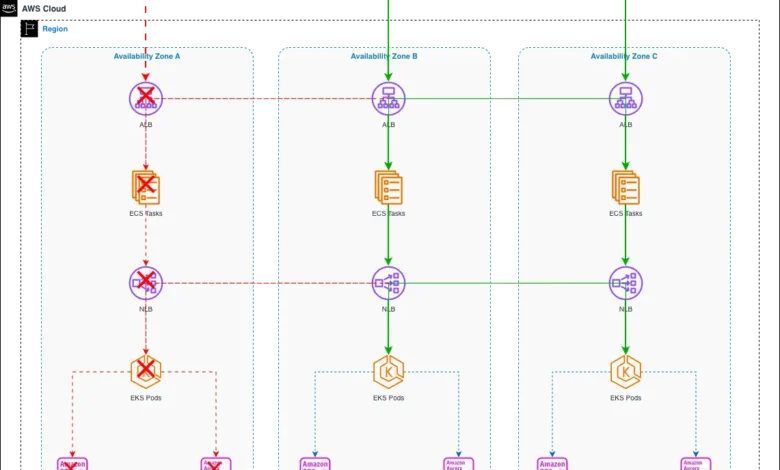
To execute a comprehensive multi-day evacuation drill, organizations must deploy a resilient multi-tier digital platform capable of maintaining service continuity during localized infrastructure loss. A standard reference architecture typically encompasses traffic ingress, containerized compute layers, and distributed database engines spanning three distinct Availability Zones.
At the ingress layer, Application Load Balancers (ALBs) fronting Amazon Elastic Container Service (ECS) and Network Load Balancers (NLBs) fronting Amazon EKS are configured across three AZs with cross-zone load balancing activated. For containerized compute, stateless tasks and pods are distributed evenly across AZ subnets utilizing strict topology spread constraints. Database tiers introduce additional architectural considerations, particularly when balancing standard Multi-AZ models against native distributed storage models.
For relational databases such as Amazon RDS for PostgreSQL configured in a standard Multi-AZ deployment, the primary database instance resides in one AZ while a synchronous standby occupies another. In contrast, Amazon Aurora PostgreSQL decouples its storage layer from compute instances, replicating data synchronously across six storage nodes spanning three Availability Zones independently. In an evacuation scenario targeting AZ A—the zone hosting the primary RDS instance or Aurora writer—the storage layer remains fully accessible, requiring only a targeted instance failover to maintain uninterrupted data operations.
Mechanics of ARC Zonal Shift and Data Plane Independence
Amazon Application Recovery Controller Zonal Shift is engineered as a foundational data-plane operation designed to function independently of the AWS control plane. This architectural distinction is critical during genuine infrastructure impairments, ensuring that mitigation actions remain fully accessible even if control plane latencies rise.
When a zonal shift is initiated for an Elastic Load Balancer or Amazon Route 53 resource, ARC coordinates immediate routing adjustments to instruct load balancer nodes located in healthy Availability Zones to cease routing traffic to targets within the impaired or evacuated zone. For Amazon EKS clusters with zonal shift capabilities enabled, the system extends its reach natively into Kubernetes networking. ARC automatically coordinates with the cluster to taint and cordon nodes in the evacuated zone, updating Kubernetes EndpointSlices to isolate pods in the targeted AZ from receiving service-to-service east-west traffic.
When combined with service-specific operational procedures—such as ECS task network reconfiguration and database failover protocols—ARC Zonal Shift delivers a comprehensive, multi-dimensional evacuation strategy covering north-south ingress, east-west internal service communication, and outbound database connections.
Chronology and Execution Methodology for Multi-Day Drills
Executing a successful 48-to-72-hour AZ evacuation requires meticulous preparation, phased execution, and continuous observability. The operational workflow spans several distinct phases across infrastructure layers, beginning with compute management and culminating in database failover.
Prerequisites and Foundation Verification
Months and weeks prior to executing a multi-day shift, engineering teams must verify that all target resources meet strict architectural baseline requirements. Target groups must maintain healthy registrations across at least two Availability Zones to prevent load balancer rejection. Furthermore, containerized workloads must be pre-scaled to absorb the total loss of an AZ’s compute capacity without relying on reactive, automated scaling mechanisms that could introduce latency during an actual incident.
Amazon ECS Task Redistribution and Ingress Shift
The evacuation procedure begins at the load balancer level by verifying that zonal shift configurations are enabled. Operators initiate the zonal shift specifying an expiration window—typically set to 72 hours for extended drills—and subsequently update ECS service network configurations to exclude subnets residing in the evacuated zone. This ensures that any newly launched tasks are exclusively placed within healthy, remaining AZs. Throughout the multi-day window, system administrators monitor resource utilization trends to confirm that the N-1 capacity pool maintains adequate headroom.
Amazon EKS Integration and Endpoint Isolation
For Kubernetes-based microservices, operators enable cluster-level zonal shifting and initiate parallel shifts for both the external Network Load Balancer and the EKS cluster control interface. Verification procedures involve inspecting Kubernetes EndpointSlices to confirm that pod endpoints within the evacuated zone have been successfully removed from active routing pools, and verifying that affected worker nodes are properly marked with scheduling constraints.
Database Failover and Standby Management
Database tiers require precise administrative intervention to ensure data integrity and continuous availability. For Amazon RDS for PostgreSQL deployments where the primary database instance resides within the evacuated zone, operators execute a forced failover via a managed reboot. This promotes the synchronous standby instance in a healthy AZ to primary status. For Amazon Aurora PostgreSQL clusters, failover execution promotes a designated reader instance located in a surviving AZ, leveraging Aurora’s rapid tier-based failover capabilities to restore write availability within seconds.
Observability and Continuous CloudWatch Monitoring
A multi-day operational drill derives its ultimate value from the quantitative evidence and telemetry it generates. Unlike brief verification tests, a 48-to-72-hour evacuation demands continuous, automated monitoring via Amazon CloudWatch dashboards configured with granular, per-AZ metric breakdowns.
Engineering teams closely monitor key performance indicators across every architectural tier:
- Load Balancer Metrics: Tracking HealthyHostCount and RequestCount ensures that traffic successfully drops to zero in the evacuated zone while distributing evenly across remaining zones without triggering anomalous TargetResponseTime spikes.
- Compute Metrics: Evaluating CPU and memory utilization on Amazon ECS services and Amazon EKS worker nodes confirms that surviving compute resources successfully absorb concentrated workloads without exceeding sustainable performance thresholds.
- Database Metrics: Tracking AuroraReplicaLag, CommitLatency, and DatabaseConnections ensures that primary database failovers complete smoothly and that client reconnection storms are managed effectively without degrading transaction processing speeds.
Comprehensive data snapshots and ARC event histories are compiled throughout the duration of the drill to establish an auditable resilience package that satisfies regulatory scrutiny and internal governance requirements.
Post-Drill Restoration and Governance Implications
Upon the successful completion of the multi-day evacuation window, restoration procedures must be executed in a methodical, sequenced order to prevent operational disruption. Operators first cancel active ARC zonal shifts, allowing traffic to gradually re-establish across all three Availability Zones. Subsequently, database subnet groups, ECS network configurations, and EKS scheduling constraints are reverted to their baseline multi-AZ states.
The adoption of multi-day Availability Zone evacuation drills represents a foundational maturation in enterprise cloud architecture. By transitioning from theoretical multi-AZ deployment strategies to empirically proven, continuously tested operational models, financial institutions and highly regulated enterprises can conclusively demonstrate robust disaster recovery capabilities. Utilizing native tools such as ARC Zonal Shift empowers organizations to meet rigorous regulatory mandates, validate system resilience under sustained stress, and ensure uncompromised digital service continuity for customers worldwide.
Related posts: