How Equinix Transformed Its Global Infrastructure by Migrating Self-Managed Kubernetes to Amazon EKS

Equinix, a prominent global digital infrastructure provider managing over 260 data centers spanning more than 70 metropolitan areas worldwide, has completed a major architectural overhaul of its containerized workloads. By transitioning away from a legacy, self-managed Kubernetes deployment hosted on Amazon EC2 instances, the company has successfully centralized its cloud infrastructure operations onto Amazon Elastic Kubernetes Service (Amazon EKS). Co-authored by Equinix engineering leaders Manikandan Vasu, Vanji Sivajothy, and Ramchandra Koty, the migration addresses historical challenges involving operational sprawl, fragmented security policies, and independent cluster lifecycles, establishing a streamlined "North Star" multi-account shared services architecture.
The Evolution of Equinix’s Container Strategy
In the early stages of cloud adoption, Equinix relied on a self-managed Kubernetes model built directly on Amazon EC2. Under this infrastructure model, internal engineering teams provisioned individual EC2 instances to function as etcd data stores, control plane nodes, and worker nodes. To maintain the cluster, the teams utilized a variety of open-source automation tools designed to handle component installation and lifecycle configurations.
While this decentralized approach offered initial flexibility and direct administrative control, it ultimately led to significant architectural fragmentation. Because individual application teams operated their own clusters independently, there was no centralized mechanism to enforce enterprise-wide governance, standardize configurations, or deploy common infrastructure services uniformly. Teams made siloed decisions regarding networking topologies, observability tooling, security parameters, and deployment pipelines. Consequently, the cloud operations team faced severe visibility gaps and escalating maintenance overhead, rendering the environment increasingly difficult to secure, monitor, and scale as the company expanded its global footprint.
The Architectural Shift to a Multi-Account Shared Services Model
Recognizing that decentralized cluster management was unsustainable for enterprise-scale growth, Equinix initiated a fundamental structural shift. The enterprise moved toward a centralized shared services model wherein the cloud operations team maintains absolute ownership and governance of the underlying infrastructure, allowing application teams to focus exclusively on developing business logic and customer-facing features.
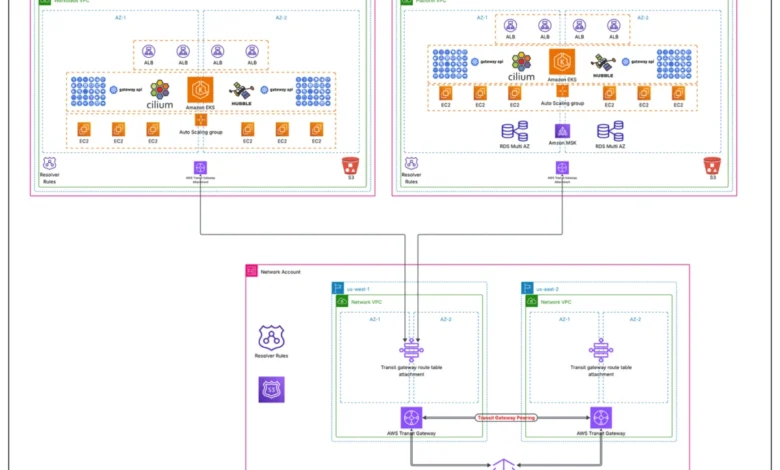
To execute this vision, Equinix designed a multi-account Amazon EKS architecture optimized for workload isolation, security compliance, and centralized governance. As detailed in their deployment blueprints, the architecture segregates responsibilities across multiple dedicated AWS accounts, utilizing robust hybrid connectivity solutions such as AWS Transit Gateway and AWS Direct Connect.
Within this framework, ingress traffic to core platform services is managed via Network Load Balancers (NLBs), supported by an advanced networking and observability stack utilizing Cilium and Hubble. By replicating identical architectural patterns across development, system integration testing (SIT), user acceptance testing (UAT), and production environments, Equinix ensured consistency across all phases of the software development lifecycle.
Measurable Operational Impact and Organizational Results
The implementation of the North Star architecture on Amazon EKS produced immediate and quantifiable performance improvements across Equinix’s global engineering organization. Most notably, the company recorded a 40 percent reduction in operational overhead. By offloading cluster lifecycle management—including high availability configurations, control plane maintenance, and security patching—to AWS, internal engineering resources were reallocated toward high-value software innovation.
Furthermore, deployment frequency increased fourfold. Engineering teams are no longer constrained by infrastructure bottlenecks or manual provisioning delays, allowing them to ship updates and new features to market significantly faster. The migration also achieved a 100 percent unified operating model across multiple business units, bringing an end to the historical fragmentation of containerized workloads.
Reflecting on the strategic milestone, engineering leadership noted that Amazon EKS provided the essential foundation for a scalable, standardized infrastructure that empowers engineers to prioritize customer-facing innovation.
Implications for Enterprise-Scale Infrastructure Management
Equinix’s transition highlights a broader industry trend among enterprise organizations managing large-scale, distributed cloud environments. As organizations scale, the administrative burden of self-managed infrastructure often outweighs the perceived benefits of granular cluster control. By consolidating operational ownership onto managed services like Amazon EKS, enterprises can eliminate undifferentiated heavy lifting, enforce rigorous security compliance, and dramatically accelerate their software delivery velocity.
The successful rollout serves as a blueprint for other digital infrastructure companies seeking to modernize legacy architectures. Moving forward, Equinix plans to use the North Star architecture as a scalable framework to support future business expansion across emerging geographic markets and newly integrated enterprise units, ensuring long-term operational resilience without sacrificing agility or security.
Related posts: