Optimizing Costs and Enhancing Efficiency for Eclipse Dataspace Components Deployments on AWS

Organizations venturing into the realm of secure and sovereign data sharing through Eclipse Dataspace Components (EDC) connectors on Amazon Web Services (AWS) frequently encounter the critical challenge of forecasting and managing infrastructure expenditure. Without robust benchmarks and a clear understanding of cost drivers, making informed decisions regarding workload sizing, environment configuration, and long-term strategic investments can prove difficult. This article, the final installment in a three-part series, delves into the essential AWS Well-Architected Framework pillars of Performance Efficiency, Cost Optimization, and Sustainability, offering actionable insights and strategies to significantly reduce operational costs while maintaining high standards of data sovereignty and performance.
The Strategic Imperative of Data Spaces and Eclipse Dataspace Components
The global digital economy is increasingly reliant on the seamless, secure, and sovereign exchange of data between independent organizations. This necessity has given rise to the concept of "data spaces" – federated ecosystems designed to facilitate trusted data sharing while ensuring participants retain full control over their data and adhere to stringent compliance and sovereignty principles. These architectures aim to dismantle data silos, foster collaboration, and unlock new value across various sectors, from manufacturing and automotive to healthcare and logistics.
At the heart of many such initiatives are technologies like the Eclipse Dataspace Components (EDC). EDC provides a foundational, open-source framework for building interoperable data connectors that enable organizations to participate in data spaces, aligning with standards set by bodies like the International Data Space Association (IDSA). These connectors are crucial for managing data access policies, contract negotiations, and secure data transfers, forming the backbone of a distributed data economy. As organizations increasingly adopt these components, deploying them on scalable and reliable cloud infrastructure becomes paramount. AWS, with its comprehensive suite of services, offers a compelling platform for this, yet understanding and optimizing the associated costs is vital for widespread adoption and economic viability.
The journey to an optimized EDC deployment on AWS has been systematically explored in this blog series. Part 1 laid the groundwork, elucidating the fundamentals of data space architectures and the role of EDC in alignment with IDSA standards. Part 2 advanced the discussion, outlining production-ready architecture patterns for deploying EDC connectors on AWS, with a keen focus on operational excellence, security, and reliability principles. This concluding segment now completes the holistic view by addressing the remaining critical dimensions: how to achieve performance efficiency, optimize costs, and ensure sustainability, ultimately providing a comprehensive guide for data space participants.
Unpacking Cost Drivers in Decentralized Data Architectures
When deploying EDC connectors, infrastructure costs can fluctuate substantially, influenced primarily by the performance and reliability requirements of the workload, coupled with the volume and velocity of data transiting across the network. It’s crucial to differentiate between the infrastructure components managed by a central Dataspace Governance Authority (DSGA) – which handles shared services like management, identity, and discovery – and those hosted by individual participants, specifically the EDC connectors themselves. This analysis zeroes in on the costs directly attributable to EDC connector deployment on the participant side, encompassing both data providers and consumers.
To provide a tangible basis for cost estimation, a set of fictional yet representative usage assumptions has been established. These serve as a baseline for organizations to model their own potential expenditures:
- Data Volume: 5 GB per participant, encompassing six months of historical data and necessary backups.
- Network Traffic: 20 GB per month per participant, representing data transfers between various participants within the data space.
- API Calls: 100,000 per month per participant, covering essential operations such as catalog queries, contract negotiations, and data transfers.
- OAuth Token Requests: 1,000 per month per participant, facilitating machine-to-machine authentication for data plane operations.
These assumptions, while illustrative, provide a realistic foundation for understanding resource consumption patterns inherent in typical EDC connector operations.
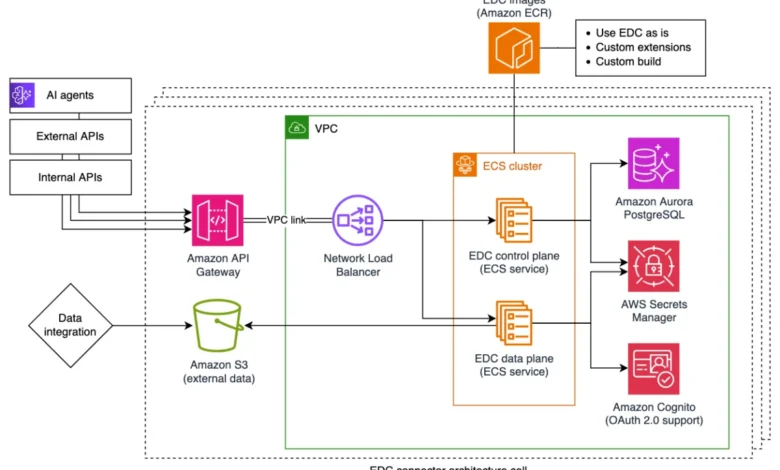
The reference architecture for production-ready EDC connectors on AWS, detailed extensively in Part 2 of this series, forms the blueprint for these cost estimations. This robust architecture typically leverages a suite of AWS services, including Amazon Elastic Container Service (Amazon ECS) with AWS Fargate for container orchestration, Amazon Aurora PostgreSQL-Compatible Edition for the database layer, Network Load Balancer (NLB) for efficient traffic distribution, AWS Secrets Manager for secure credential management, Amazon Cognito for identity and access management, Amazon Elastic Container Registry (ECR) for container image storage, Amazon API Gateway for managing API access, and Amazon Simple Storage Service (S3) for object storage.
Based on this architecture, two distinct cost scenarios are considered, reflecting different workload criticalities:
- Business-critical workloads: These demand constant availability, high performance, and robust reliability, typical for core operational data sharing.
- Non-critical workloads: Suitable for development, testing, or experimental environments where some level of interruption or lower performance is acceptable.
Both scenarios adhere to the architectural patterns described previously, with the primary differentiators lying in the sizing and configuration of compute and database resources.
Cost Estimation: Business-Critical Workloads
For business-critical EDC connector deployments, where uptime, performance, and data integrity are paramount, the infrastructure is provisioned for constant availability and high throughput. The estimated monthly costs for such a configuration, based on the aforementioned usage assumptions, reveal key expenditure drivers:
| AWS Service | Configuration | Monthly Cost (USD) |
|---|---|---|
| Amazon Aurora PostgreSQL-Compatible | db.r6g.large (2 vCPU, 16 GB), 20 GB storage + 10 GB backup | 276.00 |
| Amazon ECS with AWS Fargate | 2 vCPU, 4 GB RAM, always on | 83.00 |
| Network Load Balancer | 20 GB processed data | 20.00 |
| AWS Secrets Manager | 10 secrets | 4.00 |
| Amazon Cognito | 1K machine-to-machine (M2M) token requests | 2.25 |
| Amazon ECR | 2 GB storage, 10 GB transfer | 1.00 |
| Amazon API Gateway | 100K REST API calls | 0.40 |
| Amazon S3 | 5 GB Standard tier | 0.10 |
| Total | 387.00 |
Table 1: Estimated monthly cost for business-critical EDC connector deployment
This detailed breakdown highlights Amazon Aurora PostgreSQL as the predominant cost driver, accounting for a significant portion of the total. The selection of a db.r6g.large instance reflects the need for sustained high memory and performance, critical for data-intensive operations and maintaining database reliability and speed in a business-critical context. Amazon ECS with AWS Fargate emerges as the second-largest contributor, primarily due to its continuous operation to ensure environment availability. The Network Load Balancer represents a third notable component, facilitating efficient and secure traffic distribution. The remaining services, while essential for the architecture’s functionality, contribute only a minor fraction to the overall monthly expenditure at these usage volumes. This analysis is crucial for organizations to identify where their budget is allocated and pinpoint areas with the highest potential for optimization without compromising core service quality.
Cost Estimation: Non-Critical Workloads and Optimization Potential
For development, testing, or experimentation environments, organizations can achieve substantial cost reductions by adopting a non-critical workload configuration. Through strategic rightsizing and leveraging cost-effective AWS services, monthly costs can be slashed by up to 58% compared to business-critical deployments.
| AWS Service | Configuration | Monthly Cost (USD) |
|---|---|---|
| Amazon Aurora PostgreSQL-Compatible | db.t4g.medium (2 vCPU, 4 GB), 20 GB storage + 10 GB backup | 110.00 |
| Amazon ECS with AWS Fargate Spot | 2 vCPU, 4 GB RAM, always on | 26.00 |
| Network Load Balancer | 20 GB processed data | 20.00 |
| AWS Secrets Manager | 10 secrets | 4.00 |
| Amazon Cognito | 1K M2M token requests | 2.25 |
| Amazon ECR | 2 GB storage, 10 GB transfer | 1.00 |
| Amazon API Gateway | 100K REST API calls | 0.40 |
| Amazon S3 | 5 GB Standard tier | 0.10 |
| Total | 164.00 |
Table 2: Estimated monthly cost for non-critical EDC connector deployment
These figures underscore the significant savings achievable through judicious resource allocation. While Amazon Aurora PostgreSQL remains the leading cost component, the adoption of a smaller instance type, db.t4g.medium, drastically reduces its contribution. Furthermore, utilizing Amazon ECS with AWS Fargate Spot capacity for compute requirements slashes costs by nearly 70% compared to the business-critical setup. Fargate Spot instances leverage spare AWS capacity, offering substantial discounts in exchange for the possibility of interruptions, which are tolerable for non-critical tasks. In total, this optimized configuration brings down the monthly cost by approximately 58%, all while maintaining identical assumptions for data throughput, API calls, and storage volumes.
This comparative analysis reveals that the primary cost contributors in both scenarios are fundamentally tied to database, compute, and load balancing resources. These represent baseline infrastructure costs rather than purely usage-based charges. Services such as Amazon S3, API Gateway, and data transfer charges contribute only marginally to the overall expenditure at these volumes. This cost structure is indicative of an architecture designed for efficient scaling; as organizations onboard more use cases and increase data volume and velocity, they can extract greater value from their existing infrastructure investment without experiencing disproportionate cost increases. This inherent scalability makes the architecture particularly attractive for growing data space initiatives.
Adhering to the AWS Well-Architected Framework: Performance, Cost, and Sustainability
The AWS Well-Architected Framework provides a set of best practices and guiding principles for designing and operating reliable, secure, efficient, and cost-effective cloud systems. While Part 2 of this series addressed Operational Excellence, Security, and Reliability, this section elaborates on how the remaining three pillars – Performance Efficiency, Cost Optimization, and Sustainability – are applied to EDC deployments on AWS.
Performance Efficiency
Performance efficiency focuses on using computing resources efficiently to meet system requirements, and maintaining that efficiency as demand changes. For EDC connectors, this involves:
- Right-sizing Compute Resources: It is critical to match Amazon ECS task definitions precisely to actual workload requirements. Over-provisioning resources from the outset leads to unnecessary expenditure and underutilization. AWS recommends starting with smaller configurations and scaling up based on observed metrics. Tools like Amazon CloudWatch Container Insights provide invaluable visibility into container performance, enabling informed sizing decisions and ensuring that compute resources are optimally aligned with demand.
- Leveraging Amazon Aurora’s Flexibility: For workloads characterized by variable demand patterns, Amazon Aurora Serverless v2 offers a compelling solution. This database option automatically scales capacity based on real-time application needs, eliminating the necessity to provision for peak capacity while ensuring consistent performance during high-demand periods. This adaptive scaling prevents both performance bottlenecks and costly over-provisioning.
- Optimizing Data Transfer Patterns: Efficient data transfer is paramount for performance and cost. EDC data plane operations should be designed to minimize redundant data movement. Utilizing Amazon S3 Transfer Acceleration can significantly speed up large transfers across geographic distances. Furthermore, employing data compression where appropriate can reduce both transfer times and associated network costs, ensuring data flows efficiently within and between data spaces.
Cost Optimization
Cost optimization is about avoiding unnecessary costs. This includes understanding and controlling where money is being spent, selecting the most appropriate and right-sized resources, and scaling dynamically.
- Reducing Compute Costs for Fault-Tolerant Workloads: For workloads that can tolerate interruptions, such as development environments, batch processing, or non-critical tasks, AWS Fargate Spot can deliver substantial savings, often up to 70% compared to On-Demand pricing. Implementing graceful shutdown handling mechanisms is essential to manage potential Spot interruptions effectively, ensuring minimal disruption to these specific workloads.
- Lowering Storage Costs Over Time: Data generated by EDC connectors, including historical transfer logs and archived assets, can accumulate over time. Configuring Amazon S3 Lifecycle policies allows for the automatic transition of infrequently accessed data to lower-cost storage classes. Options like S3 Intelligent-Tiering, which automatically moves data between access tiers based on usage patterns, or S3 Glacier Instant Retrieval, suitable for data requiring millisecond retrieval times but infrequently accessed, can significantly reduce long-term storage expenses.
- Monitoring for Unexpected Cost Increases: Proactive cost management is key. AWS Cost Explorer provides detailed insights into spending patterns, while setting up AWS Budgets with alerts can help detect and notify stakeholders of unexpected cost spikes. Consistent tagging of all EDC-related AWS resources (e.g., by project, environment, or cost center) is crucial for accurate cost allocation and identifying specific optimization opportunities within the deployment.
- Locking in Lower Rates for Predictable Workloads: For business-critical connectors with stable, predictable usage patterns, AWS Savings Plans for Amazon Aurora and AWS Fargate offer significant discounts over On-Demand pricing. These plans involve committing to a consistent amount of compute usage (measured in USD per hour) for a one- or three-year term, providing a cost-effective strategy for stable workloads.
Sustainability
The sustainability pillar focuses on minimizing the environmental impacts of running cloud workloads. This includes reducing energy consumption and carbon footprint.
- Optimizing Resource Utilization: Higher utilization of provisioned resources directly translates to less waste and a lower environmental impact. Implementing automatic scaling policies to dynamically match capacity with real-time demand ensures resources are neither idle nor over-provisioned. Additionally, shutting down non-production environments outside of business hours or when not in use can significantly reduce energy consumption.
- Selecting Efficient Instance Types: The choice of underlying compute infrastructure plays a vital role in sustainability. AWS Graviton-based instances, such as the
r6gandt4gfamilies used in the cost estimation examples, offer superior price-performance and significantly enhanced energy efficiency compared to equivalent x86 instances. Graviton processors are designed to deliver improved performance per watt of energy use, contributing directly to a reduced carbon footprint for cloud operations. - Minimizing Data Movement: Every data transfer consumes energy, regardless of the distance. Designing data space integrations to avoid redundant transfers is a fundamental sustainability practice. Caching frequently accessed catalog data of peers locally using the Federated Catalog and batching operations where feasible can substantially reduce the total number of network round trips and, consequently, the energy consumed by data movement.
Broader Implications and Future Outlook
The ability to deploy Eclipse Dataspace Components on AWS in a cost-effective, high-performing, and sustainable manner carries significant implications for the broader data economy. By rightsizing AWS infrastructure to align with actual compute and database capacity needs, data space participants can achieve substantial cost savings without compromising the crucial aspects of data security and sovereignty that define the value proposition of data spaces. The demonstrated comparison between business-critical and non-critical workload configurations provides a clear roadmap for organizations to strategically manage their cloud spending.
These patterns and estimations offer a robust foundation for organizations planning their cross-organizational data strategy and embarking on their data spaces journey on AWS. As data spaces gain increasing traction and adoption across diverse industries and geographies – from automotive consortia sharing sensor data for autonomous driving, to healthcare networks securely exchanging patient records for research, and smart cities optimizing urban services – understanding these cost dynamics becomes an increasingly critical factor for successful network participation and long-term viability. AWS’s commitment to providing flexible, scalable, and optimized cloud services empowers organizations to innovate and collaborate in the burgeoning data economy, fostering trust and accelerating digital transformation globally.
Getting Started with Optimized EDC Deployments
To begin optimizing your EDC connector deployments on AWS, organizations should first thoroughly assess their workload criticality to determine whether a business-critical or non-critical configuration best fits their specific needs. Subsequently, the AWS Pricing Calculator can be utilized to generate precise cost estimates tailored to specific data volumes, preferred AWS regions, and unique usage patterns. For an end-to-end reference implementation that combines Infrastructure-as-Code with custom EDC extensions and AI tooling integration, organizations are encouraged to explore the comprehensive "Dataspace Connector on AWS" project available on GitHub. This resource provides a practical starting point for building robust and cost-efficient data space participation.
Related posts: