Scaling Multimodal Artificial Intelligence Pipelines from Prototype to Production with Ray and Anyscale on Amazon Web Services

The rapid evolution of artificial intelligence and machine learning (AI/ML) has transformed how organizations process and analyze multimodal data, including complex combinations of text, video, and audio. However, engineering teams tasked with building these pipelines on cloud infrastructure frequently encounter severe architectural bottlenecks. As projects transition from a single compute instance to distributed architectures, developers are often forced to rewrite significant portions of code to accommodate multi-node scaling. Furthermore, managing escalating operational costs across the distinct phases of model training, fine-tuning, and production inference remains a persistent financial and logistical hurdle. This complexity is compounded by a fast-moving ecosystem of diverse hardware accelerators, software frameworks, and foundational model architectures, where each sequential stage of a machine learning pipeline demands unique compute, networking, and storage specifications.
To address these systemic engineering challenges, enterprises increasingly rely on the integration of Ray—an open-source distributed computing framework—with the Anyscale application platform running natively on Amazon Web Services (AWS). This architecture provides a unified framework designed to streamline the entire machine learning lifecycle. By combining Ray’s distributed execution engine with the extensive portfolio of AWS compute, storage, and networking services, developers can seamlessly scale complex multimodal workloads from local prototyping environments to large-scale production deployments without altering their underlying application code.
The Foundation of Distributed Computing: Ray Core and AI Libraries
At the structural core of this ecosystem is Ray Core, a distributed computing framework that provides low-level primitives for parallelizing Python workloads across elastic clusters of compute instances. Ray Core automates critical distributed systems functions, including task scheduling, inter-node communication, fault tolerance, and cluster autoscaling. This foundational layer allows custom or non-standard machine learning workloads to leverage the same robust distributed infrastructure used by standardized AI libraries.
Built directly on top of Ray Core are specialized libraries tailored for distinct stages of the machine learning pipeline. Ray Data ingests, processes, and transforms massive datasets at scale, streaming clean data directly into downstream training, fine-tuning, and inference workflows. For model development, Ray Train orchestrates distributed multi-node training jobs with built-in fault tolerance. It supports foundation model fine-tuning across popular open architectures such as Llama and Mistral, automatically selecting optimal data-parallel, model-parallel, or pipeline-parallel strategies based on the underlying hardware topology.
Concurrently, Ray Tune accelerates experimentation by parallelizing hyperparameter tuning sweeps across large clusters, while Ray Serve powers production inference endpoints capable of handling high-throughput requests through dynamic batching, autoscaling, and multi-model deployments. Additionally, Ray RLlib supports complex distributed reinforcement learning workloads, facilitating advanced alignment techniques such as reinforcement learning from human feedback (RLHF) for large language models.
Architectural Integration on AWS: The Managed Anyscale Paradigm
While many organizations initially adopt self-managed Ray clusters deployed directly on Amazon Elastic Compute Cloud (Amazon EC2), scaling these clusters efficiently often demands dedicated infrastructure management. Anyscale operates as a fully managed application platform that deploys securely within an organization’s AWS account, integrating natively with existing Amazon Virtual Private Cloud (VPC) environments, AWS Identity and Access Management (IAM) governance roles, and enterprise compliance frameworks.
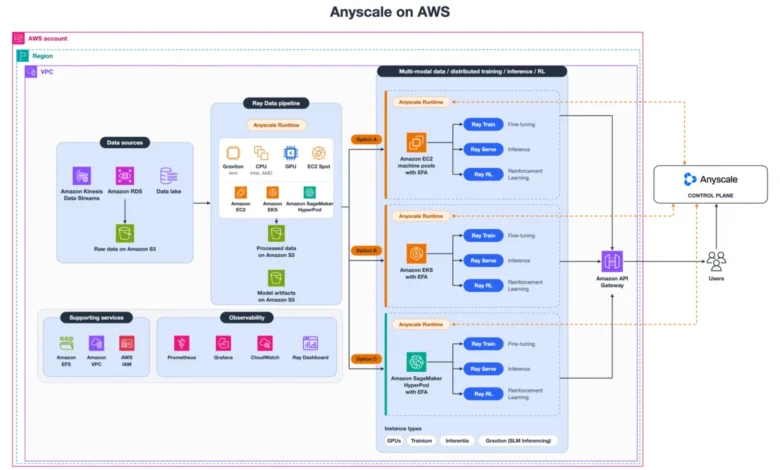
The Anyscale architecture cleanly separates the control plane from the data plane. A hosted control plane sends operational instructions to an operator deployed inside the customer’s AWS environment, while the data plane—comprising Amazon EC2 instances, storage volumes, and networking fabrics—remains entirely within the customer’s account. This ensures that sensitive enterprise data remains secure and private, with Anyscale managing cluster lifecycles without ever gaining direct access to underlying datasets.
The combined AWS and Anyscale ecosystem delivers three fundamental pillars for production AI: cost-efficient infrastructure spanning the breadth of the Amazon EC2 portfolio, a reliable Ray-on-Anyscale software stack that scales predictably, and an integrated development framework that minimizes operational friction across teams. This setup allows engineering organizations to map specific pipeline stages to the most cost-effective and performant instance types available.
Flexible Deployment Architectures to Suit Operational Demands
Organizations deploying Anyscale on AWS can choose from three distinct architectural pathways, depending on their specific operational requirements, existing infrastructure standards, and resilience needs.
Option A: Amazon EC2 with Elastic Fabric Adapter (EFA)
Deploying directly on Amazon EC2 provides maximum compute control and flexibility without software constraints. This pathway is recommended for teams transitioning existing EC2-based workloads into AI/ML operations without overhauling their foundational tooling. Ray Data handles preprocessing on cost-effective CPU and Spot Instances, while Ray Train utilizes GPU and AWS Trainium instances connected via Elastic Fabric Adapter (EFA) for high-performance, low-latency inter-node communication. Anyscale automatically manages the provisioning and termination of instances based on real-time workload demand, utilizing Amazon Simple Storage Service (Amazon S3) for datasets and checkpoints, and Amazon FSx for Lustre to provide parallel file system throughput for training jobs requiring repeated access to large files.
Option B: Amazon Elastic Kubernetes Service (Amazon EKS)
For organizations that have standardized on Kubernetes for container orchestration, Amazon EKS enables the execution of the full Ray pipeline within a containerized environment. The Anyscale Kubernetes operator deploys Ray nodes as standard pods, allowing Ray libraries to function identically to the Amazon EC2 deployment model at the application layer. Node autoscaling is managed via Karpenter, which dynamically provisions GPU nodes for training, Graviton nodes for preprocessing and inference, and Spot Instances for batch workloads. Furthermore, Ray Serve benefits from native Kubernetes integrations, facilitating zero-downtime rolling upgrades for production inference endpoints.
Option C: Amazon SageMaker HyperPod
Designed specifically for resilience-critical, long-running training jobs where hardware failures on massive GPU or Trainium clusters can jeopardize weeks of progress, Amazon SageMaker HyperPod provides automated cluster resilience. HyperPod continuously monitors the health of the underlying infrastructure, automatically evicting and replacing unhealthy nodes and seamlessly resuming training from the latest checkpoint without manual intervention. Supporting both Slurm-orchestrated and Amazon EKS-based clusters, HyperPod covers the entire model development lifecycle—including large-scale foundation model training and inference deployment—while integrating with Amazon SageMaker Studio for centralized experiment tracking and model governance.
Optimizing Costs through Heterogeneous Compute Strategies
A primary advantage of the Anyscale on AWS architecture is the ability to granularly match hardware accelerators and CPU architectures to the precise computational demands of each pipeline stage. This heterogeneous approach prevents over-provisioning and significantly reduces total cost of ownership.
For CPU-bound tasks such as data preprocessing, tokenization, feature extraction, and embedding generation, AWS Graviton-based instances deliver exceptional price-performance metrics. Benchmarks indicate that PyTorch inference workloads executed on Graviton3 C7g instances achieve up to 50 percent cost savings compared to traditional x86-based equivalents. Successor Graviton4 processors offer further enhancements, providing a 30 percent improvement in compute performance per core and a 75 percent increase in memory bandwidth over Graviton3, making them highly efficient for running small language models ranging from one to seven billion parameters.
For high-throughput training and fine-tuning workloads, NVIDIA GPU instances and custom AWS Trainium accelerators provide the necessary computational density. Notably, second-generation AWS Trainium (Trainium2) chips deliver a 30 to 40 percent improvement in price-performance for large-scale model training compared to comparable GPU instances. For low-latency production inference, AWS Inferentia2 chips offer up to four times higher throughput and ten times lower latency than their predecessors. Because Ray automatically detects underlying hardware accelerator types, Anyscale intelligently routes workload stages to the appropriate silicon without requiring manual code modifications.
Advanced Cost Management: Spot Instances and Capacity Blocks
To maximize cost efficiency at scale, Anyscale supports sophisticated purchasing and provisioning strategies. By maintaining cluster head nodes on On-Demand instances while running worker nodes on Amazon EC2 Spot Instances with automatic fallback mechanisms, organizations can achieve up to a 60 percent reduction in distributed training costs and up to 90 percent savings on data preprocessing. Ray’s native fault tolerance ensures that if a Spot Instance is reclaimed, Ray Data automatically retries failed tasks on replacement nodes, Ray Train resumes execution from recent checkpoints, and Ray Serve proactively migrates inference replicas upon receiving preemption notices.
For predictable, scheduled training runs that require guaranteed hardware availability, organizations can leverage Amazon EC2 Capacity Blocks. These blocks allow engineering teams to reserve between one and 64 accelerated instances for up to six months, with reservations bookable up to eight weeks in advance. Housed within Amazon EC2 UltraClusters equipped with petabit-scale networking, these blocks support massive training clusters comprising up to 512 GPUs or 1,024 Trainium chips. Anyscale machine pools can reference these capacity reservations directly, establishing a prioritized fallback hierarchy: utilizing Capacity Blocks first, transitioning to Spot Instances for elastic scale, and falling back to On-Demand instances only when necessary.
A Phased Implementation Methodology
Adopting this distributed architecture follows a structured, four-phase lifecycle designed to minimize operational friction and eliminate the need for code rewrites as workloads expand:
- Phase 1: Local Validation (1 to 2 Days) – Developers begin by running Ray locally on a single Amazon EC2 instance or a workstation, establishing data processing pipelines and training loops to validate model logic and baseline accuracy before introducing distributed infrastructure.
- Phase 2: Data Scaling (1 to 2 Weeks) – Teams deploy Ray Data alongside AWS Graviton and Amazon EC2 Spot Instances to process full enterprise datasets at scale, leveraging low-cost compute to accelerate data preparation while minimizing expenditure.
- Phase 3: Training Scaling (2 to 4 Weeks) – Organizations select their optimal deployment pathway—Amazon EC2 for flexibility, Amazon EKS for Kubernetes environments, or Amazon SageMaker HyperPod for resilient, long-running training—scaling computational jobs across multi-GPU or Trainium clusters connected via EFA.
- Phase 4: Inference Deployment (1 to 2 Weeks) – Production endpoints are established using Ray Serve, configured with dynamic autoscaling policies to match real-world user traffic patterns and latency requirements.
Conclusion
The integration of Ray and Anyscale on AWS establishes a robust, production-ready framework that bridges the gap between experimental AI development and enterprise-grade deployment. By accommodating diverse operational requirements through flexible deployment architectures—ranging from raw Amazon EC2 instances to containerized Amazon EKS clusters and resilient Amazon SageMaker HyperPod environments—organizations can seamlessly orchestrate multimodal AI pipelines. Through intelligent, stage-specific hardware allocation spanning AWS Graviton processors, NVIDIA GPUs, AWS Trainium, and AWS Inferentia, combined with advanced cost-optimization mechanisms like Spot Instances and Capacity Blocks, engineering teams can achieve unprecedented scalability, operational efficiency, and financial control across the entire artificial intelligence lifecycle.