The digital landscape is undergoing a fundamental architectural shift, rendering traditional website visitor management models obsolete. For decades, Search Engine Optimization (SEO) professionals operated under a binary paradigm: allow crawlers to access a website to index its contents or block them via standard exclusion protocols. However, the proliferation of generative artificial intelligence, large language models (LLMs), and autonomous software agents has fragmented web traffic into a complex ecosystem of diverse automated actors. Today, relying on rudimentary block lists and basic robots.txt files is no longer sufficient to protect intellectual property, manage server loads, or maintain visibility in modern search engines. Industry experts warn that actual enforcement often occurs behind the scenes through Content Delivery Networks (CDNs) and web security tools—frequently without the knowledge of the SEO teams responsible for digital visibility.
The Evolution of Web Crawlers and Automated Traffic
To understand the current crisis in bot management, one must examine how web traffic has transformed over the past two decades. In the early days of search engines, web crawlers served a singular, predictable purpose: discovering, parsing, and indexing web pages to populate a keyword-based search index. Webmasters managed these interactions primarily through the robots.txt file, a voluntary standard established in 1994 that instructs automated agents which parts of a site they are permitted to visit.
As the internet matured, secondary crawlers emerged for tasks such as uptime monitoring, security scanning, and content aggregation. Yet, the foundational rules of engagement remained largely unchanged. The advent of generative artificial intelligence and conversational search engines completely disrupted this equilibrium. Modern websites are now visited simultaneously by traditional search crawlers, deep learning AI training crawlers, real-time retrieval-augmented generation (RAG) bots, user-initiated fetches, and autonomous personal shopping or browsing agents.

These distinct categories of automated traffic serve drastically different commercial and technical functions. While a training crawler copies massive volumes of data to build foundational weights for a proprietary neural network—often without sending referral traffic back to the source—a retrieval bot fetches live content to answer a user’s specific query in an AI-generated summary. Lumping all of these diverse automated visitors under the broad umbrella of "AI bots" creates severe blind spots for digital marketers and technical architects alike.
The Disconnect Between Policy and Enforcement
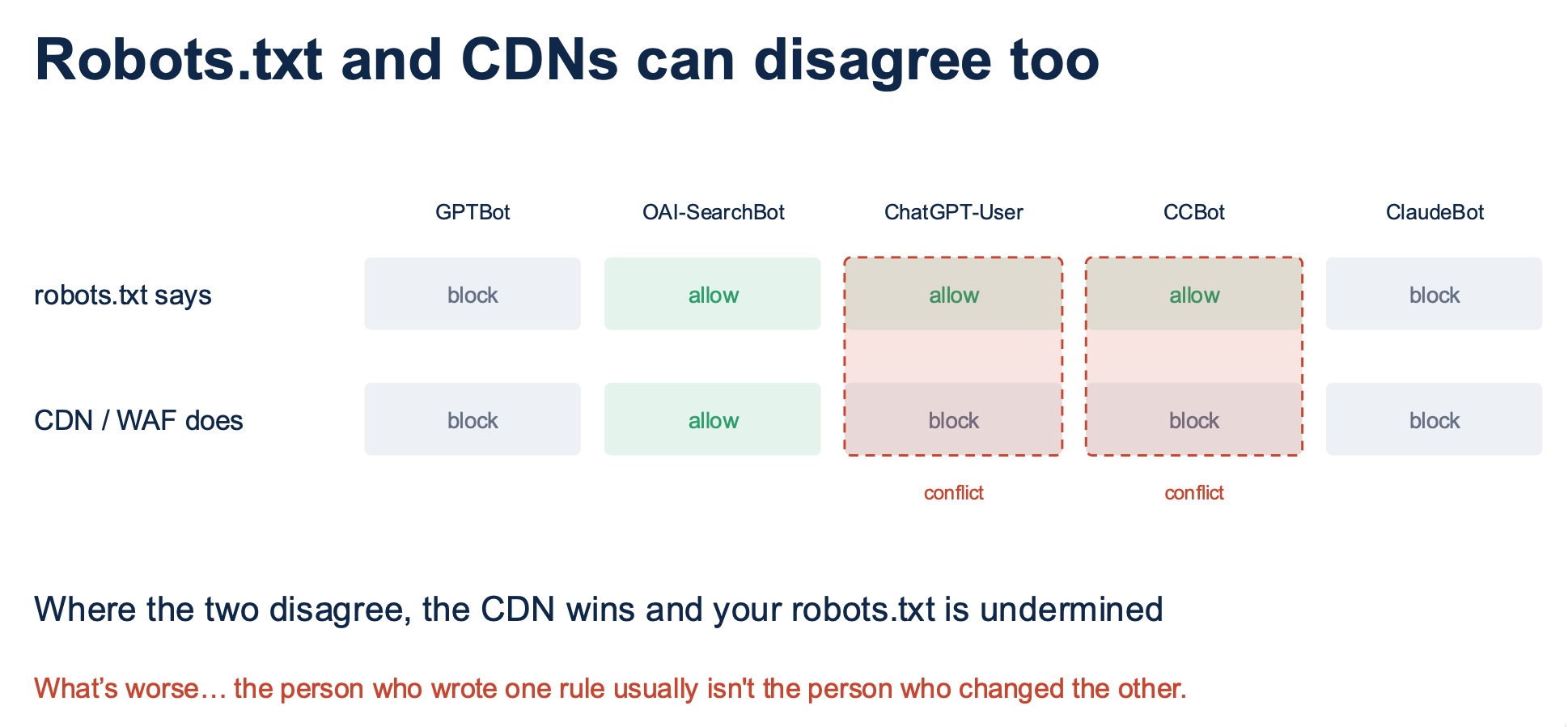
A central vulnerability in modern bot management lies in the operational disconnect between SEO governance and technical security enforcement. While SEO practitioners typically define crawling policies via robots.txt or meta-tags, actual enforcement rarely takes place at the application layer. Instead, websites rely heavily on CDNs, Web Application Firewalls (WAFs), and specialized bot mitigation platforms to block malicious traffic, mitigate distributed denial-of-service (DDoS) attacks, and prevent web scraping.
Security engineers configure these security layers to protect server resources and guard against intellectual property theft. However, security protocols are frequently implemented without consulting marketing or SEO teams. Consequently, a security rule designed to block aggressive data scrapers might inadvertently intercept legitimate AI search bots, retrieval engines, or user-facing assistive agents. Conversely, a website might explicitly invite certain AI partners via its robots.txt file, only to have a heavily configured corporate firewall block those exact user-agents at the network perimeter.
Because many organizations operate in silos, marketing teams remain entirely unaware that their preferred traffic sources are being rejected at the CDN level. This misalignment can lead to sudden drops in visibility, inaccurate analytics data, and a complete failure to capture traffic from emerging AI-driven search modalities.
The Rise of Autonomous Agents and Discovery Implications
The challenge of bot management has intensified with the introduction of autonomous AI agents capable of navigating websites much like human users. Unlike simple scripts that parse raw HTML, modern agents can execute JavaScript, interact with user interfaces, fill out forms, and trigger analytics tracking events.
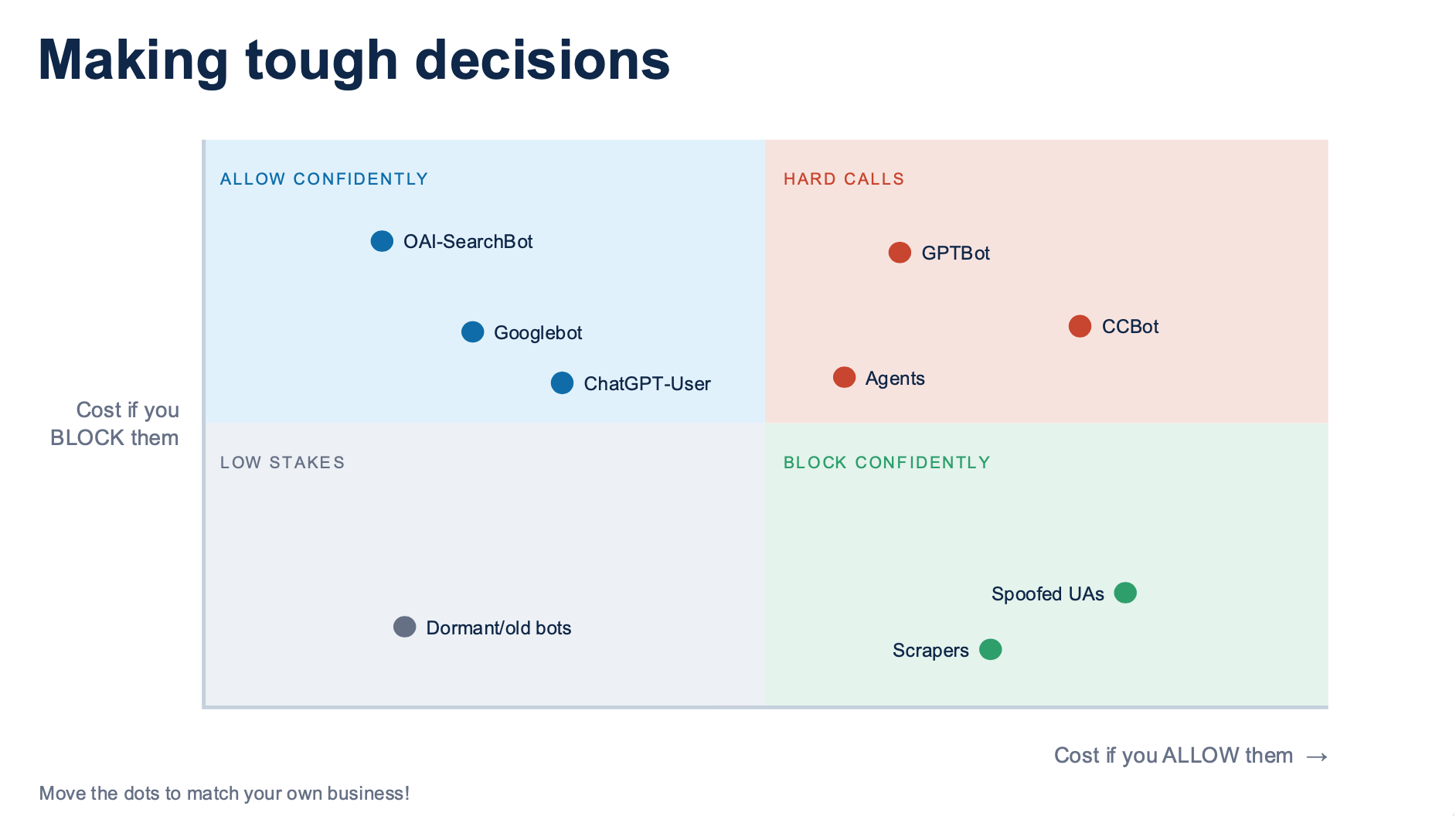
This behavioral mimicry makes it exceptionally difficult for traditional bot detection tools to separate sophisticated AI agents from genuine human visitors. As personal assistants and enterprise-grade procurement agents become commonplace, businesses face high-stakes strategic dilemmas. Blocking an autonomous agent that is performing a product comparison, price check, or itinerary assembly on behalf of a consumer can carry severe commercial penalties. If an organization’s security layer mistakenly rejects these functional agents, the brand risks disappearing entirely from the conversational answer engines and recommendation workflows that increasingly drive modern consumer decisions.
Transitioning From Block Lists to Strategic Bot Policies
In response to these complex operational realities, technical search optimization and cybersecurity authorities are advocating for a comprehensive shift in methodology. Organizations must transition away from reactionary block lists and embrace deliberate, cross-functional bot management policies.
Developing an effective policy requires answering fundamental questions regarding every category of automated traffic: Who is accessing the content, what is their underlying purpose, and what are the quantifiable business consequences of granting or denying them access? Addressing these questions successfully demands unprecedented collaboration across multiple corporate departments. SEO specialists, systems engineers, cybersecurity teams, legal counsel, and commercial stakeholders must align their objectives to establish cohesive rules.
Furthermore, these policies cannot remain static. As AI technologies evolve and new search modalities emerge, organizations must continuously review, monitor, and adjust their bot management strategies. Implementing centralized logging, analyzing server-side request patterns, and auditing CDN filtering rules are becoming essential competencies for modern digital enterprises. Ultimately, navigating the age of generative AI requires businesses to view automated traffic not merely as a security threat to be repelled, but as a complex ecosystem that requires sophisticated stewardship and strategic integration.