The Essential AI SEO Tools for Small Businesses Navigating the Evolving Digital Landscape

The rapid integration of Artificial Intelligence (AI) into marketing strategies presents both unprecedented opportunities and significant challenges for small businesses. As the digital landscape continues its swift evolution, keeping pace with marketing trends and maintaining a competitive edge has become paramount. For many small enterprises, the primary hurdle lies in discerning which AI-powered Search Engine Optimization (SEO) tools offer genuine value and are truly necessary, particularly amidst a proliferation of solutions promising to address every conceivable business need. The encouraging reality, however, is that AI capabilities are increasingly embedded within a wide array of readily available tools.
Industry data underscores the imperative for small businesses to invest in AI SEO tools, whether through the allocation of financial resources or dedicated time. The adoption of AI in marketing is demonstrably on the rise. According to HubSpot’s recent "AI Trends for Marketers" report, two-thirds of global marketers are currently leveraging AI in their professional roles, a figure that escalates to 74% among their American counterparts. This widespread adoption signals a shift in industry standards and competitive benchmarks.
This comprehensive guide aims to cut through the market noise, identifying the essential AI SEO tools that lean teams are effectively employing to maximize output with limited resources. It encompasses foundational, often free, tools such as Google Search Console (GSC) and Google Analytics (GA4), alongside dedicated, paid platforms like HubSpot, offering a balanced perspective on essential digital marketing infrastructure.
Identifying AI SEO Tools That Deliver Sustained Value
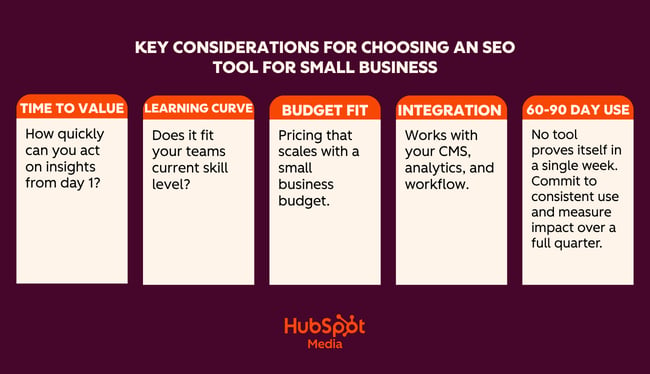
AI SEO tools empower small businesses across a spectrum of critical functions, including keyword research, content creation, page optimization, technical issue resolution, and visibility tracking. The challenge for business owners and marketing managers often lies in selecting tools that align with their specific needs and operational capacities. When evaluating these solutions, key considerations for small business buyers generally revolve around the speed of value realization, the ease of learning and implementation, cost-effectiveness, and the seamlessness of integration with existing systems.
Prioritizing Time-to-Value
The "time-to-value" metric quantifies how rapidly a tool begins to deliver tangible benefits after its initial setup. This factor holds immense importance for lean teams, particularly those without a dedicated SEO specialist. A tool that demands weeks of intricate configuration or necessitates the engagement of external consultants for implementation might prove more burdensome than beneficial. The urgency for a tool to become operational and its impact on existing workflows and overarching business priorities should guide this decision. In some instances, the investment of time and capital is justified by the tool’s long-term strategic advantage. Conversely, a solution that requires minimal setup and yields actionable insights within 24 hours might be a more pragmatic choice.
Consider a common scenario involving a new client. Certain tools are immediately indispensable. Google Search Console (GSC), for instance, is a free yet invaluable resource. Its immediate recommendation for all clients, or its direct setup by the consultant, ensures that once the tracking script is integrated into a website, the tool operates autonomously, providing critical data on website performance and SEO health within a day. GSC’s comprehensive utility makes it an essential component for virtually all websites.
In contrast, platforms like HubSpot, while offering a broader suite of capabilities, typically require a more substantial initial setup period. Furthermore, unlocking certain advanced features may necessitate a financial investment, as some functionalities are exclusive to higher subscription tiers.
The distinction lies in the specialization and scope of these tools. GSC excels in performing a focused set of SEO functions, such as:
- Performance monitoring: Identifying search queries that drive traffic and impressions.
- Indexation status: Ensuring Google can discover and understand website content.
- Technical error detection: Highlighting issues that may hinder search visibility.
- Mobile usability assessment: Confirming a positive user experience on mobile devices.
HubSpot, on the other hand, offers a more expansive and integrated approach, enhancing a wide range of marketing and business operations. Its capabilities extend to:
- Integrated CRM: Seamlessly connecting marketing efforts with sales and customer data.
- Content management: Facilitating the creation and optimization of website content.
- Email marketing automation: Streamlining communication and lead nurturing.
- Social media management: Consolidating social media presence and engagement.
- Landing page creation: Building high-converting pages for specific campaigns.
- SEO recommendations: Providing actionable insights for on-page and technical optimization.
- Reporting and analytics: Offering a unified view of marketing performance across channels.
While some tools may demand a greater initial investment in setup time and financial outlay, their strategic importance can be considerable. If a tool demonstrably saves human hours, positively influences marketing conversion rates, resolves cross-functional business challenges, and directly contributes to growth, then the accompanying time and financial expenditure is often justifiable. Conversely, a tool that requires extensive setup but remains underutilized by the marketing team offers little intrinsic value.
Navigating the Learning Curve
The efficacy of any tool is directly proportional to the team’s ability to utilize it consistently and effectively. Enterprise-grade platforms, often designed for large SEO agencies, can overwhelm small business users with an abundance of features they may not need. When assessing the learning curve, critical questions include:
- User-friendliness: Is the interface intuitive and easy to navigate?
- Resource availability: Are there sufficient tutorials, documentation, and support channels?
- Actionability of insights: Are recommendations presented in a clear, understandable manner?
The most effective AI SEO tools for small teams typically feature guided workflows, recommendations presented in plain language, and clearly defined next steps, rather than raw data that necessitates expert interpretation.
Cost and Budget Alignment
The most robust AI SEO solutions for small businesses strike a balance between comprehensive functionality and affordability. Businesses require tools that are not only utilized by their teams but also address specific, critical problems at a reasonable price point. Furthermore, the scalability of the solution is a crucial long-term consideration. Businesses should evaluate the potential cost implications not just for the current year but also for the next five years. If projected future costs for upgraded packages are beyond the budget, investing in the tool initially could lead to significant challenges and time expenditure in migrating to a new solution later.
A strategic approach involves identifying the three most time-consuming SEO tasks each week that are not adequately addressed by existing tools. Evaluating potential platforms specifically against these bottlenecks can yield more impactful results than investing in tools that offer broad but shallow solutions.
Seamless Integration with Existing Systems
The adoption rate of new tools significantly increases when they can integrate with a business’s current technological infrastructure. According to MuleSoft’s "Connectivity Benchmark Report," 86% of IT leaders acknowledge that AI agents can introduce complexity rather than value if not properly integrated.

For example, if SEO data can be seamlessly connected to an already-implemented Content Management System (CMS), the adoption of the new SEO tool becomes more natural, as it complements existing workflows rather than creating a new, isolated process. Integrations that enhance and enrich workflows and data, rather than complicating them, tend to be more favorably received by teams. When comparing platforms, it is essential to assess their compatibility with the tools a team already utilizes.
The 60-to-90 Day Usage Benchmark
The initial enthusiasm generated by product demonstrations and trial periods often does not reflect long-term utility. A more reliable indicator of a tool’s true value is its consistent usage at the 60- to 90-day mark, coupled with the team’s ability to articulate specific positive outcomes attributed to the tool. When conducting comparisons of AI SEO tools, negotiating extended testing periods or opting for monthly payment plans for the initial few months before committing to annual billing can provide a more realistic assessment of the tool’s fit.
Understanding AI’s Role in Small Business SEO
It is crucial to recognize that SEO success for small businesses cannot rely solely on tools. A balanced approach requires understanding where AI excels and where human oversight remains indispensable.
Content Generation and Scaling: A Cautious Approach
AI can rapidly generate various forms of content, including blog posts, FAQs, service page copy, and meta descriptions, offering a significant time-saving advantage for businesses struggling with consistent content publication. By providing AI with specific prompts regarding target keywords, audience, and desired tone, a solid initial draft can be produced, alleviating the challenge of facing a blank page.
The quality of AI-generated drafts varies depending on the subject matter. Objective factual content or simple explanatory pieces, such as defining "anchor text" or "bounce rate," are well within AI’s generative capabilities. However, content requiring thought leadership, novel perspectives, or expert opinions is best developed or heavily refined by human authors. For instance, questions like "Is SEO obsolete in the age of AI search?" or "How should small businesses adapt to Google’s latest algorithm update?" demand a level of nuance and original insight that AI currently cannot fully replicate.
Human Review Remains Critical: AI lacks an intrinsic understanding of a business’s unique identity, target audiences, or industry intricacies. Consequently, it may occasionally produce factual inaccuracies, overlook subtle nuances, or generate generic content. Editors must review all AI-generated content to ensure personalization, factual accuracy, and adherence to brand voice before publication. Search engines like Google prioritize content that demonstrates genuine expertise and first-hand experience, qualities that AI cannot authentically simulate.
Identifying Keyword and Topic Ideas
AI tools are highly effective in generating initial ideas. They can suggest keyword clusters related to a business’s services, generate questions potential customers might ask, or identify related topics that might otherwise be overlooked. This capability can significantly reduce the time spent on manual research, particularly for small teams lacking dedicated SEO resources.
Human Validation is Essential: AI-generated keyword suggestions may sometimes lack robust search volume data. Marketers should still validate promising ideas using tools like Google Keyword Planner to confirm demand before investing in content creation. A human "sense check" is also valuable. While AI can generate numerous keyword ideas, its proficiency in content clustering and detailed SERP analysis is generally less pronounced.
Optimizing Existing Content
AI tools can analyze existing web pages and suggest improvements to title tags, meta descriptions, heading structures, and overall readability. For small businesses managing numerous underperforming pages, this audit-and-optimize workflow can yield substantial improvements without requiring a significant budget.
Human Judgment is Still Necessary: For critical pages, a layer of human review or strategic judgment remains important. While AI is generally adept at this task, for pages that are central to a business’s SEO strategy, human oversight can ensure that optimizations align with broader marketing objectives and brand messaging.
Essential AI SEO Tools for Small Businesses
The tools highlighted in this guide have been selected for their ability to address real challenges faced by lean teams and for the practical utility of their integrated AI capabilities.
For businesses embarking on their SEO journey, the HubSpot SEO Starter Pack is a valuable free resource to explore before diving into specific tools.
Tools for SEO and Technical Audits
HubSpot SEO Recommendations
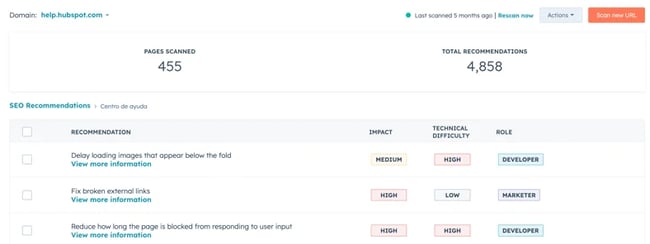
HubSpot’s integrated SEO recommendation tools, embedded within Marketing Hub, represent one of the most cohesive approaches to SEO for small businesses. Unlike standalone SEO platforms that present a list of issues and leave users to decipher solutions, HubSpot directly links SEO recommendations to its content editor, CRM, and reporting dashboard. This unification ensures that every optimization, content piece, and ranking improvement is connected to measurable business outcomes.
A significant advantage of HubSpot’s approach is the clear presentation of findings. While tools like Screaming Frog are powerful, they often require an SEO expert to interpret the data and assign solutions. HubSpot’s SEO Recommendations prioritize on-page updates for non-experts, making it particularly well-suited for small business teams without dedicated technical SEO resources. Instead of presenting raw data, HubSpot clearly explains the rationale behind each flagged issue, its potential impact on search performance, and the specific actions required for resolution. This transparency empowers users to understand issues, implement fixes, and prioritize efforts based on their potential impact.
The SEO Recommendations tool automatically scans a website’s live pages and flags issues, ranked by priority. These recommendations are accessible site-wide within Marketing Hub or on a page-by-page basis through the Optimize panel in HubSpot’s content editor. This integration allows writers and marketers to identify and rectify SEO issues without leaving their primary working environment.
On the technical front, HubSpot’s SEO tools detect common ranking inhibitors for small business websites, including broken links, missing or duplicate meta descriptions, absent alt text for images, HTTPS issues, slow page load times, and improper heading structures. Each identified issue is accompanied by a clear explanation and a specific, actionable step, moving beyond generic advice like "fix your meta descriptions" to pinpointing precisely which pages require attention and outlining best practices for optimization.
SE Ranking
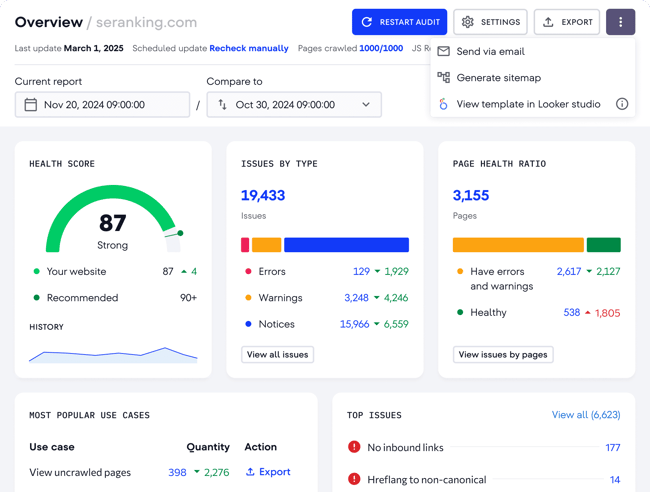
SE Ranking is a comprehensive AI-powered platform that offers robust features for keyword tracking, website audits, competitive analysis, and AI-specific insights. Beyond technical SEO, SE Ranking encompasses keyword research, backlink analysis, competitor monitoring, and content gap identification. It stands out as a well-rounded platform, incorporating top AI search optimization tools beneficial for content creators managing multiple clients or projects.
Key Features:
- Website Audit: Identifies technical SEO issues, on-page optimization opportunities, and potential ranking blockers.
- Keyword Research: Provides insights into search volume, competition, and keyword difficulty.
- Rank Tracking: Monitors keyword rankings across various search engines and locations.
- Backlink Analysis: Assesses the backlink profile of a website and its competitors.
- Competitor Analysis: Offers detailed insights into competitors’ strategies and performance.
- Content Marketing Tools: Includes a content editor and AI-powered suggestions for content optimization.
Pricing: Plans begin with the Wallet tier, with Standalone and Enterprise options available for larger entities or agencies. A 14-day free trial is offered without requiring credit card information.
Strengths: SE Ranking effectively bridges the gap between advanced SEO platforms and the budgetary constraints of small businesses. Its interface is clean, and its recommendations are actionable, providing clear guidance on how to address identified issues. This clarity is particularly valuable for teams lacking in-house SEO expertise.
While Semrush and Ahrefs are undeniably powerful and arguably leading platforms in the SEO space, SE Ranking offers a compelling balance of features and affordability, making it a strong contender for small businesses.
Best for: Small businesses and lean SEO teams seeking a full-featured SEO platform without the premium price tag associated with enterprise-level tools.
Tools for Automated Content Optimization
The consistent creation of high-quality content represents a significant bottleneck for many small business teams. The tools in this category leverage AI to accelerate the drafting, optimization, and structuring of content.
HubSpot Content Hub
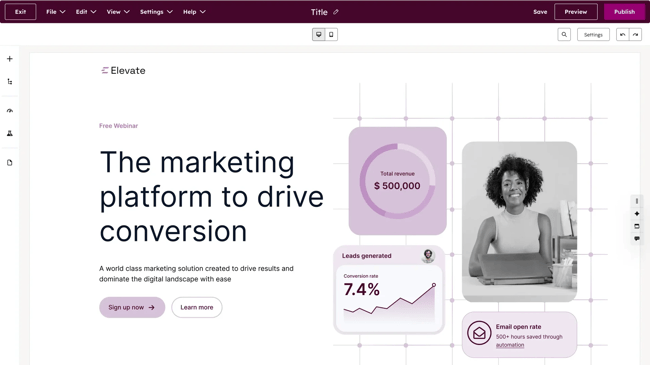
HubSpot’s Content Hub serves as a central hub where content strategy, creation, optimization, and performance measurement converge. For lean teams operating with limited personnel, this consolidation is a critical advantage.
One of Content Hub’s most valuable features for small businesses is its topic cluster tool. This feature facilitates a structured approach to content creation, moving away from isolated blog posts towards a framework built around a central pillar page (a comprehensive, authoritative piece on a broad subject) supported by a network of cluster content that delves into related subtopics. This interconnected structure signals topical authority to search engines, a key factor in improving search rankings. This approach is particularly effective for small business websites aiming to compound organic traffic over time, as search engines reward depth and expertise on a given subject.
Breeze: HubSpot’s AI Layer for Content: Within Content Hub, Breeze functions as the underlying engine powering the platform’s content creation and optimization capabilities. It is not a singular feature but rather a suite of AI tools integrated throughout the content workflow, from topic ideation to post-publication promotion.
Breeze acts as a co-pilot for content writers, enabling content to be co-created with AI while allowing human writers to inject their expertise and make necessary edits. The AI blog writer assists teams in drafting and refining on-brand content based on a given topic or keyword, generating a structured draft that writers can then refine, expand, or rewrite within the editor. The Breeze Content Agent can suggest blog topics and generate search-optimized drafts that align with a defined brand voice, amplifying the capabilities of subject-matter experts rather than replacing them.
The practice of co-creating content with AI, as facilitated by Breeze, upholds a higher standard of quality compared to relying solely on AI-generated outputs. The continuous layer of human review ensures accuracy, preserves brand voice, and maintains audience trust. Beyond initial drafts, Breeze handles essential optimization tasks that often fall by the wayside in lean teams, such as generating meta titles and descriptions, suggesting internal links, reformatting content for improved readability, and remixing existing content into new formats. The Content Remix feature allows for the repurposing of a single asset across various formats and channels, transforming a blog post into social media captions, email introductions, or landing page sections efficiently.
HubSpot’s Brand Voice capability enables Breeze to generate content within specified tone and language parameters, preventing AI-generated drafts from sounding generic. This feature is particularly vital for small businesses where brand voice is a significant differentiator, ensuring that speed does not compromise consistency.
Performance Tracking Tied to Revenue: As Content Hub is built upon HubSpot’s CRM, every piece of content is tracked not only for traffic and rankings but also for its contribution to lead generation, pipeline development, and overall revenue. This allows teams to ascertain which blog posts generate contacts, which pillar pages drive the most organic sessions, and how content performance trends over time, all within a single platform. This attribution capability is invaluable for small businesses seeking to justify content investments to stakeholders or clients, shifting the narrative from mere "blog traffic increases" to demonstrable contributions to leads and deals.
Pricing: Content Hub is available as a standalone product with a free plan. Paid plans commence at $20 per user per month. Content Hub can also be included as part of broader HubSpot subscription packages. The Breeze Content Agent, encompassing AI blog drafting and Content Remix, is accessible in Content Hub Pro and Enterprise editions. For small businesses already utilizing Marketing Hub, it is prudent to verify if these features are already included in their existing plan before making separate purchases.
Yoast SEO
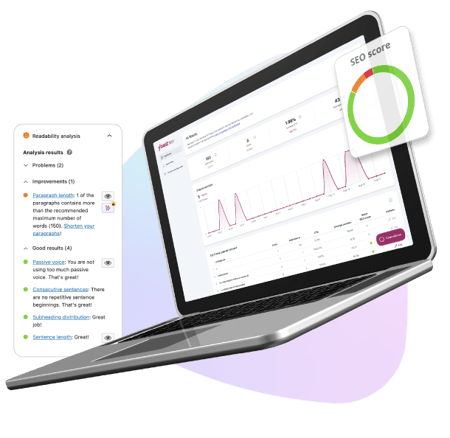
For small businesses operating on WordPress, Yoast SEO represents one of the most accessible methods for integrating AI-assisted SEO recommendations directly into their content creation workflow. Without the need to log into a separate platform or conduct manual audits, Yoast’s recommendations appear within the WordPress editor as content is being written or edited.
Key Features:
- On-Page SEO Analysis: Provides real-time feedback on keyword usage, readability, and other on-page factors.
- Focus Keyphrase Optimization: Guides users in optimizing content for a primary search term.
- Readability Analysis: Assesses the clarity and ease of understanding of written content.
- XML Sitemaps: Generates and manages XML sitemaps to aid search engine crawling.
- Schema Markup Integration: Helps in implementing structured data for richer search results.
Pricing: The free version offers basic on-page SEO analysis, focus keyphrase optimization, readability checks, and XML sitemaps, serving as a solid starting point for budget-conscious small businesses. Premium and AI+ packages are available, starting at $9.90 per month.
Strengths: Yoast SEO has long been a dominant force in the WordPress ecosystem, utilized by millions of websites. Its free version offers substantial value, and for those requiring more advanced features, the Premium version is affordably priced. It is important to note that Yoast primarily functions as an optimization assistant, not a comprehensive SEO platform. It excels at refining and improving existing content but is not designed for in-depth keyword research, competitor analysis, backlink monitoring, or rank tracking. For businesses requiring these functionalities, Yoast complements tools like SE Ranking effectively.
It is worth reiterating that if a business utilizes HubSpot’s Content Hub, Yoast SEO may become redundant, as Content Hub offers comparable on-page optimization features. This underscores the importance of carefully evaluating existing toolsets and needs before making new investments.
Best for: Small businesses running WordPress websites seeking real-time on-page SEO guidance integrated directly into their content creation process.
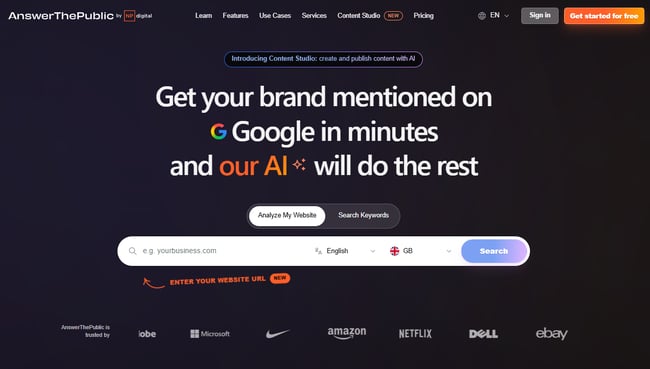
AnswerThePublic
AnswerThePublic is a content ideation tool that leverages Google’s autocomplete data. Users input a keyword or topic, and the tool generates a visual representation of questions, prepositions, comparisons, and related searches that people are actively using on search engines. This is an invaluable resource for lean teams seeking to identify relevant content topics and remove guesswork from their content planning.
Key Features:
- Visualizations: Presents search queries in engaging visual formats (e.g., question clouds, preposition maps).
- Topic Discovery: Uncovers a wide range of related questions and search phrases.
- Trend Identification: Highlights emerging search trends and popular user inquiries.
- Content Idea Generation: Provides a rich source of inspiration for blog posts, FAQs, and other content formats.
Pricing: Offers three free searches per day, with paid packages starting at $13.33 per month for increased search volume and export capabilities.
Strengths: For its price point, AnswerThePublic offers one of the most efficient methods for identifying topics that real users are actively searching for. Its visual format is intuitive and aids in spotting content ideas that naturally lend themselves to a topic cluster structure, aligning well with content strategy frameworks like HubSpot’s Content Hub. For small businesses on a tight budget, it is an excellent tool. However, for businesses already invested in HubSpot, there may be some overlap in functionality.
Best for: Small business marketers and content teams aiming to quickly identify the questions, topics, and search phrases their target audience is actively using.
Tools for Tracking Rankings and AI Visibility
Monitoring SEO performance traditionally involves tracking keyword rankings, organic traffic, and on-page engagement. In the current digital environment, this picture is incomplete without also assessing a brand’s visibility in AI-generated answers. SEO and Answer Engine Optimization (AEO) are complementary disciplines, and effective small business strategies must optimize for both.
HubSpot AEO (Answer Engine Optimization)
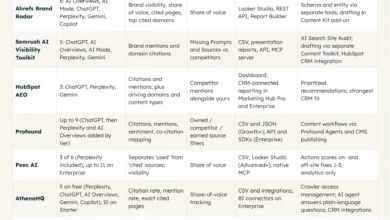
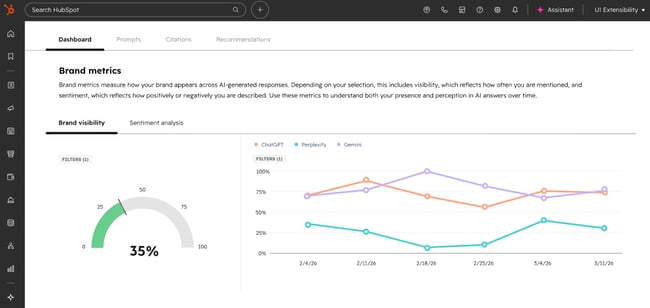
HubSpot AEO is specifically designed to provide marketers with insights into how their brand appears within AI answer engines, offering clear, actionable steps for improvement. Its key differentiator is its seamless integration with the HubSpot CRM. The tool automatically suggests prompts based on industry, competitors, and customer segments, leveraging existing CRM data. Standalone AEO tools often lack this contextual understanding.
HubSpot AEO is a powerful LLM SEO analysis software. Teams can define prompts based on the questions their target buyers are likely to ask AI engines, and HubSpot will run these prompts daily across platforms like ChatGPT, Perplexity, and Gemini. The platform then tracks brand mentions, descriptions, competitive positioning, and identifies gaps in AI-generated answers. A brand visibility scorecard monitors performance across AI-driven search experiences, signaling opportunities for enhancement.
Because HubSpot AEO is integrated within Marketing Hub, recommendations directly connect to existing content and social media tools. This allows teams to transition swiftly from identifying a lack of presence for a specific prompt to actively publishing content that addresses it.
Key Features:
- AI Engine Monitoring: Tracks brand visibility across ChatGPT, Perplexity, and Gemini.
- Prompt Management: Allows users to define and manage a list of relevant prompts.
- Competitive Analysis: Compares brand mentions and positioning against competitors in AI answers.
- Brand Visibility Scorecard: Provides a quantitative measure of performance across AI search experiences.
- CRM Integration: Connects AEO insights directly to customer data for targeted prompt generation.
Pricing: A free 28-day trial offers access to 25 prompts across all three engines, with no credit card required. Post-trial, the cost is $50/month (or $45/month billed annually) for tracking 25 prompts daily across three engines, up to 2,500 answers per month.
HubSpot AEO Grader
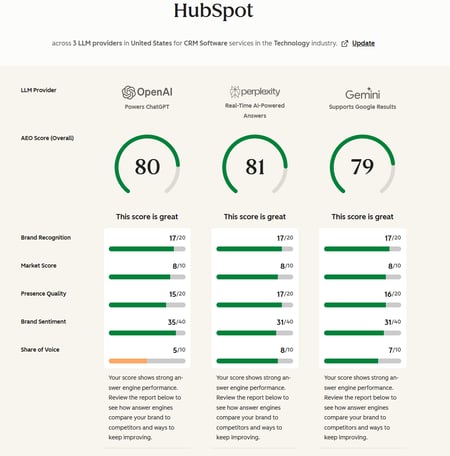
The HubSpot AEO Grader offers a free, rapid assessment of AI visibility across ChatGPT, Perplexity, and Gemini. It provides a composite score out of 100 by analyzing brand information across these platforms. Users input their company name, location, industry, and product or service description, and the grader delivers a comprehensive report.
The score is broken down across five dimensions:
- Brand Mention: How frequently the brand is mentioned in AI responses.
- Brand Description: The accuracy and completeness of the brand’s portrayal.
- Competitor Comparison: How the brand stacks up against competitors in AI answers.
- Key Information: The presence and accuracy of essential business details.
- Brand Authority: The perceived credibility and expertise of the brand within AI responses.
The AEO Grader is best understood as a diagnostic tool, offering an immediate snapshot of how AI engines perceive a brand. It serves as a valuable starting point for businesses considering ongoing monitoring through HubSpot AEO.
Strengths: The HubSpot AEO Grader is free, fast, and delivers genuinely useful insights. It is an excellent tool for establishing an initial benchmark of a website’s or its competitors’ AI performance, often used early in the auditing process. The structured, plain-language breakdown of performance across key dimensions makes it highly accessible for small businesses new to the concept of AI visibility. The gaps identified by the Grader can effectively inform subsequent content planning strategies.
Pricing: Free forever.
Google Analytics (GA4)
Google Analytics (GA4) forms the bedrock of any small business’s analytics infrastructure. It is a free, Google-developed tool that tracks the origin of website traffic, user behavior upon arrival, and the conversion of that activity into meaningful outcomes. No paid tool on this list can fully replace its foundational role, and the most effective solutions integrate with it.
Key AI Features within GA4:
- Predictive Metrics: Offers insights into user behavior, such as purchase probability and churn probability.
- Anomaly Detection: Identifies unusual patterns in data that may require attention.
- AI-Powered Insights: Provides automated analysis and actionable recommendations based on user data.
- Attribution Modeling: Helps understand the contribution of different channels to conversions.
Pricing: Free forever.
Strengths: GA4 is an indispensable free tool. Its utility in segmenting audiences by AI referral source and tracking their behavior offers an affordable way to assess the impact of AI-driven traffic without the need for additional specialized tools. Setting up reports to track conversions from AI traffic is a straightforward yet powerful method for understanding its ROI.
Google Search Console (GSC)
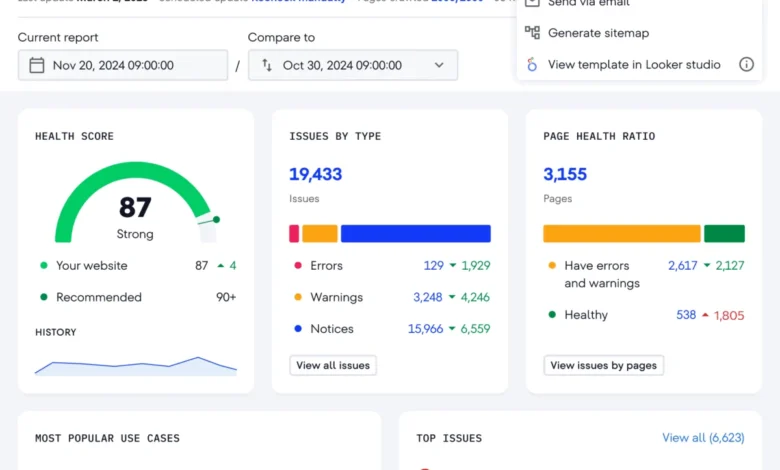
Google Search Console tracks website performance on Google before a visitor even arrives on the site. It is the primary tool for understanding SEO, whereas GA4 serves as a broader marketing analytics platform.
GSC is the sole source that precisely details the search queries generating impressions and clicks, the status of page indexing, any technical issues flagged by Google, and the performance of Core Web Vitals across the site. The data originates directly from Google, making it the most reliable source for understanding actual search performance, superseding any third-party rank tracker.
Key Features:
- Performance Reports: Details search queries, impressions, clicks, and average position.
- URL Inspection Tool: Allows users to check the indexability and rendering of individual URLs.
- Index Coverage Report: Identifies pages that are indexed, excluded, or have errors.
- Mobile Usability Report: Highlights issues affecting the mobile user experience.
- Core Web Vitals: Measures page experience based on loading, interactivity, and visual stability.
Strengths: GSC employs AI to present insights in plain English, making it highly accessible for small teams without extensive SEO expertise. It simplifies the understanding of website performance in search results.
Pricing: Free forever.
Frequently Asked Questions About AI SEO Tools for Small Businesses
Do small businesses truly require multiple AI tools for SEO?
Small businesses may not necessarily need a multitude of AI tools, but often find that at least two are beneficial. No single tool encompasses the entire SEO workflow. The optimal combination depends on internal challenges and operational bottlenecks. The key is to avoid excessive tool sprawl and redundant features.
What is the most effective way to gain citations in AI answers quickly?
The fastest route to AI citations involves providing structured, specific, and authoritative content that directly addresses the questions users are asking. Clear definitions and step-by-step sections enhance citation potential in AI answers. Breaking down content into logical, scannable sections with descriptive headers, concise definitions, and direct answers to common queries provides AI systems with richer material.
How can I prevent AI from altering my brand voice?
The most reliable method is to establish a clearly defined brand voice document that AI tools can reference. This typically includes guidelines on tone, language, preferred terminology, and phrases to avoid. Most capable AI content tools, including HubSpot’s Breeze, allow teams to input brand voice parameters that shape generated output before human review.
When should a small business invest in paid AI SEO tracking tools?
The optimal time to transition from free to paid tools is when a specific, identified gap emerges that free tools cannot adequately address. Ultimately, a tool should justify its cost through demonstrable value or time savings. For instance, HubSpot’s paid SEO and content tools become a logical investment when a team is ready to integrate content production, SEO recommendations, and revenue attribution into a single platform.
The Right AI SEO Tool Solves Multiple Problems
For small businesses seeking to streamline their technology stack without compromising on capability, HubSpot emerges as a robust all-in-one platform. The SEO tools within Marketing Hub cover technical recommendations, on-page optimization, topic cluster planning, and performance tracking. Content Hub and Breeze handle content creation, while AEO addresses AI visibility monitoring. Coupled with the free CRM for revenue attribution, this single platform can replace the disparate tools many teams currently cobble together. The HubSpot SEO Starter Pack provides a practical, free entry point for teams scaling their SEO efforts without a dedicated specialist.