Artificial intelligence-powered search is rapidly transforming the landscape of B2B software procurement, establishing itself as a pivotal gatekeeper in the decision-making process. Recent research indicates a significant shift in buyer behavior, with a substantial majority now integrating AI chatbots into their research workflows. This evolution is not merely an incremental change but a fundamental reimagining of how businesses discover, evaluate, and ultimately select software solutions. The implications for marketers and vendors are profound, demanding a recalibration of strategies to ensure visibility and influence in this new AI-driven ecosystem.
The core of this transformation is captured in G2’s comprehensive report, "The Answer Economy: How AI Search is Rewiring B2B Software Buying." The findings are stark: a remarkable 71% of B2B buyers now utilize AI chatbots at some stage of their software research. More critically, 51% of these buyers initiate their research journey with an AI chatbot, surpassing traditional search engines like Google as their primary starting point. This indicates a growing preference for the synthesized, direct answers that AI can provide, moving beyond the list of links that characterized earlier digital research methods.
This burgeoning reliance on AI chatbots is directly impacting vendor shortlisting. According to the G2 report, AI chatbots have emerged as the leading influencer on buyer shortlists, cited by 54% of respondents. This figure significantly outpaces other traditional sources, with software review sites influencing 43% and vendor websites impacting 36%. The practical implication is that a significant portion of B2B buyers are now receiving curated recommendations and forming initial perceptions of vendors before ever visiting a company’s website or engaging with a sales representative. This fundamentally alters the traditional funnel, compressing stages and demanding a new approach to market entry and visibility.
For B2B marketers, this paradigm shift redefines the very nature of the "visibility problem." The objective is no longer solely about achieving high search engine rankings, earning clicks, or driving website traffic. Instead, the primary challenge is ensuring that AI systems understand a product’s value proposition well enough to include it within their generated answers. This requires a deeper level of data optimization and content clarity, as AI models are trained on vast datasets and their ability to accurately represent a product hinges on the quality and comprehensiveness of the information they can access and interpret. The report’s central message is unequivocal: if a product or service is not surfaced early and accurately by AI, it risks being overlooked entirely in the crucial early stages of the buyer’s journey.
AI as the New Discovery Engine: Beyond Keywords and Clicks

G2’s framing of AI visibility as a "go-to-market issue" rather than a mere "search trend" is a critical distinction. The report posits that success in AI search is predicated on "winning the answer" rather than simply "winning the click." This represents a significant departure for B2B marketing teams that have historically relied on metrics such as search rankings, website visits, and page-level performance as primary indicators of success. The new frontier demands an understanding of how AI synthesizes information and generates responses, shifting the focus from attracting attention to providing definitive, trustworthy information that AI can leverage.
The research further suggests a fundamental evolution in how buyers use search tools. They are transitioning from using search as a mere reference point to employing AI for comprehensive synthesis. This means buyers are not just seeking out sources of information; they are tasking AI tools with comparing vendors, summarizing their respective strengths and weaknesses, and delivering a ready-to-use recommendation set in a matter of minutes. This efficiency is a key driver of the rapid adoption of AI in the B2B software research process.
The efficiency gains are quantifiable. G2’s data reveals that 53% of buyers find software research more productive using AI search compared to traditional search methods. This represents a significant increase from just seven months prior, when the figure stood at 36%. Furthermore, an overwhelming 86% of buyers reported an increase in their use of AI chatbots for software research over the past year. This sustained and growing adoption rate underscores the permanence of this behavioral shift.

For marketers, this presents a more complex challenge than simply "optimizing for AI." The emphasis shifts to ensuring that the underlying data and messaging are so clear and compelling that AI can confidently incorporate them into its answers. This means that messaging clarity, the precise definition of category fit, the strength and volume of customer reviews, and robust third-party validation all become integral components of an AI’s ability to accurately describe and recommend a product or service.
The Accelerated Shortlist Formation: A Compressed Buyer Journey
The G2 report highlights the dramatic compression of the buying journey, a phenomenon that directly impacts competitive dynamics in B2B marketing. Historically, building a shortlist of potential software vendors involved extensive manual effort, including hours or days spent creating comparison spreadsheets and meticulously narrowing down options through multiple vendor touchpoints. Now, according to G2’s observations, many buyers are effectively "one-shotting" the shortlist process with a single, well-crafted chatbot prompt.
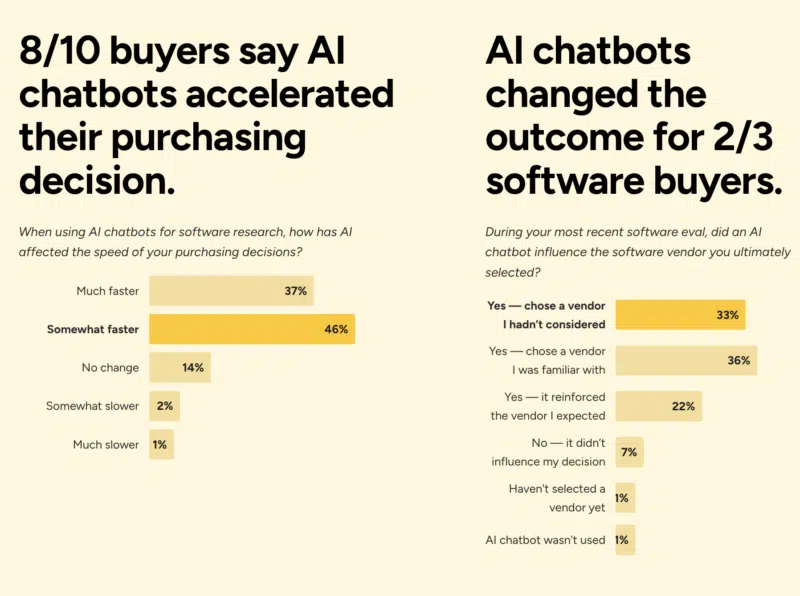
This acceleration means that shortlisting can now occur before a vendor has even generated a website visit, captured crucial intent data, or triggered any of the traditional signals that marketers rely on to gauge interest and engagement. This fundamentally alters the competitive playing field, as vendors can be evaluated and potentially disqualified before they even have a chance to make a direct impression.
The increased reliance on AI for early-stage decision-making also amplifies the cost of weak or unclear positioning. G2’s research found that 69% of buyers reported that AI chatbots surfaced information leading them to select a different vendor than they had initially considered. Moreover, 85% of buyers indicated that they think more highly of a vendor that is cited by AI in an answer. If a brand is misunderstood, inadequately represented, or poorly differentiated in the data that AI systems access, the AI can effectively reroute the deal away from that vendor before their sales or marketing teams are even aware of the opportunity.
Implications for B2B Marketing Strategy: Adapting to the AI Era

While the rise of AI search is undeniable, it is important to note that traditional search engines and vendor websites still hold relevance in the buyer’s journey. G2’s report indicates that 80% of buyers still utilize Google at some point during their research. However, the critical takeaway is that AI is now playing a far more influential role in the initial stages of discovery and shortlist formation. This necessitates a strategic pivot for B2B marketers, shifting the focus from being found everywhere to being clearly and accurately understood where AI is actively searching.
This evolving landscape demands a re-evaluation of marketing strategies. Key considerations include:
- AI-Optimized Content: Content needs to be not only informative and engaging for human readers but also structured and semantically rich to be easily understood and leveraged by AI. This involves using clear language, providing specific data points, and ensuring factual accuracy.
- Data Integrity and Accessibility: Vendors must ensure that accurate, up-to-date information about their products and services is readily available and accessible to AI crawlers. This includes product descriptions, feature sets, pricing models, case studies, and customer testimonials.
- Review Management: The prominence of reviews in AI recommendations means that actively soliciting, managing, and responding to customer reviews on relevant platforms is more crucial than ever. Positive and well-articulated reviews can significantly influence AI’s perception of a vendor.
- Clear Value Proposition: B2B marketers must hone their messaging to clearly articulate the unique value proposition of their offerings. AI systems are designed to identify and highlight key benefits, and a concise, compelling message will be more likely to be surfaced.
- Category Definition: For emerging categories or niche solutions, clearly defining the problem the software solves and its place within the broader market is essential for AI to accurately categorize and recommend it.
- Third-Party Validation: Building a strong reputation through analyst reports, industry awards, and trusted media mentions can provide the third-party validation that AI systems often rely on to build confidence in a vendor.
- Understanding AI Outputs: Marketers need to develop an understanding of how AI chatbots are currently answering questions related to their industry and product category. This involves actively querying AI tools and analyzing the types of information they prioritize and the vendors they recommend.
The "Answer Economy" is not a fleeting trend; it represents a fundamental shift in how B2B software is discovered and evaluated. Vendors and marketers who fail to adapt to this new reality risk becoming invisible to a growing segment of potential buyers. The future of B2B software procurement is being shaped by AI, and those who can effectively navigate and contribute to this AI-driven information ecosystem will be best positioned for success. The emphasis is no longer just on being present, but on being understood, trusted, and recommended by the intelligent systems that are increasingly guiding purchasing decisions.

The implications extend beyond just marketing efforts. Sales teams will also need to be prepared for buyers who arrive with pre-formed opinions and shortlists generated by AI. Understanding the AI’s output and the rationale behind its recommendations will be crucial for effective sales conversations. Furthermore, product development teams may find that the data used by AI for recommendations can provide valuable insights into market perceptions and competitive positioning, influencing future product roadmaps.
In conclusion, G2’s "The Answer Economy" report serves as a critical wake-up call for the B2B software industry. The rapid ascent of AI chatbots as primary research tools signifies a profound alteration in buyer behavior. Visibility is no longer achieved solely through traditional search engine optimization and content marketing aimed at driving traffic. Instead, it hinges on ensuring that AI systems can comprehend, trust, and effectively communicate a vendor’s value proposition. As AI continues to evolve and integrate further into business processes, B2B companies must proactively adapt their strategies to thrive in this new, AI-powered discovery and decision-making environment. The ability to "win the answer" is rapidly becoming the ultimate competitive advantage.