Two Decades of Cloud Transformation: Reflecting on the Twentieth Anniversary of Amazon EC2

Two decades ago, a single blog post authored by Jeff Barr quietly introduced the world to the Amazon EC2 Beta, a development that would fundamentally alter the trajectory of global information technology. On that day in 2006, the service offered little more than resizable Linux virtual servers, billed hourly, restricted to a single instance type—the m1.small—and confined to a single AWS Region in the eastern United States. What began as a minimal, experimental utility has since matured into the bedrock of the modern internet, powering everything from nascent startups to the most sophisticated artificial intelligence training clusters in existence.
The Genesis of Cloud Infrastructure
In 2006, the prevailing model for computing infrastructure was capital-intensive and rigid. Organizations were required to forecast hardware needs months in advance, procure physical servers, and manage data center facilities. The introduction of Amazon Elastic Compute Cloud (EC2) democratized access to high-performance compute resources. By enabling developers to provision and terminate virtual servers via software, Amazon effectively converted capital expenditure (CapEx) into operational expenditure (OpEx).
This shift was not merely a change in billing; it was a shift in engineering philosophy. By abstracting the hardware layer, Amazon allowed software engineers to treat infrastructure as code. This capability became the catalyst for the "DevOps" movement, enabling the rapid iteration and continuous deployment cycles that define modern software development.
Chronology of Evolution: A Strategic Roadmap
The evolution of EC2 is marked by a series of strategic innovations that transitioned the service from a basic utility to a comprehensive platform.
- 2006: The launch of the EC2 Beta.
- 2008: The introduction of Amazon Elastic Block Store (EBS), which provided the persistent storage necessary for running databases and stateful applications in the cloud.
- 2009: A pivotal year for scalability and architecture. The introduction of Elastic Load Balancing, Auto Scaling, and Amazon CloudWatch allowed applications to handle traffic fluctuations automatically. Simultaneously, Amazon Virtual Private Cloud (VPC) brought the security and isolation required for enterprise-grade adoption.
- 2017: The debut of the AWS Nitro System. This marked a critical transition to custom hardware, allowing AWS to offload virtualization functions from the main CPU to dedicated hardware, significantly increasing performance and security.
- 2018: The launch of AWS Graviton processors. By designing its own ARM-based silicon, AWS broke its dependency on third-party processor roadmaps, offering superior price-performance ratios for scale-out workloads.
- 2018–2019: The expansion of the "edge" model. With the introduction of AWS Outposts, Local Zones, and Wavelength, EC2 moved beyond the traditional data center, bringing compute power closer to the end-user, into private facilities, and even onto 5G telecommunication networks.
Supporting Data: Scaling to Global Proportions
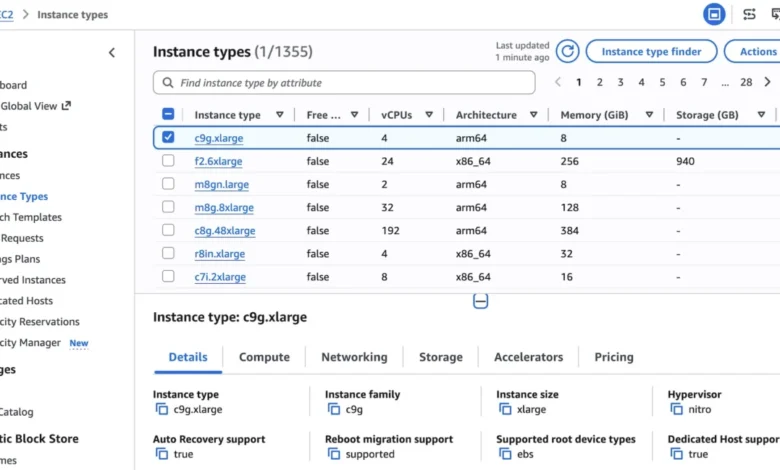
The scale at which EC2 operates today is unprecedented. From its humble origins as a single instance type in one Region, the service has expanded into an ecosystem of over 1,200 distinct instance types. These are categorized to meet specialized requirements: general-purpose, compute-optimized, memory-optimized, storage-optimized, and accelerated computing (which includes high-performance GPU and NPU clusters).
Geographically, the service has grown to encompass 39 AWS Regions globally. This footprint is critical for multinational enterprises that must comply with data sovereignty regulations while maintaining low-latency access for a global user base. Furthermore, the reliance on EC2 is pervasive; virtually every high-level AWS service—including Amazon ECS, EKS, Lambda, Fargate, Batch, EMR, SageMaker, and Bedrock—functions as a layer of abstraction sitting atop the foundational EC2 compute fabric.
Analysis: Why the Minimalist Approach Succeeded
The sustained success of EC2 can be attributed to a "minimal-yet-useful" product strategy. By launching with a stripped-down feature set, the engineering teams at Amazon were able to gather immediate feedback from early adopters. This iterative process allowed them to prioritize features based on actual customer usage rather than theoretical demand.

This philosophy fostered an environment of rapid innovation. When customers required higher performance for AI, AWS responded with specialized accelerated computing instances. When customers sought to optimize costs for massive container fleets, AWS introduced Graviton. This reactive, feedback-driven model has shielded the platform from the bloat that often plagues legacy enterprise software.
Industry Implications and Official Perspectives
The impact of EC2 extends far beyond Amazon’s revenue sheets. It provided the compute capacity necessary for the "Big Data" revolution of the 2010s and is currently serving as the engine for the Generative AI boom. Without the ability to rent thousands of GPUs on demand to train trillion-parameter models, the current pace of AI development would be restricted to a handful of entities with the physical infrastructure to support such massive electricity and cooling requirements.
Reflecting on this milestone, industry observers note that the core value proposition remains unchanged even as the technical complexity has ballooned. The ability to launch secure, resizable compute capacity in minutes, without long-term commitments, remains the standard by which all cloud computing is measured.
In recent comments, Amazon executives have emphasized that the architectural decisions made in 2006—specifically the decision to build a platform that could accommodate rapid growth—were the most critical in the company’s history. The strategy was not to build a finished product, but to build a modular system capable of evolving alongside advancements in semiconductor technology and networking.

The Next Frontier: Future-Proofing the Cloud
As we look toward the next twenty years, the requirements of cloud computing are shifting toward higher levels of abstraction and specialized hardware. The rise of machine learning, quantum computing, and edge-native applications suggests that EC2 will continue to evolve, likely moving further away from the "virtual machine" concept and toward more specialized, event-driven, or hardware-accelerated compute models.
However, the foundational principle remains the same. Whether it is a simple web server or a distributed training cluster for a large language model, the lifecycle of a modern application still begins with the decision to launch an instance.
The longevity of EC2 serves as a case study in infrastructure durability. By resisting the urge to overhaul the platform entirely, AWS has maintained a consistent interface that has allowed millions of developers to migrate their legacy workloads while simultaneously enabling them to build the future. As the industry moves into an era defined by AI integration and increased geographic distribution, the elasticity that EC2 introduced in 2006 will remain the definitive requirement for any organization seeking to remain competitive in the digital economy.
Ultimately, the story of EC2 is not just about servers or data centers; it is the story of how the world transitioned from owning the means of computing to accessing it as a fundamental utility, similar to electricity or water. Twenty years later, this transition is complete, and the infrastructure that supports it has become the most essential utility of the 21st century.