Building Scalable Real-Time WebSocket Fleet Management Systems on Amazon ECS and AWS Fargate

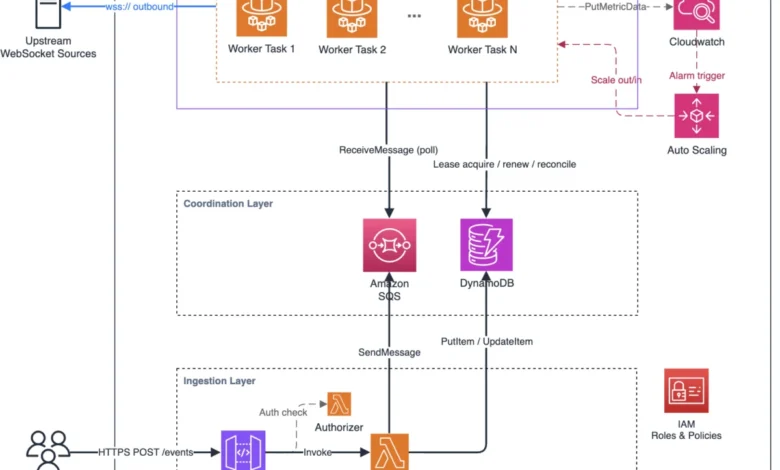
Operating real-time data ingestion pipelines at scale presents architectural obstacles, particularly when maintaining thousands of persistent, bidirectional communication channels. In high-throughput environments such as real-time transcription services processing hundreds of concurrent meetings, distributed worker nodes must maintain dedicated outbound WebSocket connections to upstream streaming sources. When a single worker node fails unexpectedly, it can instantly sever over a hundred active connections, precipitating prolonged data loss and forcing operations teams to manually intervene to restore baseline service levels.
Addressing these persistent synchronization hurdles requires a robust application-layer coordination framework. Industry engineers have increasingly looked toward serverless and containerized paradigms, specifically combining Amazon Elastic Container Service (Amazon ECS) and AWS Fargate with Amazon DynamoDB, to establish distributed lease ownership models. This architectural approach eliminates the need for external coordination clusters while reducing connection recovery windows from minutes down to mere seconds.
The Architectural Challenge of Long-Lived Connections
Unlike stateless HTTP request-response cycles where intermediate servers retain no context once a payload is delivered, WebSocket connections establish a continuous, stateful TCP pipe. The worker infrastructure must actively manage this persistent channel, continuously ingest data streams from upstream providers, and reliably respond to routine keep-alive pings.
This inherent statefulness introduces complex operational scenarios across standard enterprise workflows:

- Worker Terminations: When container instances crash due to out-of-memory errors, underlying host failures, or unexpected network partitions, associated WebSocket pipelines drop immediately. Without automated detection mechanisms, upstream data is systematically lost.
- Rolling Deployments: Standard continuous deployment pipelines cycle out older container tasks while launching new ones. During these transition windows, unmanaged downtime spikes unless task handoffs are meticulously orchestrated.
- Horizontal Scaling Operations: While scaling worker fleets outward is straightforward, scaling inward requires safely draining connections from departing tasks to guarantee seamless migration before container termination.
- Split-Brain and Double-Claiming Issues: If concurrent worker nodes mistakenly assume ownership over a single connection identifier, protocol errors, redundant data processing, or outright upstream connection rejections can destabilize the ingestion pipeline.
Because worker nodes act as WebSocket clients initiating outbound connections, standard network-layer load balancers cannot handle application-level connection ownership tracking. A distributed application-layer consensus mechanism is vital.
Implementing the Lease-Based Ownership Pattern
To solve the state synchronization problem without deploying heavyweight external coordination services like Apache ZooKeeper or etcd, architects leverage Amazon DynamoDB conditional writes to establish a distributed lease table.
In this architecture, every connection is represented by a specific row within a DynamoDB table containing metadata such as its desired operational state, the target upstream WebSocket Uniform Resource Locator (URL), the last processed sequence number, and the identifier of the worker currently holding the lease.
+-------------------------------------------------------------------------+
|                      DynamoDB Lease Table Schema                        |
+--------------------------+----------------------+-----------------------+
| Attribute                | Type                 | Description           |
+--------------------------+----------------------+-----------------------+
| pk                       | String (Partition)   | Connection Identifier |
| desired_state            | String               | STARTED or STOPPED    |
| ws_url                   | String               | Upstream WebSocket URL|
| lease_owner              | String               | Active Worker ID      |
| lease_expires_at_ms      | Number               | Epoch Expiration Time |
| last_seq                 | Number               | Resumption Sequence   |
+--------------------------+----------------------+-----------------------+
The core mechanics of this pattern rely on four distinct operational lifecycle phases: Acquisition, Renewal, Release, and Expiration.
Acquisition and Conditional Writes
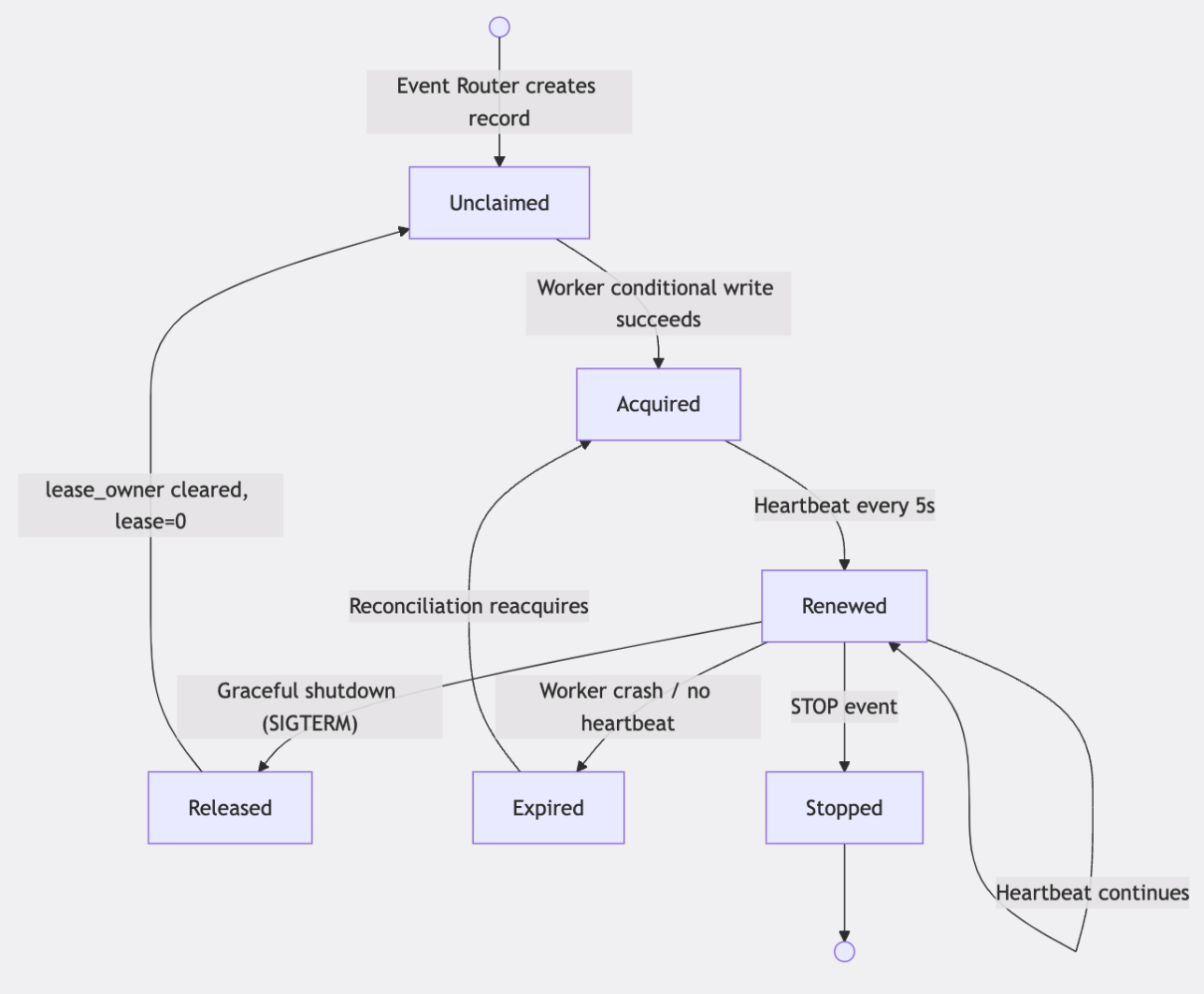
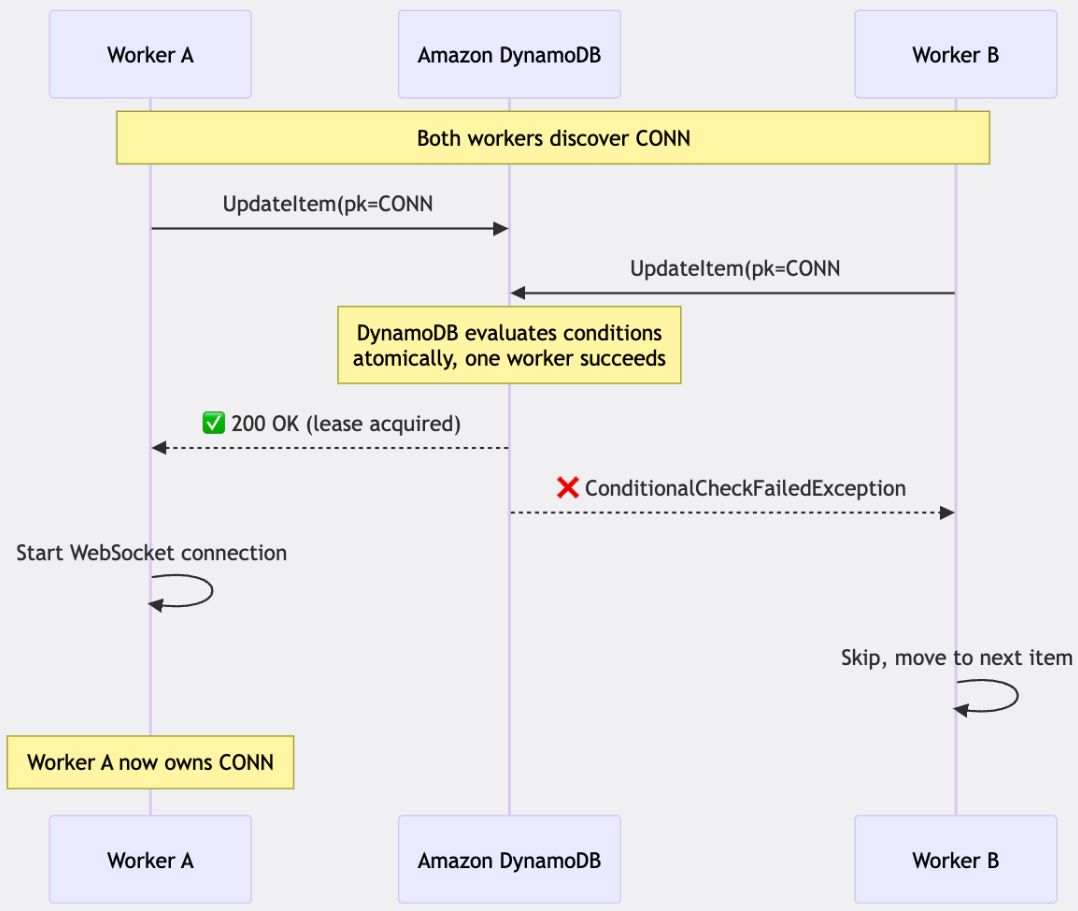
When a worker attempts to claim an active connection, it executes a conditional update against DynamoDB. The conditional expression dictates that the write will only succeed if the lease does not currently exist or if the existing lease expiration timestamp has passed. If multiple workers race to claim the same connection simultaneously, DynamoDB processes the transactions atomically, ensuring only one worker succeeds while competitors catch a ConditionalCheckFailedException and back off gracefully.
Heartbeat Renewal
Once ownership is established, the worker continuously renews its lease every few seconds by submitting update transactions that verify its specific worker identifier remains the active owner. If a renewal fails—signaling that ownership has been revoked or expired—the worker immediately terminates its local stream processing to prevent split-brain processing scenarios.
Graceful Shutdown and Orphan Reconciliation
During standard rolling deployments, Amazon ECS issues a SIGTERM signal to container tasks. Rather than abruptly terminating, the worker initiates a parallelized shutdown sequence: it closes active WebSockets and explicitly releases its DynamoDB leases by setting their expiration timers to zero. This permits other healthy worker nodes to acquire the liberated connections immediately during their next reconciliation cycle, bypassing standard expiration delays.
For unexpected crashes where container tasks terminate without running shutdown routines, a secondary fallback mechanism takes over. A global secondary index (GSI) targeting desired_state and lease_expires_at_ms allows healthy workers to routinely query for orphaned connections—records marked as started whose leases have expired without renewal. Any healthy worker can then reacquire these abandoned streams, bounding total failover recovery windows to under ninety seconds.
Event Ingestion and Fleet Scaling Dynamics
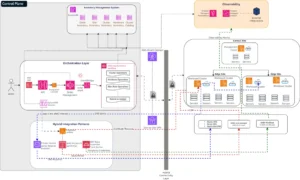
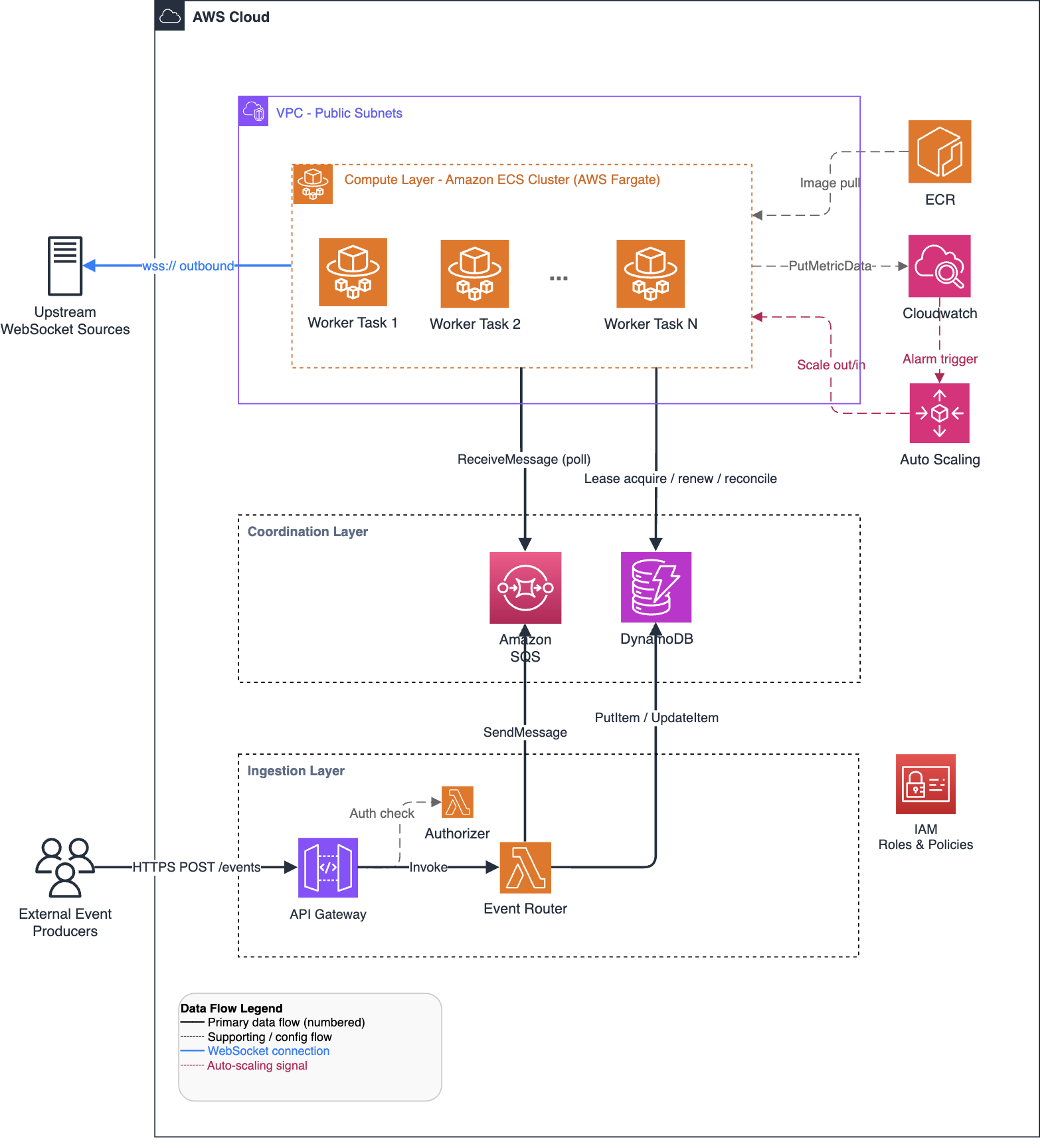
The complete end-to-end architecture relies on a cohesive suite of cloud services working in tandem. When external applications need to initialize or terminate a streaming session, an incoming event passes through Amazon API Gateway to an AWS Lambda event router. The Lambda function updates the primary DynamoDB state table and immediately pushes a notification message to an Amazon Simple Queue Service (SQS) FIFO queue.
+-----------------------------------------------------------------------+
|                  WebSocket Fleet Management Architecture              |
+-----------------------------------------------------------------------+
|                                                                       |
|   [External Client] ---> [API Gateway] ---> [AWS Lambda]              |
|                                                     |                 |
|                                       +-------------+------------+    |
|                                       |                          |    |
|                                       v                          v    |
|                                 [Amazon SQS]             [Amazon DynamoDB]
|                                       |                          |    |
|                                       +-------------+------------+    |
|                                                     |                 |
|                                                     v                 |
|                                      [ECS Fargate Worker Fleet]       |
|                                                     |                 |
|                                                     v                 |
|                                      [Amazon CloudWatch Metrics]      |
+-----------------------------------------------------------------------+
Amazon SQS acts as a fast notification channel, alerting available workers instantly when new work arrives so they do not have to wait for scheduled reconciliation sweeps. Meanwhile, Amazon CloudWatch aggregates custom operational telemetry, such as active connection counts per worker instance.
Using native Amazon CloudWatch metrics, Application Auto Scaling policies dynamically adjust the size of the Amazon ECS Fargate worker fleet. When average connection density per container task exceeds predefined thresholds—such as 700 concurrent connections—the orchestrator provisions additional Fargate tasks. Conversely, during off-peak hours, tasks scale inward securely because the underlying lease pattern safely reallocates active pipelines before container reclamation.
Operational Economics and Cost Optimization
Maintaining real-time synchronization at scale introduces predictable infrastructure expenditures, heavily driven by DynamoDB write capacity units (WCUs). Because heartbeat renewals execute continuously for every active pipeline, write throughput scales linearly with connection volume.
At a default five-second heartbeat interval, systems processing 500 concurrent connections consume roughly 100 WCUs per second. For high-density production environments maintaining thousands of sustained streams, organizations are advised to adopt DynamoDB provisioned capacity modes coupled with target tracking scaling policies rather than relying purely on on-demand pricing models. Provisioned throughput models significantly reduce operational overhead costs for steady-state workloads characterized by predictable, high-frequency write operations.
Furthermore, engineering teams can tune architectural parameters to balance recovery speeds against database costs. Extending heartbeat intervals, adjusting lease durations, and implementing batched query operations via BatchGetItem effectively curb unnecessary read and write consumption without sacrificing system resilience.
Conclusion and Future Implementation Pathways
Architecting distributed real-time systems requires careful consideration of state management, failure domains, and resource orchestration. By replacing traditional network-layer locking mechanisms with application-level distributed leases backed by Amazon DynamoDB, organizations can successfully manage thousands of concurrent WebSocket connections across elastic container fleets.
This reference architecture significantly hardens streaming data pipelines against abrupt container failures, minimizes data loss windows during continuous deployment cycles, and ensures elastic scalability without the administrative burden of maintaining external cluster coordination services. Comprehensive deployment templates, including complete Terraform configurations and asynchronous Python worker source code, are publicly accessible via community repositories for engineering teams seeking to deploy production-grade real-time streaming architectures.