Testing Application Resilience and Mitigating SQS Access Failures with AWS Fault Injection Service

When enterprise applications can no longer send or receive messages through an Amazon Simple Queue Service queue, downstream processing pipelines frequently experience severe operational stalls. Modern distributed architectures depend heavily on asynchronous messaging patterns to decouple microservices, making message broker availability paramount. The underlying cause of an Amazon SQS disruption may stem from a misconfigured AWS Identity and Access Management policy, an unexpected network partition, a faulty software deployment, or a transient regional cloud service event. Despite the varying root causes, client applications observe remarkably consistent symptoms: fundamental queue operations begin throwing exceptions or failing outright. How applications handle these critical failures—whether they fail fast on operations that cannot possibly succeed, engage defensive circuit breakers, or buffer payloads on the producer side—often dictates the difference between a brief, self-healing disruption and a catastrophic, cascading system outage.
Historically, engineering teams have waited for production anomalies to test their error-handling code, inadvertently relying on untested assumptions about system behavior. To eliminate this operational risk, Amazon Web Services provides the AWS Fault Injection Service, a fully managed service that enables developers to orchestrate controlled chaos engineering experiments. By proactively simulating operational failures, organizations can evaluate how their software responds to degraded dependencies before real users are impacted. The core objective of resilience experimentation is not to verify that AWS infrastructure functions correctly, but rather to uncover precisely what an application does when operations fail and whether internal observability tools surface the anomaly in a timely manner.
The Mechanics of SQS Access Impairment
To execute a controlled resilience experiment, systems architects must isolate the application’s access to the messaging layer without permanently damaging the underlying infrastructure. A proven methodology involves applying a scoped, explicit deny resource policy to the target queue, observing the subsequent system behavior, and then restoring full access to measure recovery rates.
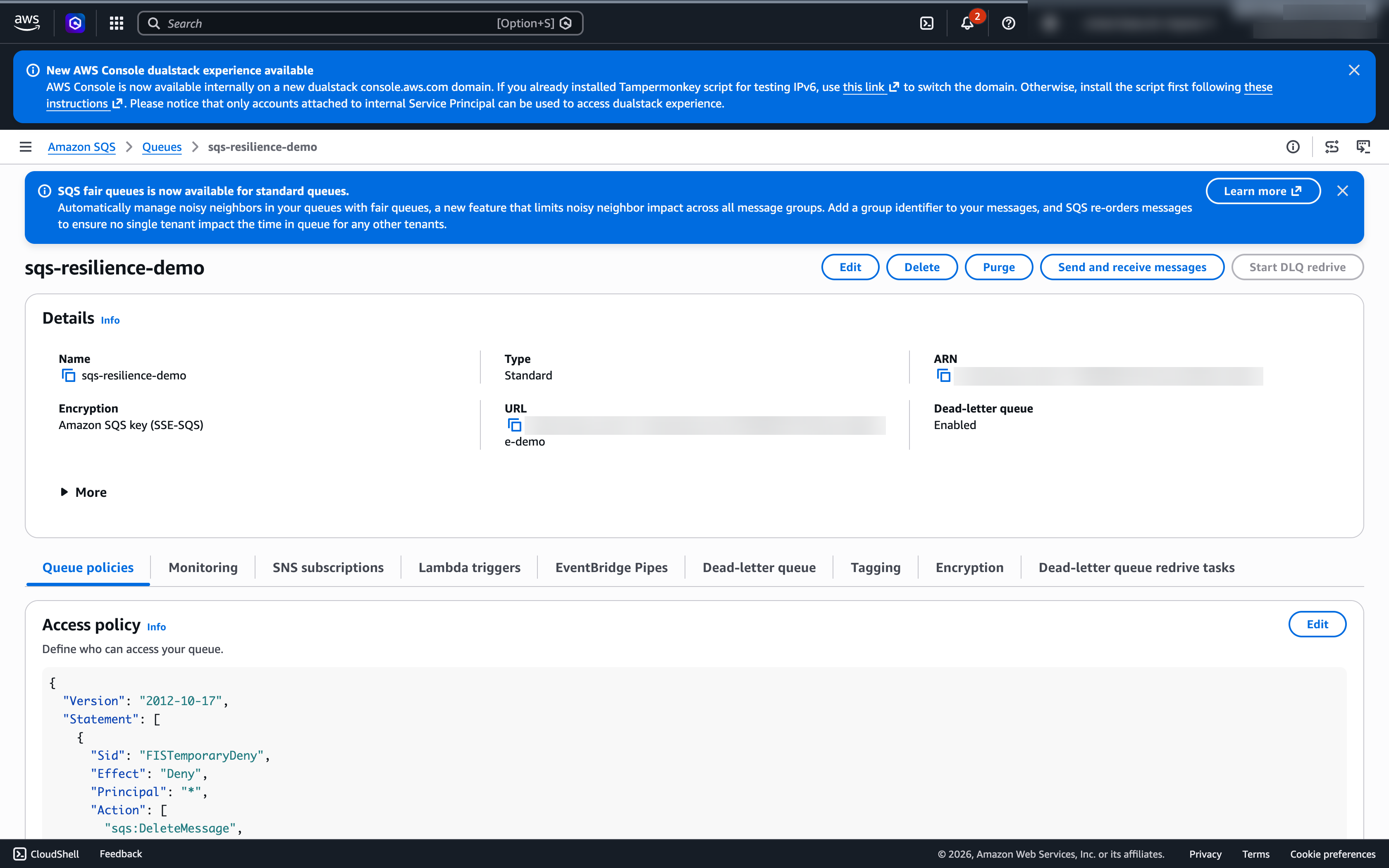
The security policy applied during the experiment must be carefully constructed. It should reject vital data-plane operations upon which the application relies—such as sending, receiving, deleting, and changing message visibility, along with queue purging operations—while intentionally leaving queue management capabilities untouched. Restricting the disruption duration across progressively longer phases allows engineering teams to surface distinct classes of system failure, ranging from minor thread-pool contention to memory exhaustion and transaction timeouts.
Safety precautions during policy deployment are critical. Administrators must strictly avoid issuing a broad denial rule across all SQS actions. In AWS IAM policy evaluation logic, an explicit denial overrides every allowed permission, including the automated scripts required to clean up the policy itself. A blanket deny statement covering sensitive configuration actions can permanently lock the queue, preventing even the administrative role that applied it from removing the restriction. Consequently, safety protocols mandate scoping the denial exclusively to data-plane actions.
Progressive Experiment Phases and System Surfaces
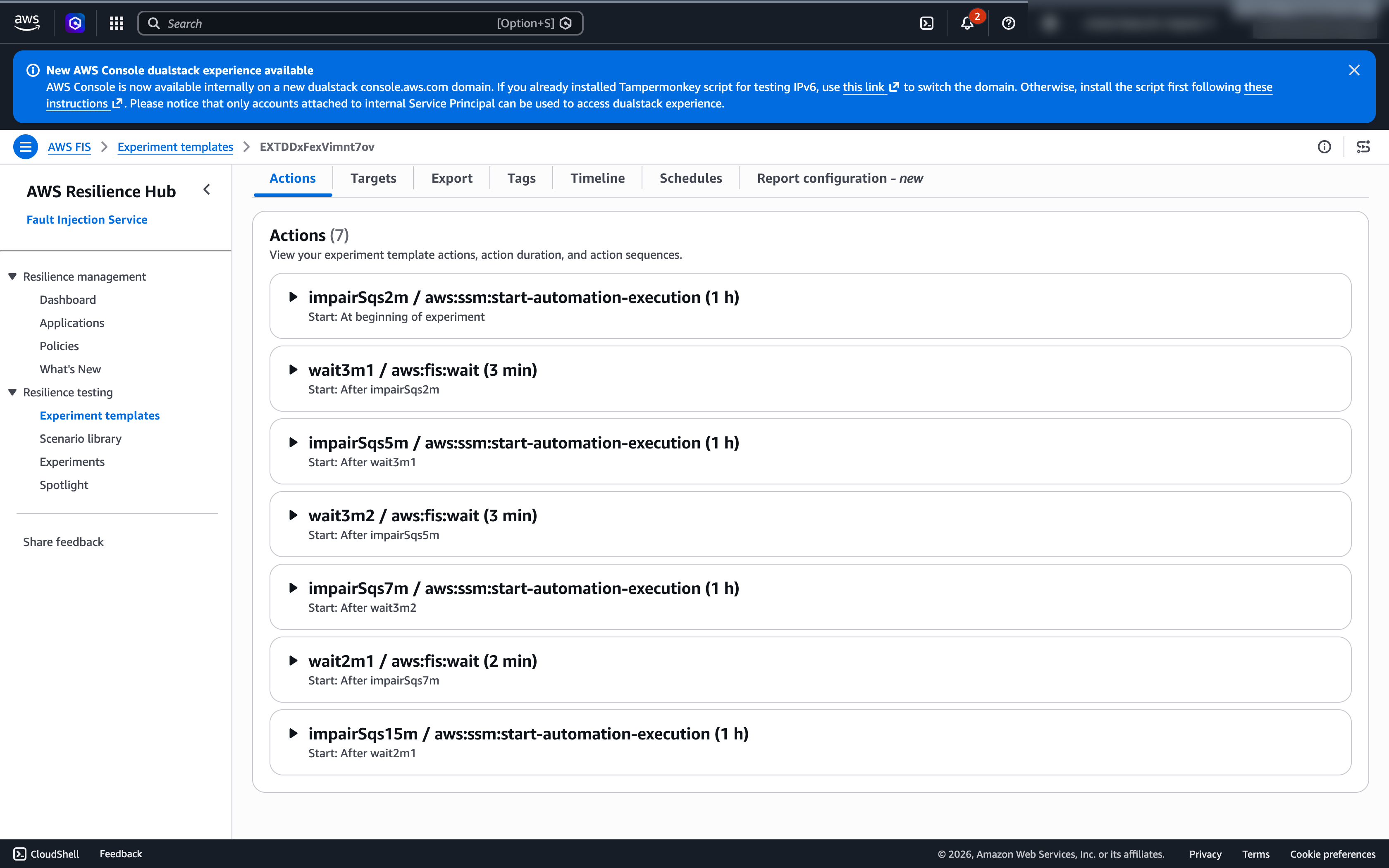
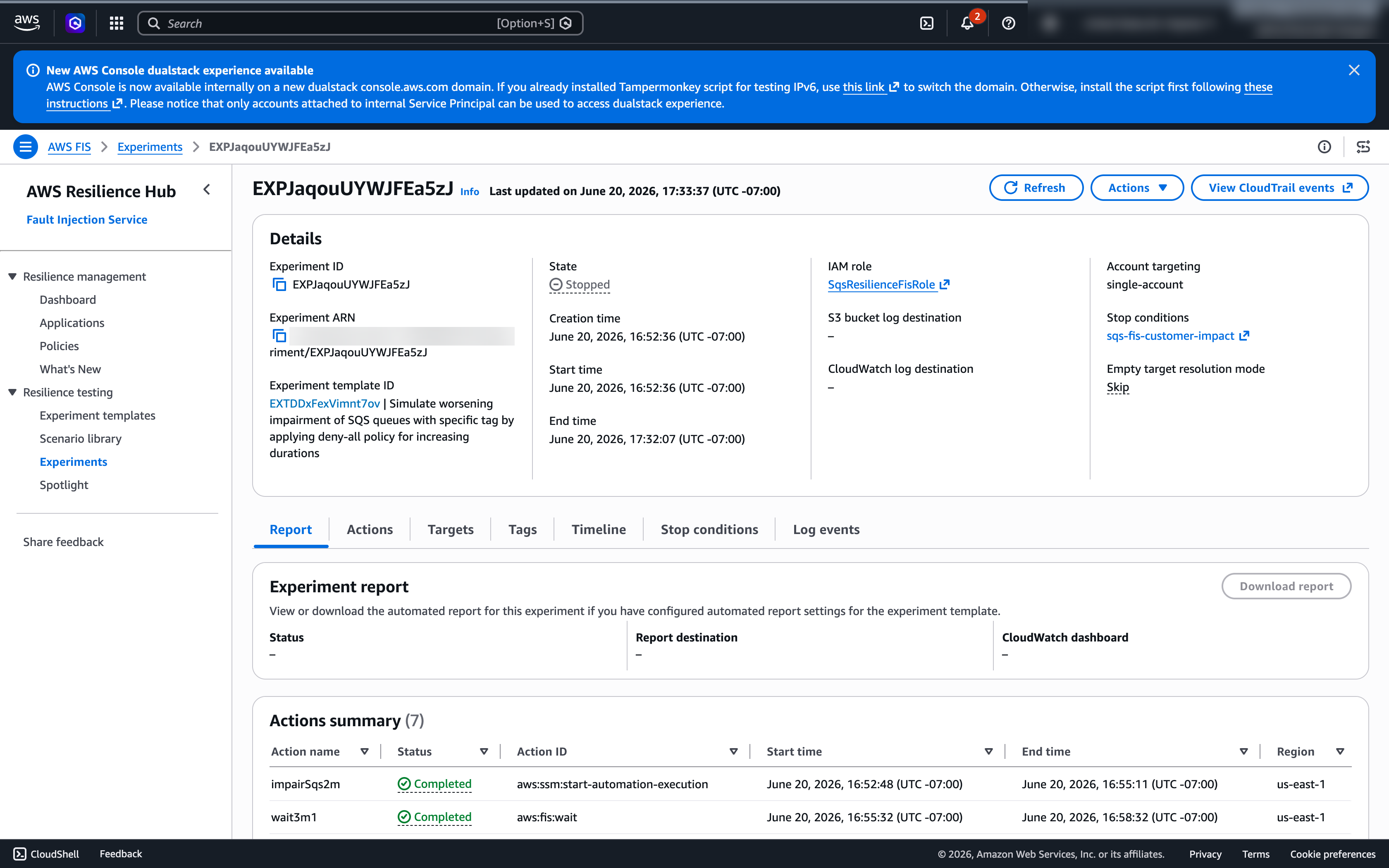
Structured resilience experiments utilize an escalating timeline to expose latent architectural weaknesses. Short-lived disruptions typically reveal whether basic failure-handling mechanisms—such as exception catch blocks and initial retry aborts—activate correctly. Conversely, prolonged disruptions expose systemic vulnerabilities that only manifest under sustained operational stress.
[Phase 1: 2-min Impairment] -> [Recovery Check] -> [Phase 2: 5-min Impairment] -> [Recovery Check] -> [Phase 3: 7-min Impairment] -> [Recovery Check] -> [Phase 4: 15-min Impairment]During these experiments, platform engineers monitor two distinct operational surfaces simultaneously:
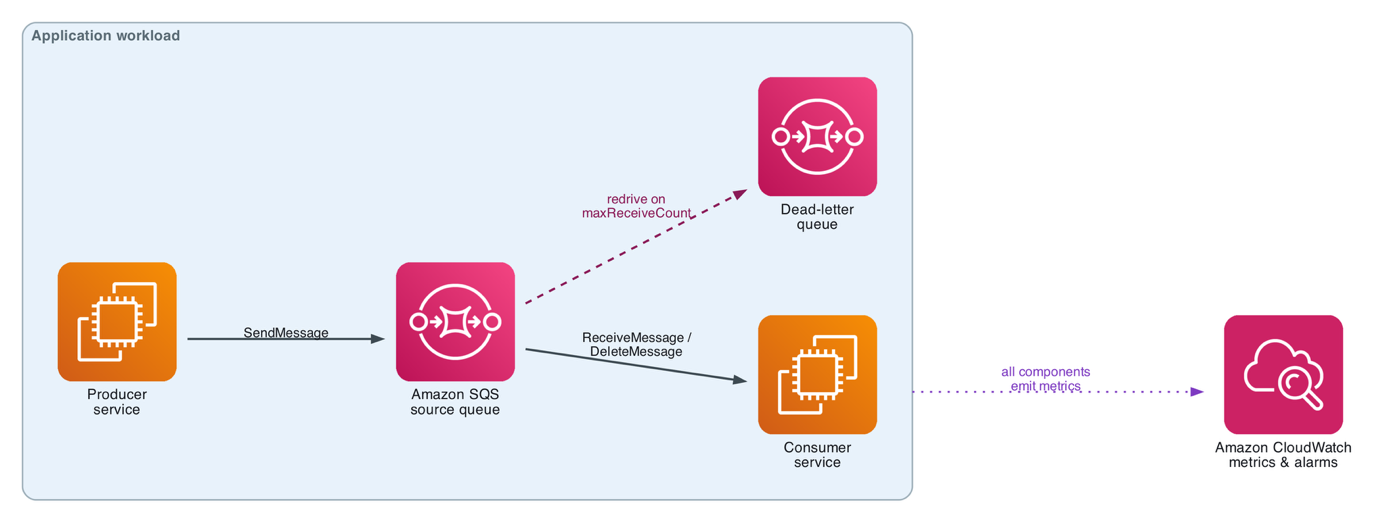
- The Producer Side: Components responsible for invoking operations like SendMessage. When outbound transmissions are blocked, engineers evaluate whether the producer fails fast, trips an internal circuit breaker, buffers items to local durable storage, or silently drops messages.
- The Consumer Side: Components responsible for calling ReceiveMessage and DeleteMessage. When inbound reads are blocked, monitoring focuses on backlog growth during the outage and subsequent redelivery dynamics upon recovery.
Defining Actionable Resilience Hypotheses
Before initiating any fault injection experiment, technical leads must articulate a formal hypothesis. This foundational step requires predicting system behavior under duress and defining exact metrics to measure success or failure. For mature applications equipped with comprehensive error-handling patterns, a hypothesis might specify that a five-minute loss of SQS connectivity will prompt producers to trip their circuit breakers within thirty seconds, fail fast, and durably buffer payloads locally rather than discarding them. Upon recovery, the system should automatically replay the buffer and return to baseline processing rates within a specified window.
For legacy systems or teams conducting their first fault injection experiment, the hypothesis can be framed around discovery. Documenting the lack of prior testing establishes a clear baseline for improvement. Regardless of the team’s maturity level, writing down expectations beforehand ensures that gaps between theoretical design and empirical reality are explicitly identified and scheduled for remediation.
Configuring the Orchestration Infrastructure
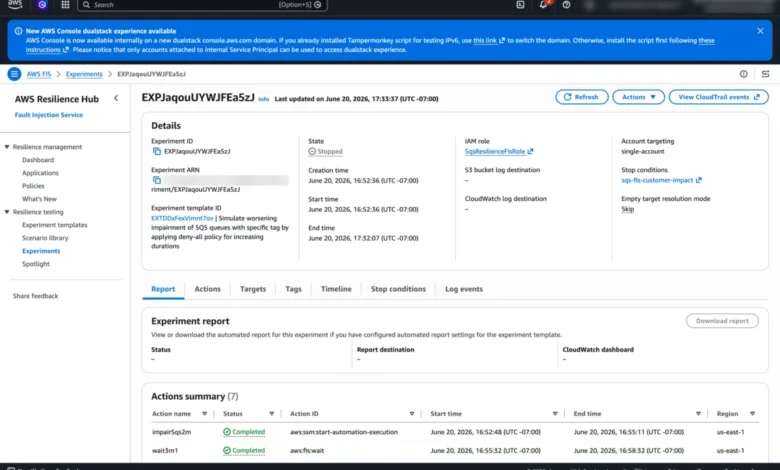
Orchestrating a controlled SQS impairment experiment requires coordinating AWS Systems Manager Automation and AWS Fault Injection Service templates. Systems Manager automation documents execute the procedural logic of applying and removing the scoped IAM deny policy, while FIS manages the chronological sequencing of the progressive phases.
  "Version": "2012-10-17",
  "Statement": [

      "Sid": "FISTemporaryDeny",
      "Effect": "Deny",
      "Principal": "*",
      "Action": [
        "sqs:SendMessage",
        "sqs:ReceiveMessage",
        "sqs:DeleteMessage",
        "sqs:ChangeMessageVisibility",
        "sqs:PurgeQueue"
      ],
      "Resource": "arn:aws:sqs:us-east-1:123456789012:MyTargetQueue"

  ]
To control the blast radius of the experiment, engineers can scope the policy using the Principal element. Applying the restriction universally simulates a total service partition across all consumers and producers. Alternatively, scoping the rule to a specific application IAM role allows teams to isolate the fault to a single microservice sharing a multi-tenant message queue.
Monitoring Signals and Metric Analysis
Observing application telemetry during an experiment requires tracking specific CloudWatch metrics that reflect underlying system health without triggering false-positive aborts. Because queue metrics such as ApproximateAgeOfOldestMessage and NumberOfMessagesSent are naturally expected to fluctuate or pause during an outage, alarming on them directly would prematurely halt the experiment during the initial phases. Instead, stop conditions must be tied to broader customer-impact signals, such as downstream HTTP error rates or transaction failure counts.
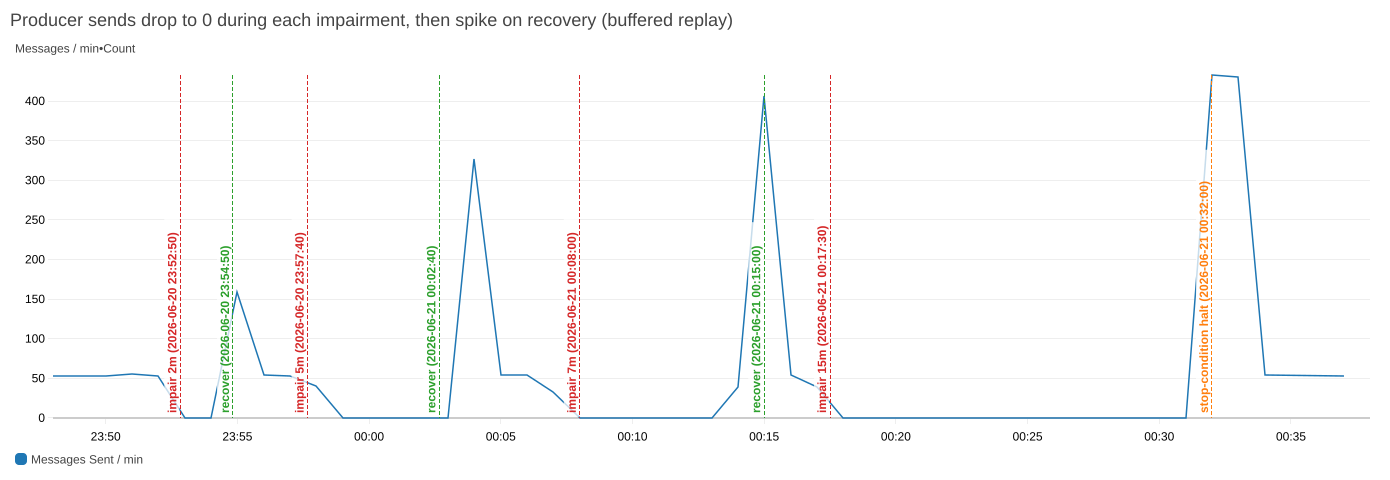
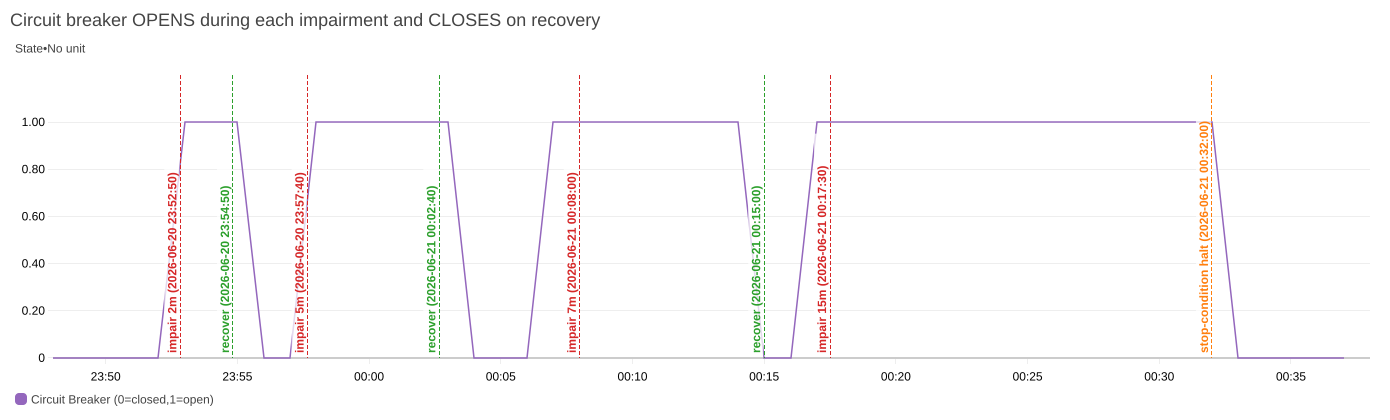
During active impairment, SQS operations will uniformly return AccessDenied exceptions. Because HTTP 403 errors are fundamentally non-retryable, this phase validates whether application code immediately recognizes authorization blocks rather than entering aggressive, infinite backoff loops. Producers experiencing blocked sends should register a drop in throughput accompanied by rising local error logs, eventually tripping circuit breakers to protect shared computing resources.
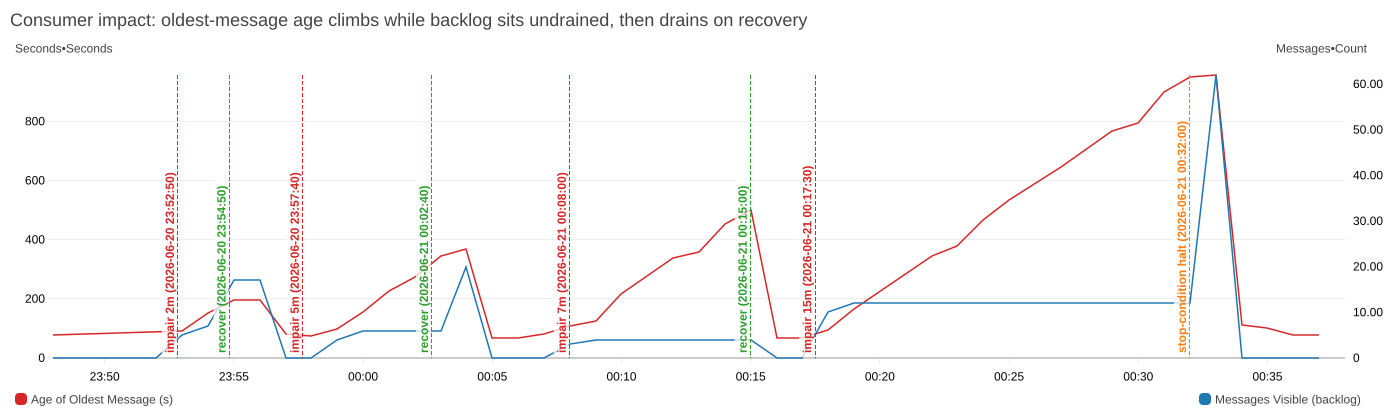
Upon restoring access, recovery metrics reveal the true robustness of the architecture. Healthy producers successfully close their circuit breakers and drain any local fallback buffers back into the primary queue. On the consumer side, visible message backlogs should steadily diminish while the age of the oldest message returns to nominal levels. If downstream consumers become overwhelmed by accumulated data during recovery, specialized dead-letter queues safely capture unprocessable poison messages without destabilizing the broader application cluster.
Strategic Implications for Cloud Architecture
Proactive fault injection transforms operational readiness from an abstract hope into a measurable engineering discipline. By systematically subjecting asynchronous messaging layers to artificial access restrictions, organizations can uncover hidden coupling, inadequate timeout configurations, and missing idempotency checks long before a real-world outage occurs.
Integrating chaos engineering into standard continuous integration and deployment pipelines ensures that as microservice architectures evolve, their inherent resilience scales in tandem. Ultimately, identifying architectural failure points in controlled non-production environments empowers engineering organizations to build self-healing cloud applications capable of weathering unexpected infrastructure disruptions with minimal end-user impact.
Related posts: