OpenTelemetry Achieves Coveted CNCF Graduated Status, Solidifying Its Position as the De Facto Observability Standard.

The Cloud Native Computing Foundation (CNCF) officially announced on May 21, 2026, the graduation of OpenTelemetry (OTel), marking a pivotal moment for the future of cloud-native observability. This significant milestone places OpenTelemetry in an elite category alongside foundational projects like Kubernetes and Prometheus, affirming its maturity, widespread adoption, and critical importance to the modern software ecosystem. The announcement, highlighted in a post on July 24, 2026, by Adriana Villela (Dynatrace LLC) and Reese Lee (New Relic), underscores a culmination of years of collaborative effort and innovation within the open-source community.
A Journey from Fragmentation to Standardization: The Observability Challenge
To fully grasp the magnitude of OpenTelemetry’s graduation, it is essential to revisit the landscape of software observability that existed just a few years prior. In the not-so-distant past, the collection and analysis of telemetry data—traces, logs, and metrics—were largely fragmented and proprietary. Each telemetry vendor developed and maintained its own distinct instrumentation libraries, data formats, and collection agents. This created a significant hurdle for organizations: vendor lock-in.
Switching observability providers was a notoriously complex and costly endeavor. Enterprises found themselves deeply embedded in a vendor’s ecosystem, necessitating a complete rip-and-replace operation to migrate. This involved stripping out existing vendor-specific libraries from application code and replacing them with new ones, a non-trivial task that consumed valuable developer resources, introduced risk, and often delayed innovation. The financial and operational overhead associated with such migrations discouraged companies from seeking best-of-breed solutions or adapting to evolving market needs.
Furthermore, the three core telemetry signals—traces, logs, and metrics—were often treated in isolation. While individual tools excelled at capturing one type of data, correlating these disparate signals to paint a holistic picture of application health and performance was challenging, if not impossible. This siloed approach resulted in an incomplete observability story, hindering rapid incident response, root cause analysis, and proactive system optimization. Developers and operations teams struggled to connect the dots between a service error (log), a slow transaction (trace), and a spike in resource utilization (metric), leading to prolonged debugging cycles and increased downtime.
Recognizing these pervasive challenges, the cloud-native community began to explore avenues for standardization. Early attempts laid the groundwork for a unified approach. The CNCF’s OpenTracing project emerged with a focus on standardized distributed tracing, providing a vendor-neutral API for instrumentation. Concurrently, Google spearheaded OpenCensus, which aimed to standardize the collection of both traces and metrics. While both projects made significant strides in their respective domains, the existence of two competing standards for similar goals presented its own set of complexities and hindered broader adoption.
The Genesis of a Unified Standard: OpenTelemetry’s Formation
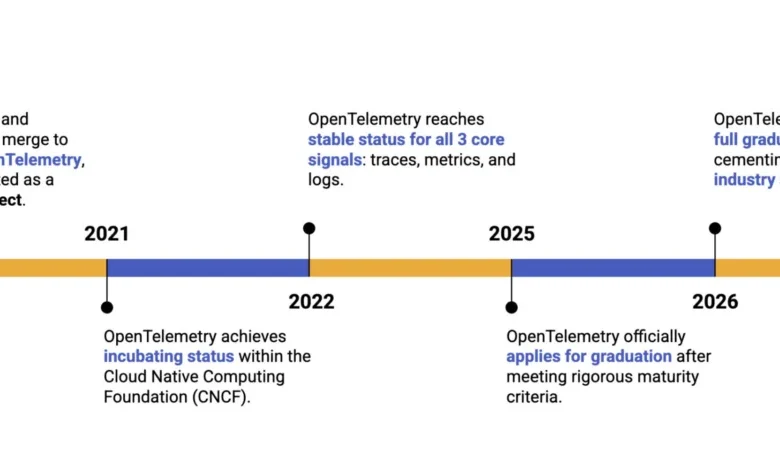
The vision for a truly unified, vendor-neutral observability standard crystalized with the decision to merge OpenTracing and OpenCensus. In May 2019, OpenTelemetry was officially formed, bringing together the strengths and communities of both predecessor projects under a single umbrella. This strategic merger was driven by the overwhelming consensus that a single, comprehensive standard would best serve the burgeoning cloud-native ecosystem. The aim was to eliminate fragmentation, foster interoperability, and provide a consistent approach to telemetry data collection across all types of applications and infrastructure.
OpenTelemetry was designed to take the best aspects of OpenTracing and OpenCensus and expand upon them. It introduced a comprehensive specification for tracing, metrics, and logs, alongside a robust set of standardized APIs and Software Development Kits (SDKs) implemented in numerous programming languages. This allowed developers to instrument their applications once, using a consistent API, and then export telemetry data to any OpenTelemetry-compatible backend, effectively eliminating vendor lock-in at the instrumentation layer. A cornerstone of the OpenTelemetry architecture is the OpenTelemetry Collector, a powerful and flexible agent capable of receiving, processing, and exporting telemetry data in various formats, further enhancing its versatility.
The commitment to a single standard was reinforced by the subsequent archiving of its predecessors: OpenTracing was officially archived in January 2022, followed by OpenCensus in July 2023. This consolidation signaled a clear path forward, with OpenTelemetry emerging as the undisputed heir to the ambition of standardized, open observability. With the backing of virtually all major observability vendors—who actively contribute to and support the project—and a rapidly growing community of developers and end-users, OpenTelemetry quickly cemented its status as the de facto open standard for collecting and exporting telemetry data.
An Accelerated Journey Through the CNCF Lifecycle
OpenTelemetry’s path to graduation within the CNCF ecosystem has been remarkably swift, underscoring its rapid maturation and critical importance. The project initially joined the CNCF as a Sandbox project, a status for nascent projects with potential. It quickly advanced to Incubation status, signifying a higher level of maturity, a growing community, and a commitment to open governance. The final step, Graduation, is reserved for projects that have demonstrated sustained growth, widespread adoption, robust governance, and a strong commitment to project health and security.
OpenTelemetry officially achieved graduated status in May 2026, culminating a journey that began with its incubation in 2025. The CNCF’s graduation criteria are stringent, designed to ensure that graduated projects are stable, secure, and ready for enterprise-scale adoption. To qualify for graduation, projects must fulfill a comprehensive set of requirements, including:
- Diverse and Active Maintainer Base: Demonstrating a healthy number of maintainers from at least two organizations, ensuring the project is not dependent on a single entity.
- Widespread Adoption: Proof of significant usage in production environments by multiple organizations, showcasing real-world applicability and value.
- Commitment to Open Governance: A transparent and well-documented governance model that encourages community participation and fair decision-making.
- Security Audits: Completion of independent security audits to identify and address potential vulnerabilities, ensuring the project’s robustness against threats.
- Clear Project Vision and Roadmap: A well-defined direction for future development and a clear understanding of its role within the cloud-native landscape.
- CNCF Brand Usage: Adherence to CNCF branding guidelines and promotion of the foundation’s values.
The successful navigation of these criteria is a testament to the tireless work of countless individuals. From dedicated OTel maintainers and enthusiastic end-users to influential CNCF Technical Oversight Committee (TOC) members, a vast collaborative effort underpinned this achievement. A special commendation was extended to Austin Parker, an OpenTelemetry Governance Committee member and former Community Manager, who played a pivotal role in leading the complex graduation effort with the CNCF. His leadership was instrumental in coordinating the diverse stakeholders and ensuring all requirements were met.
Unprecedented Growth and Community Momentum
The statistics associated with OpenTelemetry’s growth are nothing short of impressive and speak volumes about its impact. According to the CNCF’s 2025 velocity report, OpenTelemetry stands as the second-highest velocity project within the entire CNCF landscape, trailing only the ubiquitous Kubernetes. This "velocity" metric reflects a project’s sustained activity, measured by factors such as the number of active contributors, commits, pull requests, and overall community engagement. Achieving such a high ranking, especially for a project that is only seven years old, underscores its dynamic development and the immense dedication of its global community.

The CNCF further highlighted the project’s incredible scale: OpenTelemetry boasts over 12,000 contributions from more than 2,800 companies and hundreds of maintainers spread across various language-specific Special Interest Groups (SIGs). This level of collaborative input from such a diverse array of organizations, including competing observability vendors, signifies a truly open and shared commitment to building a common standard. This broad participation ensures that OpenTelemetry remains relevant, adaptable, and robust across a multitude of technological stacks and use cases. The sheer volume of contributions also translates into rapid feature development, bug fixes, and continuous improvement, making OpenTelemetry a highly dynamic and responsive project.
Expanding Horizons: Key Milestones and Ecosystem Evolution
Since its inception, OpenTelemetry has continuously evolved, expanding its capabilities and ecosystem. A crucial milestone was the achievement of General Availability (GA) for its core telemetry signals: traces, logs, and metrics. This GA status signifies that these components are stable, production-ready, and recommended for broad deployment. Beyond these foundational signals, OpenTelemetry has been proactive in addressing emerging observability needs. Notably, "Profiling" was added as a new OTel signal, allowing developers to gain deeper insights into application performance and resource consumption, moving beyond traditional metrics and traces.
The OpenTelemetry Demo, a reference implementation designed to showcase OTel’s capabilities across a microservices architecture, has also significantly expanded, providing a practical blueprint for adoption. Concurrently, the OpenTelemetry Collector, the flexible agent for processing and exporting telemetry, has seen continuous enhancement with new components and integrations added regularly.
The project has also focused on making OpenTelemetry more ergonomic and accessible, leading to the introduction of several key ecosystem components:
- OpAMP (OpenTelemetry Agent Management Protocol): A standardized protocol for managing and configuring OpenTelemetry Collectors and other agents at scale, simplifying operational overhead.
- OpenTelemetry Operator: Designed for Kubernetes environments, this operator streamlines the deployment, configuration, and management of OpenTelemetry Collectors, integrating seamlessly with cloud-native infrastructure.
- OTel Weaver: A tool that assists teams in defining and governing their telemetry schemas, ensuring consistency and correctness across large-scale deployments, which is crucial for effective data analysis.
- OTel Arrow: Leveraging Apache Arrow, OTel Arrow aims to optimize the wire format and processing of telemetry data, significantly improving performance and efficiency, especially in high-volume environments.
These innovations, coupled with the project’s rapid growth and broad adoption, send an unmistakable signal to the industry: OpenTelemetry is not merely a transient trend but a foundational technology built for longevity. Its graduation solidifies this promise, providing a stamp of approval for its stability and future trajectory.
The Significance of Graduation: A New Era for Observability
OpenTelemetry’s graduation to CNCF status carries profound implications for organizations of all sizes, especially those that may have previously hesitated to fully embrace an emerging standard. As Dan Gomez Blanco, a maintainer of the OTel End User SIG, eloquently articulated in a recent LinkedIn post, "For end users, this graduation signals that OTel is far from being an ’emerging standard’. Its contributor health, security and quality standards, governance processes, and wide adoption have been evaluated to be at the level required by any enterprise, of any scale."
This statement encapsulates the core message of graduation: OpenTelemetry is unequivocally production-ready and fully open for business. For the segment of "skeptics" or organizations that were holding out due to concerns about maturity, long-term viability, or enterprise-readiness, these excuses are now nullified. Graduation provides the ultimate seal of approval from the CNCF, an independent body renowned for fostering robust and impactful cloud-native projects. It signals that OpenTelemetry has demonstrated:
- Enterprise-Grade Stability: A project that has passed rigorous evaluation and is deemed stable enough for mission-critical workloads.
- Robust Security: Completion of security audits addresses common enterprise concerns regarding data integrity and system vulnerabilities.
- Sustainable Governance: A transparent and diverse governance model ensures the project’s long-term health and prevents single-vendor influence.
- Vibrant Community Support: The sheer volume of contributions and diverse company involvement guarantees ongoing development and support.
- De Facto Industry Standard: Its position as the dominant standard simplifies integration, reduces complexity, and promotes interoperability across the observability ecosystem.
For decision-makers in large enterprises, this graduation significantly de-risks adoption. It provides the confidence needed to invest heavily in OpenTelemetry-based observability strategies, knowing they are aligning with a stable, secure, and universally supported open standard. This will likely accelerate the transition away from proprietary instrumentation and further entrench OpenTelemetry as the foundational layer for all cloud-native observability initiatives.
Looking Ahead: The Future of OpenTelemetry
While graduation marks a significant achievement, the OpenTelemetry project is far from "done." Software is an ever-evolving entity, and OpenTelemetry will continue to grow and adapt to the dynamic demands of modern software development. The roadmap ahead is rich with innovations across its specification, API & SDK implementations, the Collector, and beyond.
A key area of focus is extending observability to new and complex types of workloads. The rapid emergence of agentic workflows and large language models, particularly in the realm of Generative AI, presents unique challenges for monitoring. OpenTelemetry is actively addressing this through the development of generative AI semantic conventions, designed to standardize how telemetry data is captured from these novel systems, enabling clearer insights into their performance, costs, and decision-making processes.
Furthermore, areas that historically received less attention are now coming into sharper focus, such as browser and mobile observability. As applications increasingly rely on sophisticated front-end experiences and ubiquitous mobile access, providing end-to-end visibility from the user’s device to the backend services becomes paramount. OpenTelemetry aims to extend its reach to these critical client-side environments, offering a unified observability story across the entire application stack.
For more mature organizations already leveraging OpenTelemetry, the focus shifts to scaling and governance. Tools like OTel Weaver are crucial here, helping teams define and enforce consistent telemetry schemas across vast microservice landscapes. This ensures data quality and facilitates meaningful analysis at scale. The project is also committed to making OpenTelemetry even easier to roll out and manage. Initiatives such as OpenTelemetry Packaging aim to bundle components into easily installable modules, streamlining deployment. Moreover, the OpenTelemetry Injector promises to enable zero-code instrumentation, significantly lowering the barrier to entry by automatically injecting instrumentation into applications without requiring manual code changes.
OpenTelemetry’s future is vibrant and expansive. Its continued success hinges on the sustained dedication of its maintainers and contributors, coupled with the ongoing support and enthusiastic adoption from its growing community of end-users. The journey so far has been transformative, and the road ahead promises even greater innovation, further solidifying OpenTelemetry’s role as the indispensable backbone of modern observability. The community eagerly anticipates the next phase of this exciting journey, inviting all stakeholders to contribute to and benefit from its evolution.
Related posts: