Scaling Enterprise Hybrid Cloud Operations Through AWS Serverless and Amazon EKS Anywhere Architecture


Managing distributed, geographically dispersed data centers has historically presented a staggering operational challenge for enterprise infrastructure teams. As businesses expand their digital footprints to edge locations, regional hubs, and compliance-restricted territories, the sheer volume of bare-metal servers, networking gear, and containerized workloads requires unprecedented levels of coordination. Traditional, siloed management tools often falter when tasked with simultaneously provisioning thousands of machines across disparate facilities. In response to these escalating demands, systems architects are increasingly turning to cloud-native orchestration engines powered by AWS serverless technologies and Amazon EKS Anywhere to establish centralized oversight while preserving localized execution.
The Operational Dilemma of Distributed Infrastructure
At the core of the hybrid cloud challenge lies a fundamental tension between centralized governance and decentralized execution. Enterprises operating across hundreds of independent sites frequently encounter severe architectural friction. Inconsistency across geographical locations remains a persistent hurdle; variations in hardware vendors, local network topologies, and regional compliance mandates mean that a standardized procedure—such as deploying a specific version of a Kubernetes cluster—frequently yields divergent results depending on the facility. Without a cohesive, centralized orchestration framework, identical management commands can succeed in one region while failing catastrophically in another.
Furthermore, manual lifecycle bottlenecks compound these vulnerabilities. The modern infrastructure lifecycle spans multiple intricate layers, ranging from foundational hardware tasks—such as BIOS configurations, firmware updates, and power management—to operating system provisioning, Kubernetes cluster orchestration, and application maintenance. While handling these processes for a single data center is a routine administrative task, multiplying these workflows across thousands of remote machines transforms manual intervention into an operational bottleneck.
Fragmented visibility further degrades enterprise readiness. When management tools operate in isolation at each site, aggregating telemetry and systemic health data becomes nearly impossible. Infrastructure operators struggle to answer enterprise-wide inquiries, such as identifying which servers are running outdated, vulnerable firmware or determining which regional clusters are approaching compute capacity thresholds. Finally, scalability limitations inherent in legacy data center tools become pronounced at enterprise scale. Synchronization mechanisms designed for dozens of nodes routinely fail when forced to coordinate thousands of concurrent state changes, turning routine maintenance windows into logistical nightmares.
Foundational Technologies Driving Hybrid Orchestration
To overcome these structural limitations, modern hybrid orchestration solutions leverage a synchronized quartet of core technologies: secure hybrid connectivity, an advanced AWS serverless architecture stack, vendor-agnostic hardware APIs, and container management platforms like Amazon EKS Anywhere.
Secure hybrid connectivity forms the indispensable foundation of this architecture. Utilizing AWS Direct Connect for dedicated private circuits or AWS Site-to-Site VPN for encrypted internet-based tunnels, organizations establish a reliable bridge between their AWS Virtual Private Cloud (VPC) and on-premises environments. This robust network pipeline enables cloud-based services to safely coordinate lifecycle commands with physical servers located thousands of miles away.
Complementing this connectivity is the AWS serverless architecture stack, anchored by Amazon EventBridge for event-driven automation, AWS Lambda for compute execution, AWS CodeBuild for compilation processes, AWS Batch for heavy batch processing, and AWS Systems Manager for direct on-premises task execution. Together, these services provide a highly scalable framework capable of managing diverse runtimes without forcing administrators to provision or maintain underlying compute infrastructure.
For hardware-level interactions, the integration of Distributed Management Task Force (DMTF) Redfish APIs provides a standardized, vendor-agnostic methodology for bare-metal control. By leveraging Redfish, engineering teams can automate BIOS modifications, firmware patching, and power cycle routines across heterogeneous hardware fleets from major enterprise vendors.
Finally, Amazon EKS Anywhere enables organizations to run native Kubernetes clusters directly on their own local hardware using the exact same Amazon EKS Distro that powers Amazon EKS in the cloud. For scenarios where regulatory mandates, strict data sovereignty policies, or Disconnected, Interrupted, Limited, or Low-bandwidth (DDIL) network conditions prevent cloud-hosted control planes, EKS Anywhere keeps the control plane securely on-premises while centralizing management from AWS.
Anatomy of the Event-Driven Orchestration Engine
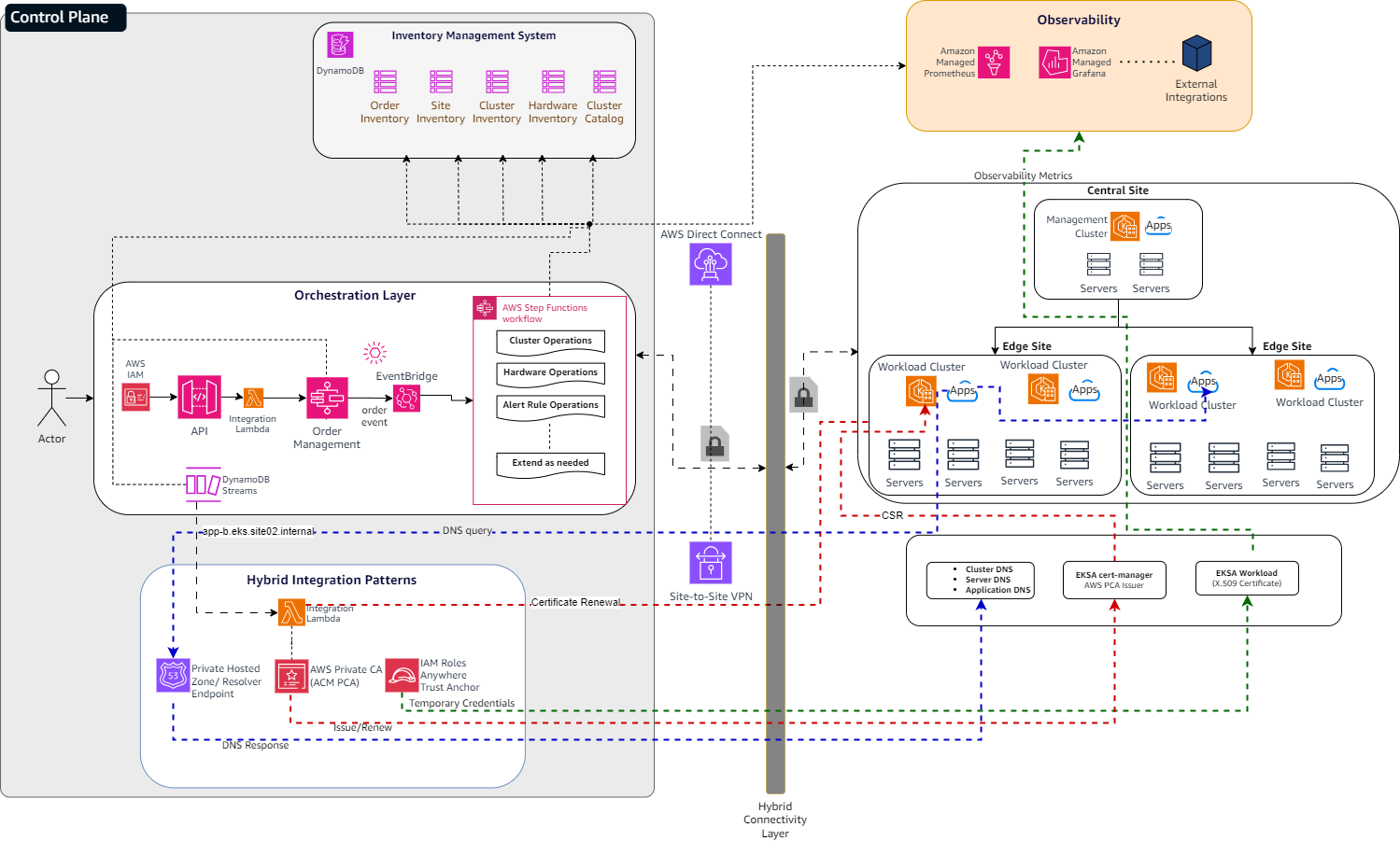
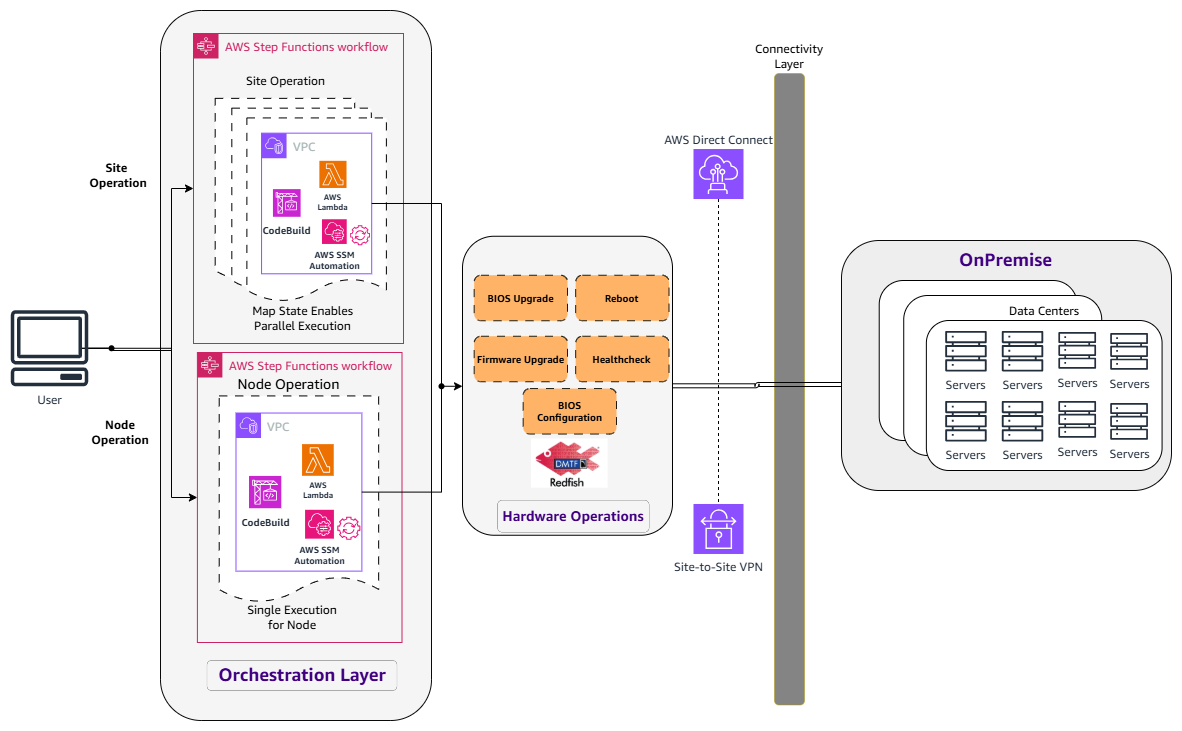
The architectural blueprint of this hybrid solution is systematically divided into three primary tiers: a centralized AWS-hosted orchestration engine, distributed on-premises infrastructure executing EKS Anywhere workloads, and the hybrid networking layer linking them. Central to this architecture is a sophisticated Inventory Management System operating on Amazon DynamoDB. These DynamoDB tables act as the single source of truth, maintaining comprehensive records of physical sites, hardware specifications, cluster configurations, active orders, and reusable deployment blueprints.
The orchestration layer itself relies heavily on AWS Step Functions to manage intricate state machines that coordinate compute, storage, and networking operations. A critical feature for hybrid architectures is the Step Functions callback pattern. Because on-premises operations such as firmware updates or operating system deployments can take hours or even days to complete, workflows can safely pause execution, issue a task token to an external system, and remain dormant until the local infrastructure signals completion via a secure callback. Additionally, the Distributed Map state enables these workflows to scale seamlessly from updating a single server to executing parallel operations across thousands of nodes simultaneously.
Order Management and Lifecycle Execution Framework
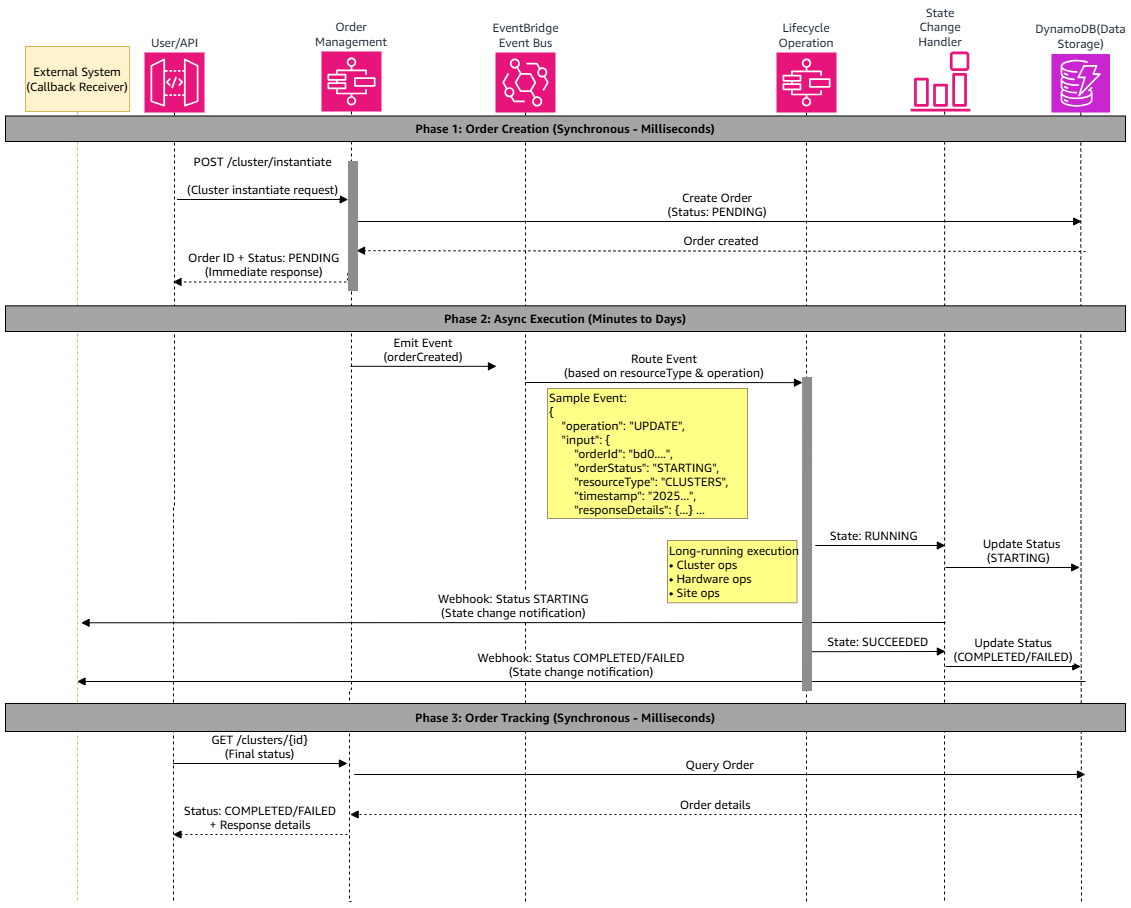
Operations within this ecosystem are governed by an advanced order management framework. When an operator initiates an action—such as terminating a cluster or updating server firmware—via the Amazon API Gateway, an Amazon EventBridge rule immediately routes the request to the appropriate Step Functions workflow. The system instantly generates a unique order ID and records the transaction in DynamoDB, returning an asynchronous confirmation to the user while execution proceeds in the background.
This order management paradigm guarantees robust lifecycle tracking, complete with an immutable audit trail from initiation to completion. It also incorporates built-in conflict management; by evaluating current resource states in the inventory repository, the engine automatically rejects conflicting commands—such as attempting to scale a Kubernetes cluster while an underlying node upgrade is already in progress.
The lifecycle framework specifically addresses the dual demands of hardware and cluster management. Hardware management utilizes Redfish APIs to automate power state transitions, firmware rollouts, and hardware health diagnostics across distributed sites. Meanwhile, cluster management leverages EKS Anywhere to provision management and workload clusters consistently. By combining a predefined cluster configuration blueprint from a centralized catalog with a hardware inventory CSV detailing target bare-metal servers, the orchestration engine utilizes AWS Systems Manager and AWS Batch to deploy operating systems, configure networks, and launch fully operational Kubernetes clusters with minimal human intervention.
Comprehensive Monitoring, Observability, and Hybrid Integration
Addressing the historical challenge of fragmented visibility, this architecture deploys the AWS Distro for OpenTelemetry (ADOT) as a collector across every EKS Anywhere cluster. These collectors aggregate metrics spanning the hardware, Kubernetes container, and application layers, forwarding them directly to Amazon Managed Service for Prometheus within the designated AWS Region. Enterprise operators gain a unified, single-pane-of-glass operational view through Amazon Managed Grafana dashboards, allowing them to monitor server health, cluster availability, and application performance in real time.
Furthermore, seamless hybrid integration patterns ensure that on-premises applications remain deeply connected to cloud-native services. Automated DNS management via DynamoDB Streams and Amazon Route 53 private hosted zones facilitates effortless service discovery across both environments. Certificate lifecycle operations are fully automated using AWS Private Certificate Authority in tandem with cert-manager, mitigating the risk of operational outages caused by expired certificates. Secure API access is established via AWS IAM Roles Anywhere, allowing workloads running on-premises to exchange local certificates for short-lived AWS credentials without storing long-term static secrets on physical servers.
Strategic Implications and Industry Outlook
The deployment of a serverless-driven hybrid cloud orchestration engine represents a significant maturation in enterprise infrastructure management. By bridging the gap between hyperscale cloud capabilities and distributed on-premises reality, organizations can eliminate the operational overhead traditionally associated with managing remote bare-metal fleets. Industry analysts note that as edge computing continues to expand across retail, manufacturing, telecommunications, and financial services sectors, automated orchestration frameworks of this caliber will transition from advanced capabilities to baseline operational necessities.
As enterprises look toward the future, the integration of event-driven automation, vendor-agnostic hardware management, and consistent containerized infrastructure establishes a resilient foundation capable of scaling alongside evolving technological demands. Organizations adopting these patterns position themselves to achieve unprecedented operational consistency, drastically reduced administrative friction, and robust compliance adherence across their entire global footprint.
Related posts: