The digital landscape is once again witnessing the resurrection of one of the internet’s most storied brands. Digg, the pioneering social news aggregator that once defined the early Web 2.0 era, has officially emerged from a brief, tumultuous hiatus. This latest iteration, spearheaded by original founder Kevin Rose, marks a dramatic departure from the failed Reddit-style community forum model that shuttered earlier this year. Instead of attempting to replicate the crowded landscape of decentralized social forums, the reborn Digg is positioning itself as a sophisticated, AI-driven signal detection engine, initially focusing on the high-velocity world of artificial intelligence news.
A Chronology of the Second Reboot
The trajectory of Digg over the past eighteen months has been characterized by aggressive experimentation and rapid course correction. In January 2026, the company launched a high-profile platform designed to compete directly with Reddit. The premise was to capture a segment of the user base seeking a more curated alternative to the increasingly fragmented forum giant. However, the endeavor faced immediate technical and strategic hurdles.
By March 2026, the company announced the cessation of its mobile application and a significant reduction in staff. The platform struggled to differentiate its value proposition in a saturated market and found itself overwhelmed by automated bot traffic, which compromised the integrity of its community-driven rankings. Following the shutdown, Kevin Rose—who had transitioned into a role as a partner at the venture capital firm True Ventures—returned to a full-time leadership position in April 2026 to oversee a complete strategic pivot.
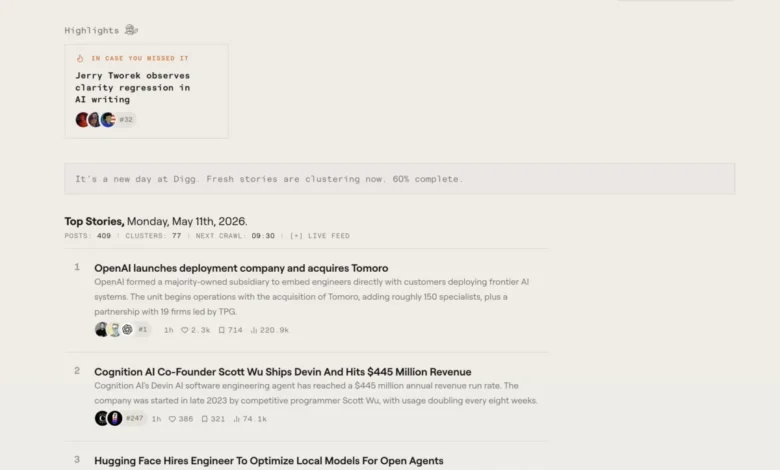
The "Version 3" launch, previewed on Friday evening, abandons the user-generated content model entirely. In its place, the new Digg utilizes a proprietary backend system designed to ingest, aggregate, and rank news based on real-time engagement data pulled from the social platform X. The beta version, currently accessible via a minimalist interface, is focused exclusively on the AI sector, with plans for horizontal expansion into other high-interest verticals if the model proves viable.
The Mechanism of Modern Curation
Unlike the original Digg, which relied on users manually "digging" or "burying" links, the new iteration acts as an automated intelligence layer. The platform’s homepage is architected to highlight the hierarchy of information through four distinct lenses: the most viewed story, the story experiencing the highest growth in discussion, the fastest-climbing headline, and an editorial "In case you missed it" curation.
Beneath the primary hero section, the site displays a ranked list of the day’s top AI developments. What sets this apart from a standard RSS reader or a Twitter "For You" feed is the underlying data processing. Digg is performing sentiment analysis, linguistic clustering, and signal detection on the firehose of data flowing from X. The goal is to strip away the "noise"—the repetitive, low-value commentary—and identify the stories that carry genuine weight.

Kevin Rose has noted that the platform is specifically designed to track the "chain reaction" of information. For instance, when an industry leader like OpenAI CEO Sam Altman engages with a specific topic or link, the platform detects the resulting surge in discussion, sentiment shift, and cross-platform propagation. By quantifying these signals, Digg aims to provide a reliable indicator of what is actually worth the reader’s attention in an era of information overload.
The Challenges of Market Saturation
Despite the technical ambition of this new model, industry analysts remain cautious about the platform’s long-term sustainability. The primary challenge lies in the shifting dynamics of online discourse. While AI-related news is currently heavily concentrated on X, other subject matters are increasingly siloed across a variety of competing platforms, including Meta’s Threads, Bluesky, and private, invite-only communities.
Furthermore, the "attention economy" has evolved since Digg’s heyday in the late 2000s. Users now have access to a multitude of sophisticated tools for news consumption, from personalized algorithmic feeds to AI-powered summaries provided by major search engines. The new Digg does not currently host its own community discussion forums, which creates a potential "read-only" experience that may struggle to foster the user retention necessary for a social-leaning brand.
The company has acknowledged these growing pains, explicitly informing beta testers that the current version is "buggy" and "raw." The absence of an integrated discussion layer suggests that Digg is positioning itself as a utility tool—an aggregator for professionals—rather than a destination for social interaction. Whether this is enough to lure users away from their established habits remains the central question facing the startup.
Broader Implications for the Publishing Ecosystem
One of the most significant, if secondary, implications of this pivot is the potential impact on the struggling digital publishing industry. For years, independent websites have faced an existential crisis characterized by a precipitous decline in organic referral traffic. This decline has been accelerated by two major factors: the evolution of Google’s search algorithms, which increasingly prioritize direct answers within the search results page, and the rise of "AI Overviews," which often provide a summary of content without requiring the user to click through to the source.
If the new Digg succeeds in becoming a high-traffic destination for those seeking reliable, curated news, it could provide a much-needed lifeline for publishers. By acting as a sophisticated discovery engine, the site could serve as a valuable conduit for traffic, funneling readers to original reporting rather than keeping them within a closed ecosystem.
This model mirrors the early promise of the internet’s "referral economy," though it remains to be seen if the current economic incentives of the web can support such a platform. Publishers have historically been wary of aggregators that capture the value of their content, but in a post-Google-dominance landscape, a high-quality, traffic-driving intermediary might be welcomed by those who have seen their search-driven revenue evaporate.

Data-Driven Value vs. User Fatigue
The new Digg’s focus on the top 1,000 entities—including the most influential individuals, companies, and political figures involved in AI—is a clear attempt to provide high-value data to a professional audience. For data analysts and industry observers, the ability to view charts and graphs illustrating the rise of specific narratives is a compelling proposition.
However, the leap from a niche tool for "data nerds" to a mainstream destination is a significant one. The core value proposition of the original Digg was its ability to democratize the news cycle; the new Digg is attempting to professionalize and automate it. By removing the human element of voting and replacing it with sentiment analysis and engagement metrics, the platform is betting that users prefer precision and speed over community-driven serendipity.
The Road Ahead
As Digg continues its beta phase, its success will likely hinge on three key factors: the accuracy of its signal detection, the platform’s ability to expand beyond the narrow confines of the AI industry, and the maintenance of a user experience that justifies a daily visit.
The history of the tech industry is littered with "zombie" brands that failed to recapture their past glory through repeated pivots. However, the current environment—where the demand for curated, high-quality information has arguably never been higher—offers a unique opening. By leaning into its identity as a filter for the digital age, Digg is attempting to solve a problem that is becoming more acute by the day: how to find the signal in an ocean of AI-generated content and platform-driven noise.
Whether or not the brand can shed the baggage of its past iterations and establish itself as a modern utility remains to be seen. For now, the "reborn" Digg stands as a testament to the persistent allure of the brand name and the ongoing struggle to define the future of news aggregation in a post-search, AI-dominated world. The company has not yet provided a definitive timeline for a full public launch, but the initial response from the tech community suggests a cautious curiosity. The coming months will determine if this latest chapter is a genuine resurgence or merely another transient attempt to regain relevance in an increasingly fragmented digital ecosystem.