California Fuel Pumps Max Out at $9.999 as U.S. Diesel Crisis Deepens Amid Global Supply Shocks

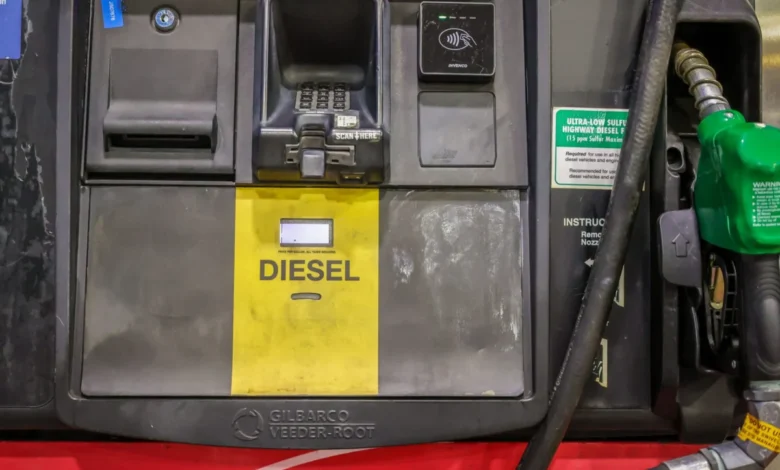
The American energy landscape is facing an unprecedented crisis as diesel fuel prices surge to historic highs, pushing retail infrastructure to its absolute limits. In California, the financial strain has reached a literal breaking point at the pump, where select fueling stations have watched prices climb so aggressively that their digital price boards have maxed out at $9.999 per gallon.
Fuel-tracking firm GasBuddy confirmed that pumps in the San Diego suburb of Serra Mesa displayed the hard-coded maximum of $9.999 on Wednesday. This milestone coincided with California’s statewide average for diesel reaching an alarming $7.91 per gallon. While Patrick De Haan, head of petroleum analysis at GasBuddy, noted that stations occasionally program the $9.999 figure as an emergency placeholder to deter motorists when supplies run entirely dry, multiple retail locations across the Golden State are genuinely pricing their diesel well north of $9.00 per gallon.
The local pricing anomaly mirrors a grim national reality. For the first time in history, the U.S. national average for diesel surpassed the $6-per-gallon threshold. Industry analysts warn that relief is nowhere in sight, with projections indicating the national average could realistically climb to $7.00 per gallon in the weeks ahead. The convergence of geopolitical conflicts, infrastructure vulnerabilities, and shrinking global refining capacities has created a perfect storm that threatens to upend supply chains and accelerate inflation across every sector of the economy.
A Chronology of Escalation: How the Energy Crunch Unfolded
The current energy emergency is the culmination of months of geopolitical tension and strategic supply disruptions that have progressively tightened global petroleum markets.
The trajectory of the crisis accelerated significantly over the spring and summer months, driven heavily by intensifying conflicts in the Middle East. The disruption began to severely impact maritime trade routes, particularly around the critical Red Sea corridor, where persistent Yemeni Houthi rebel attacks hindered commercial shipping and energy transit.
By early September, the situation deteriorated further as hostilities directly impacted major energy installations and vital transit chokepoints. On September 10, the global benchmark for crude oil spiked by nearly 8 percent in a single session, surging from $101 to $109 per barrel—marking the highest valuation recorded since May. Concurrently, the national average for regular unleaded gasoline in the United States climbed to $4.27 per gallon on September 10, establishing a record high for the month of September.
As autumn arrived, the combination of halted maritime traffic through the Strait of Hormuz and targeted strikes on Saudi energy infrastructure choked off petroleum flows. OPEC data revealed that Saudi Arabia’s crude oil production in August plummeted to 6.2 million barrels per day—its lowest output level since 1990—down sharply from pre-conflict baseline levels of approximately 10 million barrels per day. With international supplies severely constrained, governments and markets have found themselves fighting a losing battle against rapidly depleting stockpiles.
The Disconnect Between Crude, Gasoline, and Diesel
While motorists often focus heavily on the daily fluctuations of regular unleaded gasoline, energy economists and market forecasters emphasize that diesel represents the true vulnerability within the modern economic engine.
Gasoline prices impose an immediate psychological and financial toll on everyday commuters, but diesel fuels the commercial apparatus of global commerce. Heavy-duty trucking fleets, freight rail networks, maritime shipping components, and the agricultural sector rely almost exclusively on diesel fuel to operate.
The timing of the current diesel spike could not be worse for the agricultural industry. September marks the traditional commencement of the harvest season across the United States. Farming operations rely heavily on diesel-powered tractors, combines, harvesters, and transport trucks to bring crops from fields to processing plants and distribution centers. The exorbitant cost of fueling these commercial vehicles guarantees that higher energy expenses will rapidly cascade through the supply chain, inevitably driving up the cost of groceries and consumer goods.
According to cumulative industry estimates, the elevated pricing environment for gasoline and diesel is costing American consumers and businesses upwards of $700 million more per day compared to the same period in the previous year. Analysts suggest that if current trajectories hold, this daily economic drag could easily swell to $1 billion per day.
Structural Vulnerabilities and the Absence of a Strategic Fuel Buffer
A critical structural flaw compounding the current crisis is the distinct lack of a federal reserve dedicated specifically to refined products. While governments worldwide maintain strategic petroleum reserves of unrefined crude oil—with the U.S. Strategic Petroleum Reserve recently depleting to 44-year lows due to repeated drawdowns—no equivalent national stockpile exists for diesel or refined gasoline.
This absence of a secondary buffer leaves the refined products market entirely exposed to domestic and international refinery bottlenecks. Industry experts point out a harsh long-term reality: no new major oil refineries have been constructed in the United States in decades. Consequently, existing refining capacity is operating near maximum limits, leaving zero margin for error when geopolitical events disrupt crude feedstock inputs.
"The global market is competing for a limited supply of diesel. So, at what point do we worry? We worry now," said Dan Pickering, founder of Pickering Energy Partners. "Prices are quite high, and there’s no easy relief valve. Nobody is building new oil refineries."
The supply crunch is further compounded by international disparities. While the situation in the United States is historically severe, pockets of absolute fuel shortages, higher absolute pricing, and acute inflationary pressures are projected across international markets, particularly in developing economies dependent on imported refined products.
Official Responses and Economic Policy Implications
Political leaders and economic policymakers are grappling with limited immediate policy levers to stem the tide. President Donald Trump acknowledged the longevity of the crisis this week, expressing resignation that the ongoing conflict involving Iran is likely to persist at least through November, with potential stabilization anticipated only in the aftermath of the midterm elections.
In the absence of a swift diplomatic breakthrough or a sudden reopening of the Strait of Hormuz, energy analysts argue that the market’s self-correction mechanism will rely on painful economic contraction. Susan Bell, senior vice president at Rystad Energy, noted that high prices may ultimately serve as the only mechanism capable of balancing supply and demand through forced consumption reduction.
"I hate to say it, but we need prices at the pump to go up higher to encourage consumers to make choices on their energy consumption. We need more global austerity measures," Bell stated.
For everyday drivers encountering $9.999 displays at California fueling stations, and for logistical operators calculating the rising cost of freight transport, the abstract concept of market rebalancing translates directly into severe operational strain. As Patrick De Haan of GasBuddy reflected on seeing the first maximum-out price displays, the sentiment in the industry is one of profound apprehension. Having previously viewed such numbers as theoretical outliers, energy analysts now view them as the stark leading edge of a persistent economic storm heading in the wrong direction.