Vessel-specific voyage optimization with machine learning: Manta on AWS | Amazon Web Services

The global maritime industry faces an escalating dual mandate: drastically reducing carbon emissions to meet stringent international environmental regulations while simultaneously navigating volatile bunker fuel markets that directly impact operational profitability. Historically, shipowners and fleet managers have relied on generalized, vessel-type averages to predict voyage performance, plan routes, and estimate fuel consumption. However, these broad benchmarks frequently fail to account for the unique physical and operational realities of individual ships. Factors such as varying hull roughness, specific machinery health, loading patterns, draft configurations, and individual crew operational practices introduce massive performance discrepancies even between seemingly identical sister ships. Recognizing this critical industry blind spot, Manta Marine Technologies has developed a specialized, machine learning-driven voyage optimization platform built entirely on Amazon Web Services. By training custom predictive models on the historical operational data of each individual vessel and integrating real-time weather and ocean forecasts, Manta is enabling maritime operators to achieve unprecedented levels of fuel efficiency, cost reduction, and decarbonization.
The Technological Architecture: Cloud-Native Infrastructure on AWS
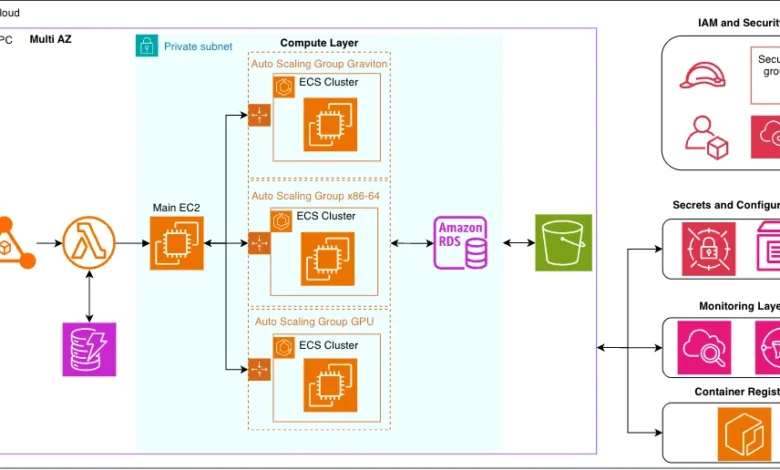
To process and analyze the staggering volumes of operational data required for vessel-specific modeling—sometimes handling up to three billion data points in a single training iteration—Manta engineered a robust, scalable, and highly secure cloud architecture deployed across multiple Availability Zones within an Amazon Virtual Private Cloud. At the center of this infrastructure sits Apache Airflow, running on persistent Amazon Elastic Compute Cloud instances to handle complex workflow orchestration. Rather than utilizing serverless containers exclusively, Manta delegates its heavy computational tasks—including extract, transform, and load pipelines, machine learning model training, and continuous voyage optimization calculations—to Amazon Elastic Container Service tasks running directly on dedicated EC2 capacity.
This deliberate architectural choice provides Manta with granular control over instance types, enabling the engineering team to leverage specialized hardware, including graphics processing units and custom ARM-based processors, tailored precisely to the demands of specific workloads. The infrastructure employs a strict isolation strategy, defining separate Auto Scaling groups, launch templates, and capacity providers for distinct instance types. Time-sensitive voyage optimization tasks are routed to On-Demand capacity for guaranteed performance, whereas less urgent data processing jobs utilize cost-effective Spot instances. Furthermore, AWS Lambda serves as the lightweight entry point for client application requests, dynamically triggering Airflow directed acyclic graphs or retrieving pre-processed database results. Container images are meticulously managed and segregated within Amazon Elastic Container Registry, categorizing builds by architecture—such as Graviton versus x86-64—and specialized operational use cases.
Data Management, Security, and Observability Protocols
Managing sensitive maritime telemetry, proprietary performance logs, and continuous environmental forecasts demands rigorous security frameworks and resilient data persistence layers. Manta relies on Amazon Relational Database Service and Amazon DynamoDB for structured and high-velocity data storage, ensuring that historical records are immediately accessible for iterative model training. Operational security is enforced through a strict implementation of the principle of least privilege, wherein every individual system component and service is assigned a dedicated AWS Identity and Access Management role restricted solely to the permissions necessary for its specific function.
Encryption is maintained across all operational vectors utilizing AWS Key Management Service, safeguarding data both at rest and in transit. Meanwhile, confidential application parameters, database connection strings, and third-party authentication tokens are securely managed via AWS Secrets Manager and AWS Systems Manager Parameter Store. To maintain high availability and operational transparency across globally distributed fleets, Manta integrates Amazon CloudWatch for comprehensive system monitoring and Amazon Simple Notification Service for automated alerting, allowing engineering teams to proactively detect and resolve anomalies before they impact client-facing voyage recommendations.
Driving Cost Efficiency and Performance with AWS Graviton
As maritime data telemetry expands rapidly with the proliferation of Internet of Things sensors and high-frequency satellite communications, managing cloud infrastructure expenditures is paramount. To optimize operational costs without sacrificing compute power, Manta has aggressively integrated AWS Graviton-based processors into its data pipelines and workload execution environments. Internal metrics and benchmark analyses indicate that migrating heavy ETL pipelines and data processing tasks to Graviton-based Amazon EC2 instances yields approximately 25 to 30 percent better price performance compared to legacy x86 architectures, aligning closely with broader AWS benchmarks showing potential improvements of up to 40 percent.
This economic efficiency directly influences the company’s experimental and developmental pipelines. Manta’s engineering teams can perform rigorous local validation of machine learning algorithms using representative data samples before scaling experiments up to production levels. Because the development environment mirrors the exact containerized images used in production, validated machine learning models transition seamlessly to full-scale deployment on AWS without requiring extensive re-engineering or infrastructure provisioning. Scaling a successfully verified optimization algorithm across an entire global fleet becomes a routine scheduling decision managed by the Airflow scheduler rather than a disruptive engineering project.
The Continuous Learning Loop and Fleet-Wide Implications
The defining characteristic of Manta’s platform is its self-improving feedback loop. Traditional routing tools rely on static algorithms that remain stagnant after deployment. In contrast, Manta’s infrastructure is designed to learn continuously from reality. As a vessel completes a voyage, all newly generated operational telemetry—including actual fuel burn, speed profiles, and encountered sea states—is ingested back into the data infrastructure. An automated scheduling mechanism evaluates the volume of newly accumulated data for that specific vessel and triggers a targeted model retraining task. Consequently, the optimization guidance provided for subsequent voyages becomes increasingly refined, aligning ever more closely with the vessel’s actual physical condition and behavior over time.
For shipowners and fleet managers navigating an increasingly stringent regulatory landscape governed by the International Maritime Organization’s carbon intensity metrics, the implications of this technology are profound. Transitioning away from generalized industry benchmarks and vessel-type averages allows operators to make precision operational adjustments that simultaneously lower operating expenses and curb greenhouse gas emissions. Based on comprehensive internal voyage simulations conducted across active commercial fleets, Manta projects tangible fuel savings of approximately 2 to 4 percent per vessel. While these figures represent immediate financial and environmental gains, the company anticipates compounding efficiency improvements as machine learning models absorb longer operational histories and incorporate advanced atmospheric and oceanic datasets.
Future Outlook and Industry Integration
As the maritime sector accelerates its digital transformation, solutions that bridge the gap between abstract theoretical efficiency and concrete operational reality will define industry leaders. By combining deep maritime operational expertise with a highly scalable, secure, and cost-optimized cloud-native architecture on AWS, Manta Marine Technologies has established a robust framework for modern voyage optimization. The ability to deliver individualized, self-updating performance guidance to vessels operating worldwide underscores the transformative potential of applied machine learning in heavy industries. As computational capabilities expand and data granularity improves, cloud-backed marine analytics will likely transition from a competitive differentiator to an essential baseline requirement for sustainable global maritime commerce.