Optimizing Eclipse Dataspace Components Deployments on AWS: A Comprehensive Guide to Cost Control and Well-Architected Principles

When deploying Eclipse Dataspace Components (EDC) connectors on Amazon Web Services (AWS), one of the foremost challenges organizations encounter is accurately predicting and effectively controlling the associated infrastructure costs. Without robust benchmarks and a clear understanding of cost drivers, making informed decisions regarding workload sizing, environment configuration, and long-term investment strategies becomes inherently difficult, potentially hindering the broader adoption of secure data sharing initiatives. This article, the concluding part of a three-part series, delves into the critical aspects of performance efficiency, cost optimization, and sustainability within the context of EDC deployments on AWS, building upon previous discussions on foundational architectures and production-ready patterns.
The journey to mastering EDC deployments on AWS began with Part 1, which established the fundamentals of data space architectures and the role of EDC, adhering to the stringent standards set by the International Data Space Association (IDSA). This foundational understanding is crucial for appreciating the technical complexities and strategic importance of data sovereignty and secure data exchange. Following this, Part 2 advanced the discussion by exploring production-ready architectural patterns for deploying EDC connectors on AWS, emphasizing pillars such as operational excellence, security, and reliability. These elements are non-negotiable for enterprise-grade data sharing, ensuring that data exchanges are not only efficient but also resilient and protected against evolving threats. This final installment now turns its focus to the economic and ecological dimensions, providing actionable insights into which AWS services primarily drive costs in an EDC connector deployment, how to meticulously estimate monthly expenditures for both business-critical and non-critical workloads, and crucially, how to implement sophisticated optimization strategies capable of reducing spending by up to 58%. This holistic approach ensures that organizations can harness the power of data spaces without incurring prohibitive costs, making secure, sovereign data exchange a financially viable reality.
Understanding the Economic Landscape of Data Space Deployments
Data spaces represent a paradigm shift in how organizations collaborate and share data, establishing secure, sovereign environments that enable controlled data exchange across independent entities. These architectures are pivotal for fostering collaborative innovation, enabling new business models, and enhancing data-driven decision-making, all while empowering participants to maintain full control over their data and strictly adhere to data sovereignty principles. However, the infrastructure costs associated with these advanced architectures can fluctuate significantly, primarily influenced by performance and reliability requirements, as well as the sheer volume and velocity of data traversing the network.
It is vital to distinguish between two primary types of infrastructure within a data space ecosystem. A Dataspace Governance Authority (DSGA) is responsible for centrally establishing core components such as management, identity, and discovery functions, forming the backbone of the data space. Conversely, individual participants — acting as data providers and consumers — host their own components, most notably the EDC connector. This article’s analysis is specifically concentrated on the costs directly linked to EDC connector deployment on the participant side, offering a granular view for organizations looking to engage in data spaces.
Establishing a Baseline: Fictional Usage Assumptions for Cost Estimation
To provide a concrete and relatable framework for cost estimation, a set of technical and operational assumptions serves as a critical baseline. These assumptions, while fictional, are derived from typical usage patterns observed in real-world data space initiatives and are designed to facilitate informed financial planning for potential participants.
Detailed Technical Assumptions
| Category | Assumption | Justification |
|---|---|---|
| Data Volume | 5 GB per participant | Includes 6 months of historical data and necessary backups, reflecting typical retention policies. |
| Network Traffic | 20 GB/month per participant | Represents data transfers between participants, accounting for collaborative exchanges. |
| API Calls | 100,000/month per participant | Encompasses catalog queries, contract negotiations, and data transfers, reflecting active participation. |
| OAuth Token Requests | 1,000/month per participant | Crucial for machine-to-machine authentication required for secure data plane operations. |
Table 1: Technical assumptions for EDC connector cost estimation
These assumptions are not arbitrary; they reflect a balanced scenario where a participant is actively engaging in data sharing without operating at an extreme scale. For instance, 5 GB of data volume for historical data and backups is a common starting point for small to medium-sized datasets, while 20 GB of network traffic suggests a moderate level of data exchange activity. The 100,000 API calls per month signifies regular interaction with the data space, from discovering available datasets to executing data transfers, underlining the operational activity of an EDC connector.
Operational Assumptions
While not explicitly detailed in the original extract, typical operational assumptions for such a deployment would include:
- Region: A specific AWS region (e.g.,
us-east-1oreu-central-1) as pricing varies by region. For this analysis, we will assumeus-east-1(N. Virginia) as a representative example, which is often a cost-effective region. - Availability: 24/7 operation for business-critical workloads, implying continuous resource allocation.
- Monitoring & Logging: Standard AWS CloudWatch logging and monitoring enabled for operational visibility, with minimal associated costs for basic usage.
- Backup Frequency: Daily automated backups for databases and storage.
- Security: Standard AWS security practices applied, including AWS Secrets Manager for credential management and Amazon Cognito for authentication, as highlighted in the cost breakdown.
- Deployment Model: Containerized deployment using Amazon ECS with AWS Fargate for managed compute.
These operational assumptions underpin the configuration choices and pricing estimates, ensuring a realistic assessment of the total cost of ownership.
Deployment Architecture and Scenarios: Tailoring to Criticality
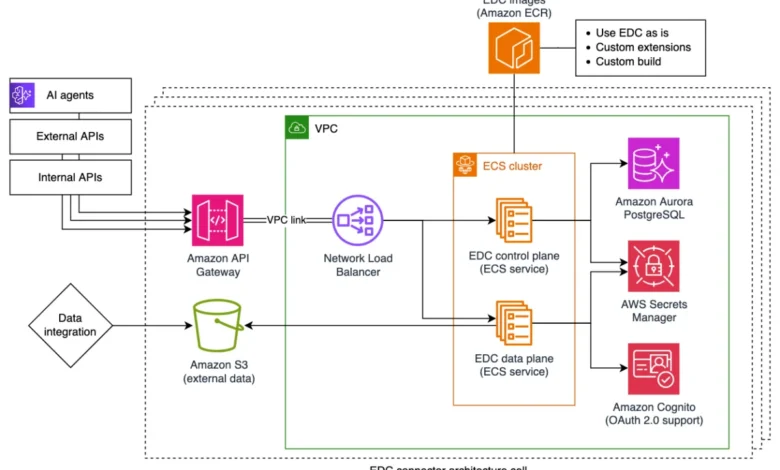
The reference architecture for deploying production-ready EDC connectors on AWS, meticulously detailed in Part 2 of this series, forms the blueprint for the cost analysis. This robust architecture, as depicted in Figure 1 (representing a diagram showing AWS services including Amazon ECS, Amazon Aurora, Network Load Balancer, and supporting services), integrates a suite of AWS services designed for high availability, security, and scalability.
Figure 1: Production-ready EDC connector deployment (Placeholder for the image description from the original article)
This article specifically examines two distinct cost scenarios, each tailored to the criticality of the workload:
- Business-critical workloads: These demand high availability, robust performance, and minimal downtime, typically involving production environments where data sharing is integral to core business operations.
- Non-critical workloads: These include development, testing, experimentation, or batch processing environments where some level of interruption or less stringent performance guarantees are acceptable, offering opportunities for significant cost reduction.
Both scenarios adhere to the architectural patterns established in Part 2, with the fundamental distinctions residing in the precise sizing of compute and database resources, reflecting a strategic balance between performance requirements and cost efficiency.
Deconstructing Costs: Business-Critical Workloads
For business-critical EDC connector deployments, where reliability, speed, and continuous operation are paramount, the infrastructure choices reflect a premium on performance and availability. It is crucial to note that these estimates are based on the aforementioned assumptions and serve to illustrate the relative cost contributions of each service. Actual costs will inevitably vary based on specific usage patterns, data volumes, and regional pricing. The primary objective here is to highlight the components that represent the most significant cost drivers and, consequently, offer the highest potential for optimization.
| AWS Service | Configuration | Monthly Cost (USD) |
|---|---|---|
| Amazon Aurora PostgreSQL-Compatible Edition | db.r6g.large (2 vCPU, 16 GB), 20 GB storage + 10 GB backup | 276.00 |
| Amazon Elastic Container Service (Amazon ECS) with AWS Fargate | 2 vCPU, 4 GB RAM, always on | 83.00 |
| Network Load Balancer | 20 GB processed data | 20.00 |
| AWS Secrets Manager | 10 secrets | 4.00 |
| Amazon Cognito | 1K machine-to-machine (M2M) token requests | 2.25 |
| Amazon Elastic Container Registry (Amazon ECR) | 2 GB storage, 10 GB transfer | 1.00 |
| Amazon API Gateway | 100K REST API calls | 0.40 |
| Amazon Simple Storage Service (Amazon S3) | 5 GB Standard tier | 0.10 |
| Total | 387.00 |
Table 2: Estimated monthly cost for business-critical EDC connector deployment
This detailed breakdown clearly identifies Amazon Aurora PostgreSQL-Compatible Edition as the predominant cost driver in a business-critical scenario. The selection of a db.r6g.large instance, characterized by its high memory and performance, is justified for constant workloads demanding exceptional reliability and speed. Following closely, Amazon ECS with AWS Fargate represents the second-largest cost contributor, as it maintains containers in continuous operation to ensure environment availability, a non-negotiable for critical systems. The Network Load Balancer constitutes a third notable cost component, facilitating efficient and secure traffic distribution. The remaining services, while essential for a comprehensive and secure deployment, contribute only a minor fraction to the total monthly expenditure. This cost structure underscores that for business-critical operations, the investment is primarily in robust, always-on compute and database resources.
Strategic Savings: Non-Critical Workloads
For organizations operating development, testing, or experimentation environments, or even certain batch processing tasks, significant cost reductions can be achieved by strategically rightsizing resources and leveraging more flexible pricing models. By adopting these optimization strategies, costs can be slashed by an impressive 58% without compromising the fundamental functionality of the EDC connector.
| AWS Service | Configuration | Monthly Cost (USD) |
|---|---|---|
| Amazon Aurora PostgreSQL-Compatible | db.t4g.medium (2 vCPU, 4 GB), 20 GB storage + 10 GB backup | 110.00 |
| Amazon ECS with AWS Fargate Spot | 2 vCPU, 4 GB RAM, always on | 26.00 |
| Network Load Balancer | 20 GB processed data | 20.00 |
| AWS Secrets Manager | 10 secrets | 4.00 |
| Amazon Cognito | 1K M2M token requests | 2.25 |
| Amazon ECR | 2 GB storage, 10 GB transfer | 1.00 |
| Amazon API Gateway | 100K REST API calls | 0.40 |
| Amazon S3 | 5 GB Standard tier | 0.10 |
| Total | 164.00 |
Table 3: Estimated monthly cost for non-critical EDC connector deployment
These figures powerfully illustrate the potential for cost reduction in non-critical configurations. The key to these savings lies in the strategic use of smaller, more flexible resources. Amazon Aurora PostgreSQL remains the leading cost driver, but transitioning to a smaller instance type, db.t4g.medium, dramatically reduces its contribution. Crucially, from a compute perspective, leveraging Amazon ECS with AWS Fargate Spot capacity slashes costs by almost 70% compared to the business-critical setup. AWS Fargate Spot allows users to run fault-tolerant containerized applications at a significant discount, provided they can handle potential interruptions, making it ideal for non-production workloads. In aggregate, this optimized configuration achieves an approximate 58% reduction in monthly costs, while remarkably maintaining identical assumptions for data throughput, API calls, and storage capacity, demonstrating the power of smart resource allocation.
Strategic Takeaways on Cost Optimization
The comparative analysis between business-critical and non-critical scenarios reveals a consistent pattern: the primary cost contributors are consistently database, compute, and load balancing resources. These represent baseline infrastructure costs that are largely independent of marginal increases in usage. Conversely, services such as Amazon S3, API Gateway, and data transfer charges contribute only marginally to overall costs at the specified volumes. This cost structure is highly indicative of an architecture that scales efficiently with increased usage. As organizations onboard more use cases, experience higher data volumes, and accelerate data velocity, they gain greater value from their existing infrastructure investment without experiencing disproportionate cost increases. This inherent scalability is a critical advantage for data spaces, which are designed to grow and evolve over time, enabling participants to expand their collaborative efforts confidently.
Adhering to the AWS Well-Architected Framework: Performance, Cost, and Sustainability
Part 2 of this series meticulously covered EDC best practices aligned with the Operational Excellence, Security, and Reliability pillars of the AWS Well-Architected Framework. This final section extends the discussion to the remaining three pillars: Performance Efficiency, Cost Optimization, and Sustainability, applying them directly to EDC deployments to ensure a holistic approach to cloud infrastructure management. The Well-Architected Framework provides a set of best practices for designing and operating reliable, secure, efficient, and cost-effective systems in the cloud.
Performance Efficiency
Performance efficiency focuses on using computing resources efficiently to meet system requirements and maintain that efficiency as demand changes and technologies evolve.
- Right-size Compute Resources: A fundamental principle is to match Amazon ECS task definitions precisely to actual workload requirements. Instead of over-provisioning resources from the outset, a more efficient strategy involves starting with smaller configurations and scaling up incrementally based on observed metrics. Tools like Amazon CloudWatch Container Insights provide invaluable visibility into resource utilization, enabling data-driven sizing decisions that prevent wasteful expenditure on idle capacity.
- Leverage Amazon Aurora’s Flexibility: For workloads characterized by variable demand patterns, Amazon Aurora Serverless v2 offers an ideal solution. This serverless database option automatically scales database capacity based on real-time application needs, eliminating the necessity to provision for peak capacity and ensuring consistent performance during high-demand periods without incurring costs for unused resources during troughs.
- Optimize Data Transfer Patterns: Designing data plane operations to minimize unnecessary data movement is paramount for performance and cost efficiency. Utilizing Amazon S3 Transfer Acceleration for large transfers across geographical distances can significantly reduce latency. Furthermore, implementing data compression where appropriate can drastically decrease both transfer times and associated data transfer costs, contributing to a more streamlined and efficient data exchange.
Cost Optimization
Cost optimization focuses on avoiding unnecessary costs. It includes understanding and controlling where your money is being spent, selecting the most appropriate and right number of resource types, analyzing spend over time, and scaling to meet business needs without overspending.
- Reduce Compute Costs for Fault-Tolerant Workloads: AWS Fargate Spot offers a compelling opportunity to save up to 70% on compute costs for workloads that can tolerate interruptions. Non-critical environments, batch processing jobs, and development workloads are prime candidates for this cost-saving mechanism. Implementing robust graceful shutdown handling mechanisms is essential to effectively manage potential Spot interruptions, ensuring minimal impact on ongoing operations.
- Lower Storage Costs Over Time: Amazon S3 Lifecycle policies are powerful tools for automated storage cost reduction. By configuring these policies, infrequently accessed data can be automatically transitioned to lower-cost storage classes such as S3 Intelligent-Tiering or S3 Glacier Instant Retrieval. For EDC connector deployments, historical transfer logs, archived data assets, and older backups are excellent candidates for tiered storage, leading to significant long-term savings.
- Monitor for Unexpected Cost Increases: Proactive cost management is critical. Leveraging AWS Cost Explorer provides a granular view of spending, while setting up AWS Budgets with integrated alerts helps detect and address unexpected cost increases swiftly. Crucially, consistently tagging all EDC-related AWS resources enables accurate cost allocation and facilitates the identification of specific optimization opportunities across the deployment.
- Lock in Lower Rates for Predictable Workloads: For business-critical connectors exhibiting predictable, steady-state usage patterns, AWS Savings Plans for Amazon Aurora and AWS Fargate offer substantial discounts compared to standard On-Demand pricing. These plans involve a commitment to a consistent amount of compute usage (measured in USD per hour) over a 1-year or 3-year term, providing significant cost predictability and reduction for stable workloads.
Sustainability
The sustainability pillar focuses on minimizing the environmental impacts of running cloud workloads. This includes optimizing resource utilization, selecting energy-efficient services, and designing architectures that reduce overall energy consumption.
- Optimize Resource Utilization: Higher utilization of provisioned resources directly translates to less waste and a smaller environmental footprint. Implementing automatic scaling policies ensures that compute capacity dynamically matches demand, preventing over-provisioning. Furthermore, judiciously shutting down non-production environments outside of business hours, when feasible, can significantly reduce energy consumption and associated carbon emissions.
- Select Efficient Instance Types: AWS Graviton-based instances, such as the
r6gandt4gfamilies used in the cost estimation examples, represent a leap forward in energy efficiency. These instances deliver superior price-performance and consume less energy compared to their equivalent x86 counterparts, offering improved performance per watt of energy use. Prioritizing Graviton instances for EDC deployments contributes to a more sustainable cloud operation. - Minimize Data Movement: Every data transfer consumes energy, making it a critical area for sustainability optimization. Designing data space integrations to avoid redundant transfers is crucial. Caching frequently accessed catalog data from peers locally using the Federated Catalog, and batching operations where possible, can drastically reduce the total number of network round trips, thereby minimizing energy consumption associated with data transmission and processing.
Broader Implications for Data Space Adoption
The ability to effectively manage and optimize the cost of deploying Eclipse Dataspace Components on AWS holds significant implications for the broader adoption and evolution of data spaces. By demystifying the cost dynamics and providing clear strategies for reduction, AWS empowers organizations of all sizes to participate in secure, sovereign data exchange without fear of runaway expenses. This financial clarity is a critical enabler for innovation, allowing businesses to explore new collaborative models, unlock insights from shared data, and drive digital transformation across industries.
The patterns and estimates presented in this series offer a robust foundation for organizations embarking on their cross-organizational data strategy and data spaces journey on AWS. As data spaces continue to gain traction across diverse industries and geographical regions, understanding these cost dynamics becomes increasingly vital for strategic planning and competitive advantage. The ability to balance data sovereignty, performance, and cost efficiency is not merely a technical challenge but a strategic imperative that will shape the future of data collaboration.
Conclusion and Next Steps
By meticulously rightsizing AWS infrastructure to align with actual compute and database capacity needs, data space participants can achieve substantial cost savings without compromising the fundamental data security and sovereignty aspects that define the value proposition of data spaces. The detailed comparison between business-critical and non-critical workload configurations vividly demonstrates how judicious selection and configuration of AWS services—such as Amazon Aurora, AWS Fargate Spot, and Amazon S3—can be combined effectively to strike an optimal balance between data sovereignty, robust performance, and compelling cost efficiency.
To commence your journey towards optimized EDC deployments, a crucial initial step is to thoroughly assess your workload criticality. This assessment will guide whether a business-critical or non-critical configuration is the most appropriate fit for your specific operational requirements. Subsequently, leveraging the AWS Pricing Calculator is highly recommended to generate precise cost estimates tailored to your unique data volumes, chosen AWS regions, and anticipated usage patterns. For organizations seeking an end-to-end reference implementation, the Dataspace Connector on AWS project, available on GitHub, offers a comprehensive solution that integrates Infrastructure-as-Code principles with custom EDC extensions and advanced AI tooling integration, providing a powerful accelerator for data space participation. This strategic guidance ensures that organizations can confidently and cost-effectively navigate the complexities of secure data sharing, unlocking new avenues for collaboration and innovation in the digital economy.
References
- Eclipse Dataspace Components: https://projects.eclipse.org/projects/technology.edc
- Part 1: Eclipse Dataspace Components on AWS: Data Sharing Fundamentals: https://aws.amazon.com/blogs/architecture/eclipse-dataspace-components-on-aws-data-sharing-fundamentals/
- Part 2: Eclipse Dataspace Components on AWS: Architecture Patterns in Production: https://aws.amazon.com/blogs/architecture/eclipse-dataspace-components-on-aws-architecture-patterns-in-production/
- AWS Well-Architected Framework: https://aws.amazon.com/architecture/well-architected/
- AWS Pricing Calculator: https://calculator.aws/
- Dataspace Connector on AWS GitHub Project: https://github.com/awslabs/dataspace-connector-on-aws
About the Authors
Placeholder for author information, if available and desired to be included.
Related posts: