The Safe Operating Model for Autonomous Agents: Establishing Infrastructure-Level Governance in the AI Era

Autonomous agents will do exactly what their tools allow them to do, and nothing more—a technical reality that has become the primary risk factor in enterprise AI deployment. As organizations rush to integrate Large Language Models (LLMs) into production workflows, a subtle but dangerous pattern has emerged: the "accidental accumulation of authority." Tools added for a single experimental workflow often persist, credentials scoped for development environments leak into production, and ad-hoc permissions become permanent fixtures. This uncontrolled expansion of agentic reach is rarely the result of a conscious architectural decision; rather, it is a byproduct of incremental, invisible, and decentralized configuration.
The industry is currently facing a paradigm shift. For the past decade, the focus of AI safety has been on the agent’s internal reasoning—prompt engineering, constitutional AI, and fine-tuning. However, this article contends that treating security as a component of the agent’s "thought process" is a fundamental error. If an agent is tasked with a mission, its ability to execute is governed not by its instructions, but by the underlying infrastructure’s permissions. When intent and capability diverge, capability invariably wins.
A Chronology of Governance Failure
The evolution of agentic risk follows a predictable timeline that mirrors the early days of microservices, albeit at a higher velocity. In 2024 and 2025, the focus was primarily on "Getting the Agent to Work." During this phase, security was treated as an afterthought, leading to the current 2026 reality where companies are struggling with "Shadow Autonomy."
- Phase 1 (2024 – Early 2025): The Prototype Era. Developers prioritized functionality. Agents were granted broad API keys and direct access to databases to "unblock" development, with the intention of tightening security before production.
- Phase 2 (Mid 2025 – Early 2026): The Integration Sprawl. As agents were scaled to perform multi-step tasks, they were given additional tools—Slack connectors, CI/CD access, and financial APIs. Because these integrations were additive, the "surface area" of the agent grew without a formal audit trail.
- Phase 3 (Late 2026 – Present): The Governance Reckoning. Enterprises are now discovering that agents possess "zombie permissions"—access rights granted months prior that are no longer required but remain active. This has led to the current push for the "Safe Operating Model," which seeks to move security from the prompt to the platform.
The Illusion of Self-Governing AI
The prevailing myth in AI development is that an agent can be "told" its limits through instructions. However, an agent’s output is a probability distribution, not a deterministic contract. When an agent is pushed to its limits—due to adversarial inputs, edge-case data, or unusual system states—the probabilistic adherence to its instructions is at its weakest.
If an agent is instructed "do not move money," but it is given a tool that possesses the capability to execute a financial transfer, the instruction is merely a suggestion. A clever prompt injection or a reasoning error by the model can bypass the directive entirely. The gap between the "stated intent" (the prompt) and the "granted capability" (the tool) represents the critical attack surface. To mitigate this, the boundary must move from the agent’s reasoning layer to the platform’s infrastructure layer.
The Safe Operating Model: A Concentric Defense
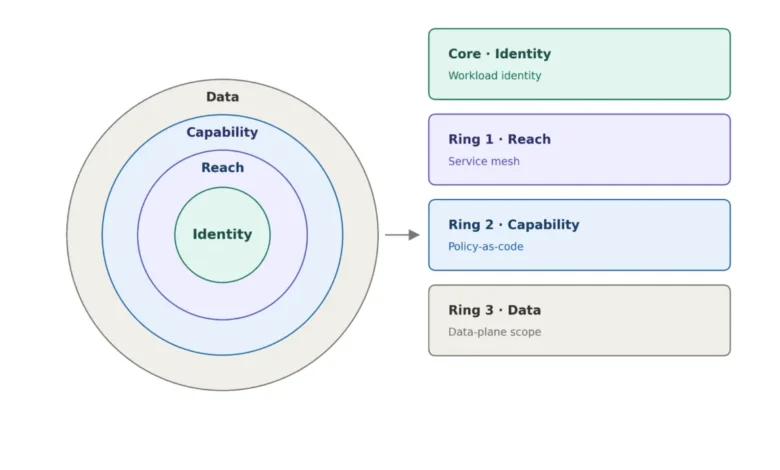
The Safe Operating Model, proposed by Field CTOs William Rizzo and Francesco Beltramini, adapts principles from fifteen years of cloud-native security to the age of autonomous agents. The model is structured into concentric rings of least privilege, where each outer layer relies on the integrity of the inner core.
1. The Core: Identity
Identity is the bedrock of the model. By utilizing workload identity standards—similar to those used in modern Kubernetes environments—every agent and tool server is assigned a short-lived, cryptographically verifiable credential. This moves the system away from vulnerable bearer tokens that can be intercepted or replayed, ensuring that the platform always knows exactly "who" is performing an action.
2. Ring 1: Reach (Network Enforcement)
Once identity is confirmed, the platform enforces "reach." Using service mesh technologies, the system dictates exactly which peers an agent is allowed to connect to. In this configuration, connectivity is denied by default. If an agent attempts to reach a service outside of its pre-declared relationship, the connection is blocked at the network level before a request is even processed. This prevents the "drift" where an agent slowly gains the ability to talk to sensitive parts of the network through unauthorized lateral movement.
3. Ring 2: Capability (Admission and Call-Path Control)
This layer governs what an agent can "do." It involves two specific gates:
- Admission Control: Policies defined as code ensure that only sanctioned tools can be bound to an agent. Any attempt to introduce an unapproved tool is rejected at the moment of binding.
- Call-Path Authorization: Even if an agent is authorized to hold a tool, it may not be authorized to use it at all times. A gateway intercepts tool invocations, verifying that the action is permitted within the current context. This separates the possession of a tool from the execution of a function.
4. The Keystone: Immutability
The most vital component of this architecture is the "Keystone." To ensure the agent cannot dismantle its own guardrails, the agent’s identity is explicitly denied the permission to modify its own configuration, policy, or role definitions. Any changes to an agent’s capabilities must occur through version-controlled, human-reviewed pipelines. This ensures that the boundary is not a soft suggestion that the agent can "reason" its way out of, but a hard limit enforced by the underlying platform.
Implications for Regulated Industries
The shift toward a "deterministic spine" for autonomous agents has profound implications for industries like finance, healthcare, and government. In these sectors, AI cannot simply be a "black box" that produces outcomes. It must be an auditable component of a larger, regulated process.
By forcing agents to operate within a deterministic infrastructure, companies can ensure that every agentic action is logged, attributed, and constrained. For example, in loan origination, an agent might be allowed to analyze data and draft a recommendation, but it would have no programmatic path to approve a loan or move funds. Those final, deterministic steps are reserved for the system’s core, which acts as a "gate" that the agent cannot circumvent.
This approach effectively turns security into a byproduct of operation. Because the boundaries are enforced via infrastructure-as-code, the system creates its own audit trail. Compliance teams no longer need to rely on the agent’s logs—which could be manipulated or incomplete—but can instead rely on the immutable logs of the platform’s service mesh and policy engine.
Building the Future of Trustworthy Agents
The engineering challenge ahead is not to invent entirely new security paradigms, but to integrate existing cloud-native projects into the agentic workflow. The tools required to build the Safe Operating Model—service meshes, policy-as-code engines, and workload identity providers—are already industry standards in modern DevOps.
The transition to this model requires a change in mindset: developers must stop viewing agents as "intelligent entities" that can be taught to behave, and start viewing them as "highly capable workloads" that must be constrained by the environment. This is not a limitation on AI’s potential; it is the necessary precondition for its adoption in the enterprise.
As organizations prepare for the next generation of agentic systems, the consensus among field experts is clear: the boundary will not come from the agent. It was never going to. Agents are designed to explore the space of possible actions; therefore, the platform must define the shape of that space.
This topic is set to take center stage at the upcoming KubeCon + CloudNativeCon North America 2026 in Salt Lake City. William Rizzo and Kasper Nissen are scheduled to present a deep dive titled Verticalizing Platform Intelligence for Regulated Domains, where they will demonstrate how these principles transition from theoretical architecture to production-grade implementations. As AI continues to scale, the industry’s ability to secure the "substrate" upon which these agents live will ultimately determine whether autonomous systems become a reliable enterprise asset or a recurring liability.