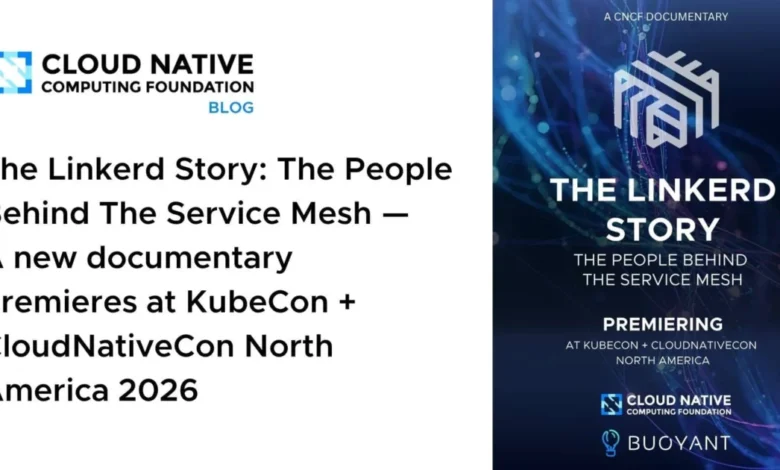
The Linkerd Story: The people Behind The Service Mesh — A new documentary premieres at KubeCon + CloudNativeCon North America 2026

The Genesis of a Service Mesh
The story of Linkerd is inextricably linked to the rapid scaling challenges faced by early distributed systems at Twitter. During the mid-2010s, as the microservices architecture began to dominate, engineers struggled with the inherent complexities of inter-service communication. The initial work on Finagle, an RPC library, provided a foundation for managing these connections, but the industry required a more robust, platform-agnostic solution to address reliability, observability, and security at the networking layer.
In 2016, this need culminated in the launch of Linkerd, the first project to formally introduce the concept of a "service mesh" to the public. The project was designed to abstract the networking layer away from application code, allowing developers to manage traffic routing, retries, and mutual TLS (mTLS) without modifying individual services. This represented a paradigm shift in how organizations approached cloud native architecture, moving from fragmented, manual networking configurations to a standardized, policy-driven mesh.
A Chronology of Technical Evolution
The decade-long evolution of Linkerd is marked by several pivotal technical transitions that mirror the broader maturation of the Kubernetes ecosystem:
- 2016: Linkerd launches as the first service mesh, primarily leveraging the JVM for its control plane and proxy architecture.
- 2017: The project is donated to the CNCF, signaling a commitment to open governance and vendor neutrality.
- 2018: The project pivots to a "Linkerd 2.0" architecture, fundamentally rewriting the control plane and proxies in Rust to significantly reduce the memory footprint and resource overhead—a decision that would later define the industry standard for "lightweight" service meshes.
- 2021: Linkerd achieves graduated status within the CNCF, recognizing its maturity, widespread adoption, and rigorous security standards.
- 2026: The project celebrates its tenth anniversary, with a focus on stability, ambient networking patterns, and continued community-driven growth.
Data-Driven Impact on Modern Infrastructure
Linkerd’s impact is best measured by its adoption across diverse industries. According to CNCF landscape data and project metrics, Linkerd has become a critical dependency for organizations ranging from fintech startups to large-scale retail giants.
The documentary features a case study on H-E-B, the Texas-based grocery retailer, which utilized Linkerd to facilitate the rapid scaling of its curbside pickup services. By implementing a service mesh, H-E-B was able to secure and monitor high-volume traffic between microservices without adding significant latency or management overhead.
From a performance standpoint, the shift from the original JVM-based architecture to the Rust-based "Linkerd-proxy" resulted in a reduction of resource consumption by as much as 80% in many production environments. This efficiency has made Linkerd a preferred choice for organizations operating on constrained infrastructure or those aiming to minimize cloud expenditure—a critical metric in the current enterprise focus on FinOps.
Voices from the Community
The documentary draws upon interviews with the original creators at Buoyant and key maintainers within the CNCF ecosystem. By focusing on the human element, the film documents the transition from a proprietary idea to a community-governed project.
"The success of Linkerd is not just in the lines of Rust code, but in the decision to prioritize simplicity in an ecosystem that was becoming increasingly bloated," noted one lead maintainer. The film highlights the "maintainer’s burden"—the responsibility of ensuring that thousands of global companies can rely on the project for critical production traffic. This shift from "writing code" to "nurturing a sustainable ecosystem" is a central theme that the film explores through personal narratives.
Implications for the Cloud Native Landscape
The premiere of this documentary occurs at a time when the service mesh market is stabilizing. After an initial period of "mesh mania," where many competing projects emerged, the industry has gravitated toward established, production-hardened solutions. Linkerd’s longevity serves as a blueprint for other CNCF projects looking to achieve long-term sustainability.
The emphasis on open governance has been a critical factor in Linkerd’s survival. Unlike proprietary software, the project’s development is guided by a diverse steering committee, ensuring that the roadmap is not dictated by the interests of a single vendor. This commitment to neutrality has bolstered trust among enterprise users who require long-term guarantees of support and development.
Looking Toward the Next Decade
As the project enters its second decade, the focus is shifting toward "ambient" mesh models and the integration of service mesh capabilities into the broader platform engineering workflow. The goal, as expressed by contributors in the documentary, is to make the service mesh "invisible"—a component that provides security and observability by default, requiring minimal manual intervention from application developers.
Industry analysts observe that the success of Linkerd provides a roadmap for the next generation of infrastructure software. By prioritizing a clean architecture and fostering a transparent, inclusive community, the project has avoided the common pitfalls of technical debt and fragmentation.
Premiere Details and Industry Context
The premiere at KubeCon + CloudNativeCon North America in Salt Lake City serves as a milestone event for the CNCF. KubeCon remains the primary venue for the cloud native community to align on standards and discuss the future of the stack. By dedicating a documentary to a foundational project like Linkerd, the CNCF acknowledges the role of historical context in driving future innovation.
The screening is expected to draw a wide audience, including early adopters who remember the initial Twitter-era engineering struggles, as well as new practitioners who interact with the project as an abstract, stable component of their Kubernetes clusters. The event will also feature a panel discussion with key figures involved in the project’s history, providing an opportunity to reflect on the lessons learned from building open source software at scale.
Conclusion: Sustaining Open Source
The overarching message of The Linkerd Story is one of resilience. The film posits that the most successful open source projects are those that can effectively balance technical ambition with the practical needs of the community. As the industry looks toward the next ten years, the Linkerd model—defined by Rust-based performance, Kubernetes-native integration, and a focus on human-centric collaboration—offers a compelling example of how to build technology that lasts.
For those interested in the technical and human history of the cloud native movement, the documentary serves as both a retrospective and a call to action for the next generation of contributors. By documenting the challenges overcome by the creators and the community, the film underscores the fundamental belief that infrastructure, while technical in nature, is ultimately a collaborative, human-driven endeavor. The premiere stands as a testament to the fact that while code may change, the principles of open source—transparency, collaboration, and community-driven innovation—remain the bedrock of modern digital architecture.
Related posts: