Achieving Multi-Region Resiliency for CloudFormation Custom Resources with an Active-Active Architecture

In an era defined by ubiquitous cloud adoption and an unyielding demand for continuous availability, Infrastructure-as-Code (IaC) has emerged as the cornerstone of modern IT operations. AWS CloudFormation stands as a foundational tool within this paradigm, empowering thousands of organizations to provision and manage their AWS resources declaratively. While CloudFormation provides robust native capabilities, the innovation doesn’t stop there. CloudFormation custom resources have become an indispensable extension mechanism, allowing teams to push the boundaries of automation and integrate virtually any service or logic into their IaC templates. However, as enterprises increasingly rely on multi-Region architectures for mission-critical workloads, a significant gap has become apparent: the lack of built-in multi-Region support for these powerful custom resources. This absence has historically compelled organizations to either accept heightened reliability risks or engineer complex, bespoke solutions. A robust active-active architecture has now been proposed, offering a standardized and resilient approach to solve this pressing challenge, ensuring that custom resource processing can withstand regional failures without compromising operational integrity.
The Imperative for Multi-Region Deployments in the Modern Enterprise
The transition to multi-Region cloud architectures is no longer a niche requirement but a fundamental imperative for businesses operating at scale. Driven by a confluence of factors, including stringent disaster recovery objectives, strict data residency mandates, the need for latency-sensitive applications closer to global users, and paramount business continuity requirements, organizations are increasingly distributing their infrastructure across multiple AWS Regions. A recent report by Statista projected the global cloud computing market to reach over $1.5 trillion by 2030, underscoring the pervasive reliance on cloud services. With this reliance comes an amplified need for resilience. Industry analysts often cite the cost of downtime, which can range from thousands to millions of dollars per hour, depending on the sector and scale of operations. Beyond financial losses, prolonged outages can severely damage brand reputation, erode customer trust, and lead to regulatory penalties. Consequently, single-Region deployments, while offering high availability within their confines, present an unacceptable risk profile for many modern applications. The ability to seamlessly failover or operate simultaneously across multiple geographically distinct Regions is now a non-negotiable aspect of enterprise-grade cloud infrastructure.
Unlocking CloudFormation’s Full Potential: The Power of Custom Resources
AWS CloudFormation, at its core, enables users to model, provision, and manage AWS resources using a simple text file. This declarative approach automates the provisioning process, ensuring consistency, repeatability, and version control for infrastructure. However, the diverse and rapidly evolving landscape of cloud services, coupled with the need to integrate third-party tools, legacy systems, or highly specific business logic, often extends beyond CloudFormation’s native resource types. This is where CloudFormation custom resources shine. A custom resource allows developers to write bespoke provisioning logic that CloudFormation invokes during stack operations (Create, Update, or Delete). When CloudFormation encounters a custom resource in a template, it sends a lifecycle event to a designated target, typically an AWS Lambda function, often routed through an Amazon Simple Notification Service (SNS) topic. CloudFormation then pauses, awaiting a response via a presigned URL, and proceeds or rolls back based on that signal.
The versatility of custom resources has led to their adoption across a wide array of use cases, effectively transforming CloudFormation from merely an AWS resource provisioner into a fully extensible orchestration engine. These uses include, but are not limited to: integrating with SaaS platforms (e.g., Salesforce, ServiceNow), configuring third-party security appliances, performing advanced data transformations during deployment, managing non-AWS resources (e.g., on-premises databases, private cloud services), enforcing complex compliance rules, and orchestrating intricate application deployments that involve steps beyond standard AWS resource creation. The ability to extend CloudFormation’s capabilities means that virtually any operational task or integration point can be brought under the umbrella of IaC, streamlining development and deployment pipelines.
Addressing the Multi-Region Challenge: A Gap in Native Support
Despite their immense utility, CloudFormation custom resources have presented a significant hurdle when it comes to multi-Region architectures. While single-Region custom resource handlers can be designed for high availability within their respective Region, extending this resilience across multiple geographical locations introduces a set of complex problems that CloudFormation does not solve natively. These challenges include:
- Avoiding Single Points of Failure: A custom resource handler deployed in only one Region becomes a critical single point of failure. If that Region experiences an outage, any CloudFormation stack operation involving that custom resource across all Regions would halt or fail, regardless of where the stack itself resides.
- Preventing Duplicate Processing: In a multi-Region setup, ensuring that a custom resource event is processed exactly once is paramount. Without proper coordination, an event might be inadvertently handled by multiple regional instances of the custom resource, leading to data corruption, inconsistent state, or unintended side effects.
- Maintaining State and Idempotency: Custom resources often involve external state management. In a multi-Region context, ensuring that this state is consistently replicated and that operations are idempotent (meaning they can be safely re-executed without changing the outcome beyond the initial application) becomes exponentially more complex.
- Seamless Failover and Recovery: Orchestrating an automated and transparent failover for custom resource processing in the event of a regional outage requires sophisticated mechanisms that are not part of CloudFormation’s inherent design.
- Data Residency and Latency: For global applications, custom resource logic might need to adhere to data residency rules or be executed with minimal latency relative to the requesting stack, adding further complexity to cross-Region deployments.
Historically, organizations faced a stark choice: either accept the inherent reliability risks of a single-Region custom resource handler—a significant concern for mission-critical applications—or invest substantial engineering effort in building complex, bespoke solutions to manage multi-Region scenarios. These custom solutions often involved intricate cross-Region messaging, manual failover procedures, and error-prone state synchronization, increasing operational overhead and potential for misconfiguration. This gap has limited the full potential of CloudFormation as a complete IaC solution for highly resilient, globally distributed workloads.
The Active-Active Solution: A Blueprint for Enterprise-Grade Resilience
To overcome these challenges, AWS architects have devised an innovative active-active multi-Region solution for CloudFormation custom resource processing. This architecture is meticulously designed around four core principles, ensuring robust, fault-tolerant operation:
- Active-Active Processing: Events are simultaneously directed to custom resource handlers in multiple infrastructure Regions, enabling immediate processing capabilities from more than one location.
- Idempotent Execution: The design ensures that even if an event is received and processed by multiple handlers, the underlying operation will execute only once and consistently, preventing unintended side effects.
- Distributed Locking: A robust mechanism is in place to prevent concurrent processing of the same event by different regional handlers, ensuring data integrity and coordinated execution.
- Automated Failover: The architecture incorporates mechanisms for detecting regional failures and seamlessly transitioning processing responsibilities, eliminating the need for manual intervention during outages.
This proposed architecture deftly avoids the single points of failure that plague single-Region custom resource designs, while simultaneously mitigating the risks of duplicate processing inherent in naive multi-Region approaches. It represents a significant advancement for mission-critical workloads where regional failures cannot be tolerated, offering a blueprint for extending the power of CloudFormation without sacrificing reliability or operational efficiency. The solution leverages a central primary Region (e.g., us-east-1) and a secondary Region (e.g., us-west-2) to process custom resource events. Customer AWS Regions fan out events simultaneously to both infrastructure Regions, supporting resilience even if the primary Region fails. The integration of Amazon DynamoDB Global Tables provides distributed locking and idempotency, while Amazon Application Recovery Controller (ARC) ensures automated failover, making this a truly enterprise-grade solution.
Operational Chronology: A Step-by-Step Workflow
The proposed architecture orchestrates a sophisticated dance between various AWS services to achieve its active-active, multi-Region resilience. Understanding the step-by-step flow illuminates how each component contributes to the overall robustness:
Step 1: Event Initiation in Customer Regions
The process begins when a CloudFormation stack in any of the customer’s AWS Regions (e.g., us-east-1, eu-west-1, or ap-southeast-1) initiates a Create, Update, or Delete lifecycle event for a custom resource. As part of this event, CloudFormation generates a unique presigned response URL. This URL is crucial, as the custom resource handler must call it to signal the success or failure of its operation. The event payload, along with this presigned URL, is then published to a local Amazon Simple Notification Service (SNS) topic within that specific customer Region. This local SNS topic acts as the initial distribution point for the event.
Step 2: Cross-Region Fan-Out via SNS Subscriptions
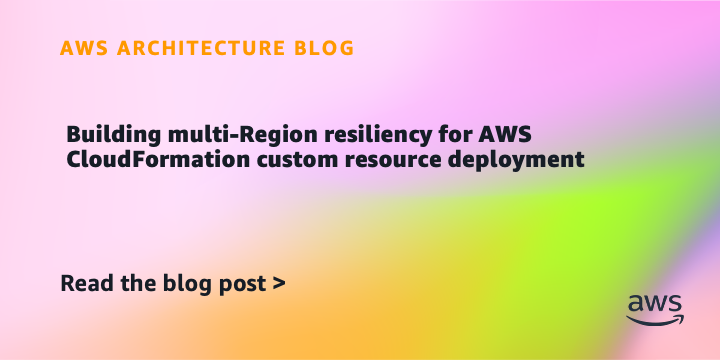
The Amazon SNS topic in the customer Region is meticulously configured with cross-Region subscriptions. These subscriptions ensure that the custom resource event is simultaneously fanned out to two Amazon SQS queues located in the central infrastructure AWS Regions designated for custom resource processing. For instance, an event from eu-west-1 would be sent to an SQS queue in the primary infrastructure Region (e.g., us-east-1) and another SQS queue in the secondary infrastructure Region (e.g., us-west-2). Both queues receive the event concurrently, establishing the foundation for the active-active processing model. This parallel delivery is key to minimizing latency and maximizing resilience.
Step 3: Primary Region Processing (Immediate)
Upon receiving the event, the SQS queue in the primary infrastructure Region (e.g., us-east-1) immediately triggers the associated Primary Lambda Custom Resource Handler. This Lambda function is designed for swift action. Its first critical task is to attempt to acquire a distributed lock in an Amazon DynamoDB Global Table, using a unique identifier derived from the CloudFormation event. If the lock is successfully acquired, the Lambda function proceeds to process the custom resource event, executing the custom provisioning logic. Once the processing is complete, it releases the lock and sends the success or failure signal back to CloudFormation via the presigned URL. This immediate processing in the primary Region is designed to handle the vast majority of events under normal operating conditions.
Step 4: Secondary Region Processing (Delayed)
Concurrently, the SQS queue in the secondary infrastructure Region (e.g., us-west-2) also receives the event. However, this queue is configured with a deliberate delay. This delay can be implemented either through an SQS Delay Queue or by setting a Visibility Timeout on the message. The purpose of this delay is to provide the primary Region’s handler sufficient time to process the event first. After the delay period expires, the Secondary Lambda Custom Resource Handler is triggered. Its first action, similar to the primary, is to attempt to acquire a distributed lock in the same Amazon DynamoDB Global Table. If the secondary handler successfully acquires the lock, it indicates that the primary handler either failed to process the event, was too slow, or the primary Region itself is experiencing an outage. In such a scenario, the secondary handler takes over, processes the event, releases the lock, and sends the response to CloudFormation. If the primary handler had already processed the event and released the lock, the secondary handler’s attempt to acquire the lock would fail, and it would simply discard the event, preventing duplicate processing.
Step 5: DynamoDB Global Tables: The Coordination Backbone
Amazon DynamoDB Global Tables are the linchpin of coordination in this active-active architecture. These fully managed, multi-Region, multi-master NoSQL databases enable both the primary and secondary infrastructure Regions to read from and write to the Global Table with strong consistency. The table stores crucial information, including:
- Distributed Locks: Each event is associated with a unique lock entry, ensuring only one handler can process it at a time.
- Idempotency Keys: These keys prevent duplicate processing by allowing handlers to check if an event has already been successfully handled.
- Event Status: Tracking the processing state (e.g., PENDING, PROCESSING, COMPLETED, FAILED) across Regions.
Bidirectional replication across the Global Table is fundamental, ensuring that both Regions always have the latest state information. This capability is critical for the reliability of the distributed lock mechanism, even in the face of network partitions or regional degradation.
Step 6: CloudFormation Response
Once either the primary or secondary Lambda function handler successfully completes processing the custom resource event, it sends the final callback (SUCCESS or FAILED) to CloudFormation using the pre-signed URL generated in Step 1. Based on this definitive response, CloudFormation then either continues the stack operation (e.g., creating other resources) or initiates a rollback to a previous stable state, maintaining the integrity of the infrastructure.
Step 7: Amazon CloudWatch Monitoring
To ensure continuous operational awareness and facilitate automated responses, Amazon CloudWatch alarms are configured to continuously monitor key metrics in both the primary and secondary infrastructure Regions. These metrics include SQS queue depth (indicating potential backlogs) and Lambda execution health (signaling function errors or throttles). These alarms serve as the critical early warning system, providing real-time insights into the health and performance of the custom resource processing pipeline and feeding into the automated failover mechanism.
Step 8: Automated Failover with Amazon Application Recovery Controller (ARC)
The pinnacle of resilience in this architecture is the automated failover capability provided by Amazon Application Recovery Controller (ARC). If the primary infrastructure Region (e.g., us-east-1) experiences a significant failure or degradation, the CloudWatch alarms (from Step 7) will detect the anomaly. These alarms are configured to trigger ARC, which then initiates an automated failover to the secondary infrastructure Region (e.g., us-west-2). This process is designed to be seamless, with no manual intervention typically required. The secondary Region, already configured to receive and process events (albeit with a delay under normal circumstances), is designed to seamlessly take over full processing responsibilities, ensuring business continuity. This automated failover significantly reduces Recovery Time Objectives (RTOs) and minimizes the impact of regional outages.
Industry Perspective and Expert Commentary
"This active-active multi-Region architecture for CloudFormation custom resources marks a significant advancement for enterprise customers," stated an AWS Principal Architect, commenting on the new approach. "For years, the absence of native multi-Region support for custom resources meant that our most demanding customers had to either accept a reliability compromise or build incredibly complex, undifferentiated solutions. This pattern provides a robust, standardized blueprint that leverages proven AWS services to deliver true fault tolerance and idempotency, raising the bar for mission-critical IaC deployments."
A Cloud Engineering Lead from a large financial services firm, who has struggled with these challenges, added, "Our organization’s compliance and business continuity requirements are non-negotiable. Previously, integrating third-party services or performing advanced data orchestration via custom resources in a multi-Region context was a significant architectural headache. This new active-active model dramatically simplifies our approach, reducing operational complexity and giving us confidence that our infrastructure deployments will remain resilient, even during regional disruptions. It effectively elevates CloudFormation as an even more complete and indispensable IaC solution for global enterprises."
Implications and Future Outlook
The introduction of this robust active-active architecture for CloudFormation custom resources carries profound implications for cloud architecture design, compliance, and operational efficiency. Firstly, it democratizes multi-Region resilience, making it accessible and manageable for a broader range of organizations. Teams no longer need to dedicate extensive engineering resources to building bespoke, often fragile, failover mechanisms for their custom IaC logic. This frees up valuable time for innovation on core business problems.
Secondly, it significantly strengthens an organization’s ability to meet stringent regulatory and compliance requirements related to disaster recovery, data residency, and business continuity. By providing a proven pattern for custom resource processing that inherently supports regional failover and maintains data consistency, it reduces audit risk and bolsters an organization’s governance posture.
Furthermore, this solution enhances trust in cloud infrastructure. As enterprises migrate increasingly critical workloads to AWS, the assurance that their foundational IaC tools, including custom extensions, are resilient to regional outages becomes paramount. This architecture provides that assurance, enabling organizations to build even more complex, globally distributed applications with greater confidence. It fosters improved operational efficiency by reducing the need for manual intervention during outages and standardizing the approach to custom resource development and deployment across diverse regions.
Looking ahead, this pattern sets a new benchmark for resilient custom resource processing on AWS. It paves the way for even more sophisticated global IaC strategies, where custom logic can be seamlessly integrated into highly available, geographically dispersed application environments. As cloud adoption continues its exponential growth, solutions that address these nuanced architectural challenges will be vital for maintaining agility, reliability, and security across the entire cloud landscape.
Conclusion
CloudFormation custom resources are an indispensable tool, empowering teams to build sophisticated infrastructure automation and extend the capabilities of AWS CloudFormation beyond its native offerings. However, the long-standing challenge of integrating these custom resources into truly resilient, multi-Region architectures has been a significant barrier. The active-active architecture detailed here directly addresses this critical gap, providing a comprehensive and robust solution.
This architecture ensures:
- High Resilience: Eliminating single points of failure by distributing processing across multiple active Regions.
- Idempotent Execution: Guaranteeing that custom resource operations are processed exactly once, preventing inconsistencies and errors.
- Automated Failover: Leveraging AWS services like Amazon Application Recovery Controller to ensure seamless transitions during regional outages, minimizing downtime.
- Simplified Operations: Offering a standardized blueprint that reduces the complexity and operational overhead associated with multi-Region custom resource deployments.
For teams operating at scale across multiple AWS Regions, this architecture provides a vital blueprint for extending the power of CloudFormation without sacrificing reliability or compliance. Whether managing compliance-driven multi-Region deployments or building for global high availability, this pattern establishes a new foundation for resilient custom resource processing, solidifying CloudFormation’s role as a complete and enterprise-ready Infrastructure-as-Code solution.
Related posts: