The Crisis of Quality: How the Ad Industry Is Grappling with AI-Driven Standards and Talent Shifts in 2026

The advertising and marketing industry finds itself at a profound crossroads. As the autumn conference cycle of 2026 unfolds across major metropolitan centers in the United States, Western Europe, and beyond, the ubiquitous buzzword dominating panel discussions, keynotes, and fireside chats remains, predictably, artificial intelligence. Yet, the tenor of these conversations has shifted dramatically. In the early, euphoric days of the generative AI era, on-stage pitches focused almost exclusively on technological innovation, operational agility, and unprecedented cost efficiencies. Today, that unbridled optimism has given way to a palpable weariness.
Years of rapid automation have yielded unintended consequences: mounting workforce reductions across adland, a tangible erosion of creative standards, and growing anxiety over the long-term dilution of brand equity. As marketing executives and agency leaders grapple with these realities, the industry is urgently seeking to establish new operational benchmarks, redefine quality control, and cultivate a resilient talent base capable of navigating an increasingly automated media landscape.
The Inaugural AI Marketing Strategies Event: A Turning Point
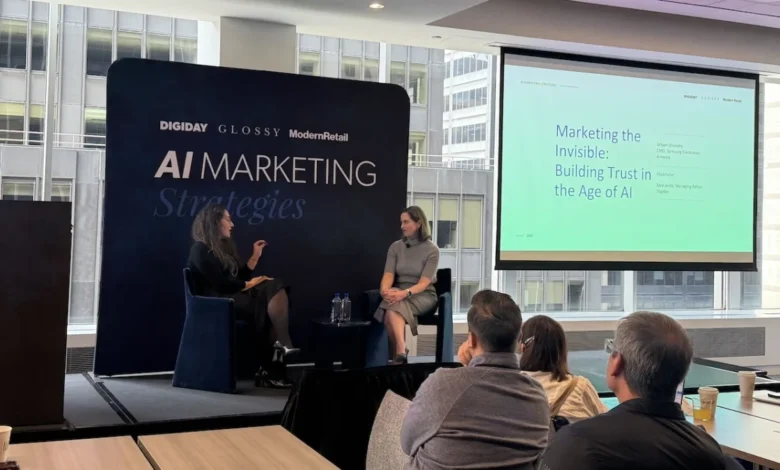
The friction between relentless automation and the preservation of brand integrity took center stage on September 24, during the inaugural AI Marketing Strategies event. Co-hosted by digital media brands Digiday, Glossy, and Modern Retail, the gathering served as a crucible for frank discussions about the state of contemporary advertising.
Against a backdrop of industry-wide layoffs that have transformed structural reductions into a grim new normal, brand-side marketers used closed-door town hall sessions—conducted under the Chatham House Rule to encourage absolute candor—to voice deep concerns. Attendees addressed the systemic risks of relying on automated workflows to hyper-scale content production at the direct expense of rigorous creative oversight.
For many premium brands, the push for volume over craft has introduced acute vulnerabilities. Participants noted that automated generation tools frequently miss the nuanced tone, aesthetic precision, and emotional resonance that define high-end market positioning. Consequently, corporate digital supply chains are increasingly congested with sub-par collateral that threatens the very brand equity companies spend decades building.
The Quality Control Deficit and the 10/80/10 Rule
Among the most pressing complaints voiced by brand-side executives during the town hall was the sheer difficulty of maintaining baseline quality control. One participant representing a prominent global beauty brand did not mince words, stating bluntly that the current crop of creative output generated by AI platforms is often substandard, making the enforcement of rigorous brand guidelines across decentralized tools exceptionally difficult.
To manage this operational hurdle, some marketers have adopted structured internal frameworks. One executive shared a pragmatic workflow model dubbed the "10/80/10 formula." In this approach, a human strategist spends 10 percent of their time upfront prompting the AI tool in the correct strategic direction. The technology then handles 80 percent of the heavy lifting in the middle tier of production. Finally, the human operator must invest the remaining 10 percent of their time refining, polishing, and correcting the output to ensure it meets acceptable enterprise standards.
However, many brand leaders expressed frustration that their agency partners appear far less motivated to safeguard these standards. Rather than deploying seasoned professionals to supervise automated pipelines, agencies are frequently leaning on junior personnel to oversee complex AI platforms. This disconnect has fostered what executives describe as a dangerous cultural acceptance of "good enough" execution.
Another brand-side participant recalled reviewing recent creative executions from an agency partner only to discover fundamental errors, such as a distorted or improperly placed corporate logo. Such oversights have forced brands to mandate strict human supervision gates, halting automated deployment until a human eye explicitly signs off on the campaign assets.
Navigating Change Management and the Human Element
Beyond production mechanics, the human cost and structural upheaval of the AI transition dominated subsequent tracks at the September event. In dedicated sessions focusing on change management, leaders from brands, agencies, and technology vendors emphasized the necessity of addressing the human element with empathy and foresight.
The economic pressures driving the adoption of generative tools have left many advertising professionals feeling professionally vulnerable. A chief executive of a boutique creative agency noted that while traditional campaign implementations used to take weeks of coordinated labor, modern AI toolsets can achieve equivalent output in mere hours. This velocity forces a fundamental existential question for the workforce: What unique value do human employees provide when foundational tasks are instantly commoditized?
Rather than ignoring these anxieties, agency leaders argued that firms must actively help workers define their evolving roles within an AI-first ecosystem. Industry veterans have drawn parallels between the current transformation and the turbulent digital-first transitions of the 2000s and early 2010s, when the advent of programmatic advertising and social media similarly upended legacy business models. Navigating this shift successfully, experts suggest, requires treating change management not merely as an IT migration, but as a cultural evolution.
Adapting Measurement and Strategy for a Two-Audience Internet
As operational workflows adapt to automation, the strategic metrics governing marketing investments are also undergoing a radical overhaul. During a prominent keynote presentation, Isabel Perry, global executive vice president of strategy at DEPT, addressed the structural shift from the traditional digital-first era to a modern ecosystem where bot- and agent-driven internet traffic is rapidly outpacing human-driven browsing patterns.
Perry argued that the industry is currently drowning in a sea of superficial measurement. Traditional dashboards churn out an overwhelming volume of metrics that often obscure true business performance. Instead of chasing conventional, semi-generic industry KPIs that offer operational comfort without strategic depth, marketers must learn to measure the gaps in their data. By identifying and analyzing these structural gaps, organizations can reallocate budgets toward the specific touchpoints that genuinely influence consumer behavior.
Furthermore, Perry stressed the importance of dividing marketing expenditure based on the nature of the consumer journey. Budgets must be dynamically distributed between interactions that remain deeply human and those mediated by artificial intelligence agents.
This theme of navigating a bifurcated audience was echoed by Rajiv Ragu, vice president of digital at Thorne, during a session focused on product discovery in a "zero-click" world. Ragu explained that as search behavior migrates toward AI-driven engines and agentic intermediaries, brands are forced to operate within an internet characterized by two distinct audiences: human consumers and automated software agents.
To succeed in this environment, companies must invest heavily in the curation and maintenance of their legacy online content libraries. Ragu noted that brands cannot afford to neglect older content assets. Ensuring that legacy archives remain accurate, properly attributed, and technically optimized for AI ingestion requires continuous capital expenditure. Without active curation, outdated or poorly indexed content risks being misinterpreted by AI agents, potentially causing severe reputational damage to the brand in automated discovery loops.
Broader Industry Implications and Future Outlook
The conversations at the inaugural AI Marketing Strategies event underscore a maturing, sober industry that is no longer blinded by the initial novelty of artificial intelligence. As the ad sector moves deeper into the late 2020s, the challenges of maintaining quality control, protecting brand equity, and managing workforce transitions have taken center stage.
The prevailing consensus among marketing leaders is that technology alone cannot substitute for strategic intent or creative craftsmanship. Agencies and brands that successfully bridge the gap between automated efficiency and rigorous human oversight will likely emerge as market leaders. Conversely, those that continue to sacrifice standards on the altar of speed risk alienating consumers and eroding the foundational trust upon which brand equity is built. Ultimately, the future of advertising will not belong solely to the algorithms, but to the organizations that master the delicate art of human-machine collaboration.