The Clash Over Wool: How PETA’s Runway Disruptions Are Challenging Fashion’s Ethical Supply Chains

Fashion week is traditionally a meticulously choreographed display of aesthetic precision, where high-profile designers and supermodels navigate a world of controlled lighting and carefully curated headlines. However, the September 2024 circuit in New York and London served as a stark departure from this polished reality. As the industry pivots toward themes of sustainability and transparency, the runway has increasingly become a battleground for animal rights activists, leading to significant real-world consequences—including the unexpected departure of high-level industry leadership.
The disruption began on September 13 at the New York Fashion Week (NYFW) showcase for the brand COS. During the presentation, PETA protesters breached the security perimeter to display messages condemning the use of wool. The subsequent fallout from this breach was swift and professional; notably, Steven Kolb, the long-standing chief executive and president of the Council of Fashion Designers of America (CFDA), stepped down from his role after two decades of service. While the direct link between the security breach and the leadership transition remains a subject of industry speculation, the timing underscores the intense pressure currently placed on fashion authorities to manage the intersection of creative expression and public activism.
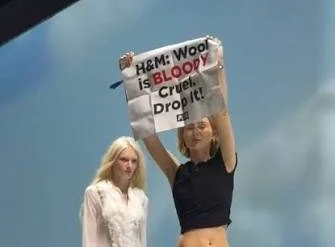
This pattern of disruption continued across the Atlantic just days later. On September 17, at the H&M showcase during London Fashion Week (LFW) held at the historic Olympia venue, the spectacle repeated itself. Three PETA supporters gained access to the runway, brandishing signs that urged the retail giant to abandon wool production entirely. Security personnel eventually escorted the demonstrators from the premises, but the message had already been disseminated across social media channels and global press outlets, sparking a broader dialogue regarding the ethics of material sourcing.
The Center of the Controversy: NATIVA Certification
At the heart of PETA’s current campaign is not merely the generic use of animal fibers, but the integrity of specific traceability systems. The focal point of the dispute is NATIVA, a branded sourcing and certification program managed by Chargeurs Luxury Materials. Designed to provide a "farm-to-closet" journey for wool, NATIVA is marketed as a premier solution for brands seeking to verify their environmental and ethical claims.
Chargeurs claims that NATIVA is the industry’s first global wool brand to utilize blockchain technology to document the entire supply chain. By tracking wool from certified farms in regions such as Australia, New Zealand, South Africa, Uruguay, and North America, through to combing mills and finished garments, the program seeks to provide a verifiable narrative of sustainability. The company highlights several environmental advantages, including reduced water usage, the biodegradability of the fiber, and its capacity for recycling—attributes that are highly prized by major fashion houses like Gucci, Stella McCartney, and Reformation.
However, PETA contends that the existence of such certifications creates a "false sense of security" for consumers and retailers alike. The organization’s fundamental argument is that the commercialization of animal hair is inherently incompatible with animal welfare, regardless of the auditing process in place.
The Investigation That Shifted the Narrative
The intensification of PETA’s campaign stems from an undercover investigation conducted by PETA Asia at a South African wool operation. PETA claims this specific farm was not only NATIVA-certified but also directly linked to the H&M Group’s supply chain. The visual evidence released by the organization depicted workers using shearing equipment to strike sheep, dragging animals by their limbs, and failing to provide medical attention to wounded livestock.
These findings have been used by PETA to challenge the validity of the NATIVA system and other similar certifications. Ingrid Newkirk, founder of PETA, stated that these protests are intended to remind the industry that "every wool garment is a product of suffering." According to PETA’s records, the organization has conducted over 150 undercover investigations across four continents. They report that in every instance, they have documented evidence of abuse, which they use to support their claim that systemic cruelty is an unavoidable byproduct of large-scale wool production.
Official Responses and Industry Defense
The H&M Group, as the primary target of the most recent protests, has issued a formal rebuttal to the accusations. A spokesperson for the retailer emphasized that animal welfare is a core priority for the company, stating clearly that "no animal should be harmed to make our products."
The company maintains that it relies on rigorous, third-party standards, specifically citing the Textile Exchange’s Responsible Wool Standard (RWS). H&M asserts that it takes any breaches of these standards extremely seriously and remains committed to transparent communication with its stakeholders. "We respect everyone’s right to express their opinions," the spokesperson added, while defending the company’s ongoing reliance on certified animal-derived fibers.
Industry analysts suggest that the clash reflects a deepening divide. On one side, companies are investing millions in traceability tech and certification schemes to meet ESG (Environmental, Social, and Governance) targets. On the other, animal rights organizations are shifting their tactics from seeking improvements in welfare standards to demanding the complete elimination of animal-derived materials from the fashion economy.
Historical Context and Future Implications
This strategy is not new for PETA, but it is evolving. The organization’s successful decade-long campaign against fur is widely regarded as a turning point in fashion history. By pressuring luxury conglomerates such as Kering and LVMH, PETA effectively contributed to the industry-wide abandonment of real fur. Following the "I’d Rather Go Naked Than Wear Fur" campaign—which the organization officially retired in 2020—the focus has pivoted toward leather and wool.
The implication for the fashion industry is significant. As PETA expands its investigative reach beyond single suppliers or certification schemes, retailers are facing a new reality: the "audit-based" model of sustainability is being challenged by "activist-based" reality checks. For brands, the financial risk is no longer just limited to supply chain logistics; it extends to brand reputation and the potential for high-profile disruption at major marketing events.
Furthermore, the data suggests that consumers are increasingly polarized. While demand for sustainable, natural fibers remains high due to concerns over synthetic plastic pollution, there is a parallel growth in the market for "vegan leather" and plant-based textiles.
Analysis of the Conflict
The tension between NATIVA and PETA highlights a fundamental disagreement on the definition of "ethical" fashion. The NATIVA model assumes that if you can measure and track an animal’s life through a digital ledger (blockchain), you can manage the ethics of its treatment. PETA argues that the commodification of sentient beings, as demonstrated by the speed and volume required in the modern global wool industry, inevitably leads to a degradation of care.
For the CFDA and other fashion governing bodies, the challenge is how to maintain the prestige and order of fashion weeks while navigating a public that is increasingly sensitive to the provenance of the garments on display. The resignation of Steven Kolb and the security breaches in New York and London serve as an early warning: the era of the "unquestioned runway" is effectively over. Brands that rely on animal-derived materials will likely face continued scrutiny, forcing them to decide whether to double down on certification transparency or begin the costly transition toward non-animal alternatives.
As the industry looks toward the next season, the conversation has moved beyond the cut of a coat or the silhouette of a dress. It has become a fundamental debate about the material basis of fashion itself, and how much of that material the public is willing to accept at the cost of the animals that produce it.