Securing the Future of Autonomous Intelligence: The Role of Kagent and Agent Substrate in Production Environments

The rapid proliferation of autonomous AI agents within enterprise workflows has created an urgent demand for robust security frameworks that transcend traditional containerization. As organizations move beyond experimental AI deployments into production-level integration, the need for rigorous, hardware-backed isolation has become a critical operational requirement. Without the implementation of controlled environments, policy enforcement mechanisms, and high-availability infrastructure, autonomous agents—whether declarative or "bring-your-own" (BYO) frameworks like LangGraph—remain significant vectors for security vulnerabilities and resource mismanagement. To address these challenges, the combination of Kagent as a declarative runtime and Agent Substrate as an underlying sandboxing layer has emerged as a cornerstone for modern agentic architecture.
The Evolution of Sandboxing for Agentic Workloads
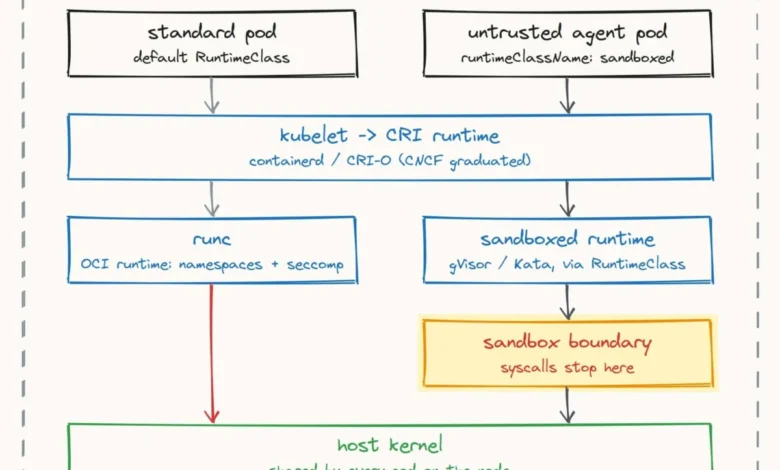
Historically, containerization engines like Docker have provided a foundational layer of isolation, yet this "flat" approach is increasingly insufficient for the complexities of modern AI agents. In a standard container environment, ingress and egress traffic often remains largely unrestricted, and the lack of granular, policy-driven oversight leaves workloads exposed to potential unauthorized lateral movement or data exfiltration. While network policies and segmentation rules can provide superficial mitigation, they do not address the fundamental requirement for multi-layered isolation that protects the kernel from the agent, and the agent from the environment.

Effective sandboxing in the era of AI requires a two-pronged strategy: hardware-level and software-level isolation. True production-grade security mandates that agents exist within ephemeral, resource-managed environments that can be provisioned and decommissioned instantly. By integrating hardware-level virtualization, organizations can ensure that even in the event of a malicious prompt injection or code execution exploit, the impact is contained within a microVM, preventing the compromise of the host system or neighboring workloads.
Architecture of Agent Substrate: A Technical Deep Dive
The architectural philosophy behind Agent Substrate centers on the abstraction of the agent lifecycle. Within this ecosystem, "Workers" function as Kubernetes Pods, acting as the hosts for "Actors." The control plane, facilitated by the ateapi, serves as the orchestrator for these Actors.
The security efficacy of this model relies on its dual-mode isolation strategy. Software-level isolation is achieved through gVisor, an application kernel that intercepts and sanitizes system calls. This creates a "Sentry" layer, a user-space environment that effectively traps and manages system requests, ensuring that an agent cannot make unauthorized calls to the underlying host kernel.

Hardware-level isolation is managed through microVMs, which leverage native hardware virtualization extensions to provide a dedicated environment for each agent instance. This ensures that the agent resides on distinct physical CPU cores, providing a level of resource contention management and security isolation that software-only solutions cannot match. For enterprises managing sensitive proprietary data, this architecture provides the necessary "air-gap" to perform complex agentic reasoning tasks without risking the integrity of the broader production cluster.
Bridging the Gap with Kagent
While Agent Substrate provides the raw security and isolation infrastructure, Kagent serves as the critical interface that bridges the gap between low-level system architecture and user-friendly, declarative management. Without a tool like Kagent, interacting with the Substrate backend would necessitate manual, programmatic interventions—often involving cumbersome API calls via cURL or custom scripts.
Kagent standardizes the deployment process by allowing engineers to manage agents through the same declarative workflows they use for traditional microservices. By utilizing Kubernetes Custom Resource Definitions (CRDs), administrators can define Harness objects and AgentTemplate configurations. This standardization ensures that agents are versioned, audited, and governed according to existing CI/CD pipelines, marking a significant shift from the "Wild West" of early AI deployments toward a structured, IT-governed model.

Implementation and Operational Workflow
Deploying this architecture follows a structured path. Following the installation of the Kagent v1.0 and Agent Substrate components, the platform automatically initializes a WorkerPool. This pool manages the lifecycle of the Workers, ensuring that compute resources are only consumed when an active session is established.
The deployment of a new agent involves the configuration of a Harness and an AgentTemplate. The template acts as the "golden image" for the agent, containing essential system prompts and model configurations, while the Harness defines the physical runtime characteristics, such as the location of snapshot storage and the specific worker pool to be utilized.
A notable feature of this design is the session-based lifecycle management. When a user initiates a session, a new Actor is dynamically provisioned. Once the interaction concludes, the Actor is decommissioned. This "just-in-time" compute model not only optimizes cloud expenditure but also enhances security by ensuring that any stateful remnants of a session are purged immediately after use. This prevents the accumulation of long-running, vulnerable processes that could otherwise be targeted by attackers.

Industry Implications and Future Outlook
The industry is currently at an inflection point regarding agentic adoption. While the potential for productivity gains is substantial, the lack of governance has served as a primary deterrent for financial, healthcare, and governmental institutions. Projects like Kagent and Agent Substrate are essentially building the "infrastructure of trust" required to move these organizations forward.
From an analytical standpoint, the move toward hardware-level isolation is inevitable. As agents are granted broader read/write permissions to internal databases and external APIs, the risk surface area grows exponentially. By offloading the burden of security from the application developer to the platform layer, companies can scale their agentic operations without incurring a proportional increase in risk.
Furthermore, the integration of snapshot policies—where agent states are stored in secure, cloud-native storage buckets (e.g., Google Cloud Storage or AWS S3)—allows for high-availability and disaster recovery. If a node fails, an agent can resume its session from a known-good state, ensuring that the user experience remains seamless even in the face of infrastructure volatility.

Conclusion
The challenge of securing AI agents is no longer a theoretical debate but a practical engineering hurdle. As demonstrated by the integration of Kagent and Agent Substrate, the path forward involves adopting cloud-native design principles that prioritize isolation, declarative control, and resource efficiency. By implementing these technologies, engineering teams can transition from managing individual, isolated agent scripts to overseeing a fleet of governed, secure, and highly available autonomous workers.
As the ecosystem matures, the focus will likely shift toward standardizing these interfaces across even more diverse environments, further commoditizing the ability to run safe, enterprise-grade AI. For organizations aiming to capitalize on the next wave of automation, the investment in a robust, sandboxed infrastructure is not merely an optional enhancement—it is the prerequisite for long-term viability in an increasingly agent-driven economy. By treating agents as first-class citizens within the Kubernetes ecosystem, the industry is setting a new benchmark for what it means to deploy AI with confidence, scalability, and, above all, security.