Optimizing Kubernetes Infrastructure for Distributed AI Training Through Topology-Aware Scheduling and Gang Scheduling

The rapid proliferation of large-scale artificial intelligence models has fundamentally shifted the requirements for modern data center infrastructure. As organizations scale their AI training workloads, the standard Kubernetes scheduler—designed primarily for stateless microservices—is increasingly proving inadequate for the specialized demands of high-performance computing (HPC). Distributed AI training requires not only massive computational power but also a high degree of synchronization and network efficiency, necessitating the adoption of Topology-Aware Scheduling (TAS) and gang scheduling. By integrating tools such as Kueue and the Coscheduling plugin, infrastructure teams can bridge the gap between native Kubernetes orchestration and the rigorous demands of GPU-intensive training, ensuring that hardware investments yield maximum productivity.
The Architectural Mismatch in Modern Scheduling
Kubernetes was architected to manage pods as independent, ephemeral units. In a traditional web-tier deployment, if a pod fails, the scheduler simply replaces it, having no impact on the overall functionality of the application. However, distributed AI training—which often utilizes frameworks like PyTorch Distributed Data Parallel (DDP) or large-scale model parallelism—operates on a rigid, interdependent model. In these environments, hundreds or thousands of GPUs must function in near-perfect lockstep.
The current scheduling paradigm in Kubernetes creates two primary points of failure for AI workloads: placement latency and partial job starts. When the scheduler ignores the physical topology of the data center, it may distribute pods across racks that lack high-speed inter-GPU interconnects, such as NVLink or InfiniBand. This results in "network-bound" training, where GPUs spend a disproportionate amount of time waiting for data to traverse the network rather than performing computations. Furthermore, if the scheduler starts pods in a piecemeal fashion, the initial resources allocated to the job sit idle, incurring costs without producing progress.
The Rise of Topology-Aware Scheduling (TAS)
Topology-Aware Scheduling represents a shift toward cluster-aware orchestration. By recognizing the physical hierarchy of a data center—ranging from the individual host and rack to the leaf-switch and cluster level—TAS allows the scheduler to make placement decisions based on communication latency requirements.
In large-scale LLM pretraining, where tensor and pipeline parallelism are common, the exchange of gradients across workers is constant and latency-sensitive. Research indicates that cross-rack communication can introduce latencies up to 10 times higher than intra-rack communication. Without TAS, a training job might be fragmented across disparate parts of a data center, forcing the system to throttle performance to the speed of the slowest network hop.
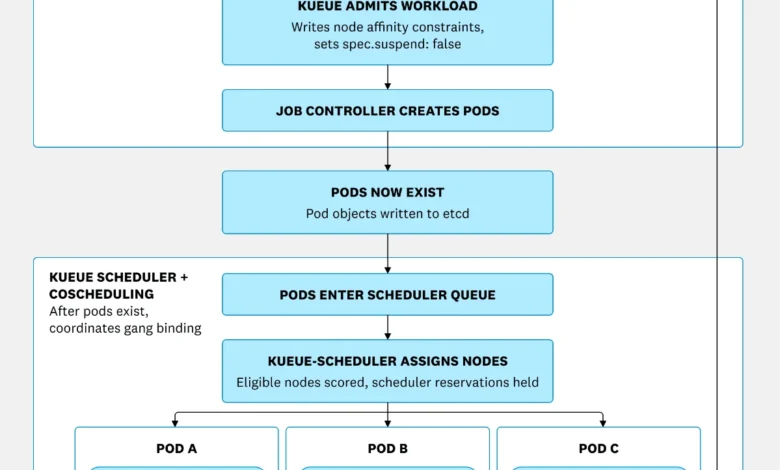
Kueue has emerged as the industry-standard solution for this challenge. By acting as a specialized admission controller, Kueue evaluates a job’s resource requirements and topology constraints before the pods are even created. It ensures that the cluster has the necessary capacity within a defined "topology domain" to accommodate the entire workload. By setting specific constraints at the admission level, Kueue provides the Kubernetes scheduler with the necessary guardrails to ensure that all workers are co-located within a proximity that maintains high-throughput communication.
Gang Scheduling: Ensuring Synchronous Execution
While TAS optimizes placement, gang scheduling ensures coordination. A gang scheduling implementation—most notably the Coscheduling plugin in the Kubernetes SIGs ecosystem—enforces an "all-or-nothing" execution policy. Under this model, the scheduler prevents any part of a distributed job from running until the entire "gang" of pods can be placed simultaneously.
This approach eliminates the "partial start" phenomenon. In a cluster with high contention, a traditional scheduler might place 80% of a training job’s pods and leave the remaining 20% in a pending state. This leads to the "straggler" problem, where the 80% of active pods wait indefinitely for the remaining resources, causing significant financial waste and resource fragmentation. By requiring a minimum number of pods to be ready before initiating the job, gang scheduling optimizes GPU utilization and ensures that the training loop begins only when all hardware dependencies are satisfied.

Chronology of Native Kubernetes Evolution
The transition from external plugins to native Kubernetes functionality has been a multi-year effort within the Cloud Native Computing Foundation (CNCF) and the Kubernetes community.
- Pre-2025: Organizations relied heavily on custom CRDs and third-party schedulers to manage batch AI jobs, leading to significant fragmentation in the ecosystem.
- Kubernetes v1.35 (Late 2025): The community introduced native support for gang scheduling as an alpha feature, signaling a long-term commitment to batch-oriented AI workloads.
- Kubernetes v1.36 (Early 2026): This release marked a major milestone with the introduction of topology-aware scheduling features, workload-aware preemption, and a native PodGroup API, moving away from the dependency on external plugin-defined PodGroups.
- Kubernetes v1.37 (Mid-2026): Gang scheduling and workload-aware preemption reached beta status under the
GenericWorkloadfeature gate. This represents the beginning of a shift toward a unified, native scheduling architecture that mimics the functionality once reserved for specialized add-ons like Kueue.
Despite these advancements, industry experts emphasize that these features are still in their infancy. As of late 2026, many of these native capabilities remain disabled by default, requiring significant configuration and testing before they can be considered production-ready.
Implications for Infrastructure Management
The shift toward these specialized scheduling techniques has profound implications for data center operations. First, it forces a change in how infrastructure is monitored. Traditional metrics like CPU or memory utilization are no longer sufficient to gauge the health of a training cluster. Instead, administrators must monitor "admission wait times" and "gang assembly status." If a workload is stuck in a pending state, it is no longer just a capacity issue; it is a signal that the cluster’s topology constraints are too rigid or that the job’s resource requirements cannot be met within the current fabric architecture.
Furthermore, the integration of these tools allows for more granular cost management. By tracking "evicted workloads" due to node failures or timeouts, organizations can pinpoint exactly where hardware volatility is affecting productivity. This is critical in cloud environments, where spot instance preemptions are common.
Broader Impact on AI Development
The impact of improved scheduling extends far beyond the data center floor. For machine learning engineers, the reliability of the underlying scheduler directly influences the iterative speed of model development. A job that takes three days to complete because of network-induced latency is significantly more expensive—in terms of both dollars and research time—than a job that completes in two days.
As organizations move from experimental models to massive-scale production training, the reliability of the Kubernetes scheduler becomes a strategic asset. The adoption of Kueue and the move toward native gang scheduling represent the "industrialization" of AI infrastructure. By moving from a "best-effort" scheduling model to a "deterministic" one, companies can better predict the time-to-market for their AI models and ensure that their capital expenditure on high-end GPUs like the NVIDIA H100s and successors is fully justified by actual training throughput.
Looking Ahead
While the path forward involves the eventual migration to native Kubernetes APIs, the current production standard remains the combination of Kueue and the Coscheduling plugin. These tools provide the observability and control that enterprise teams need to troubleshoot complex, distributed failures. As the Kubernetes project continues to refine the GenericWorkload API, the lessons learned from these out-of-tree implementations will serve as the foundation for the next generation of cloud-native AI infrastructure.
For now, the focus for infrastructure teams should remain on rigorous monitoring of admission queues, the validation of topology assignments, and the correlation of training framework signals with Kubernetes scheduling logs. By treating the scheduler as a critical component of the AI application stack rather than a transparent utility, organizations can achieve the performance consistency necessary to compete in the increasingly crowded field of generative AI. Success in this domain will not be defined by the total number of GPUs an organization owns, but by the efficiency with which those GPUs are orchestrated and utilized at scale.