China Merchants Bank Wins CNCF End User Case Study Contest for Revolutionary AI Infrastructure Efficiency Gains

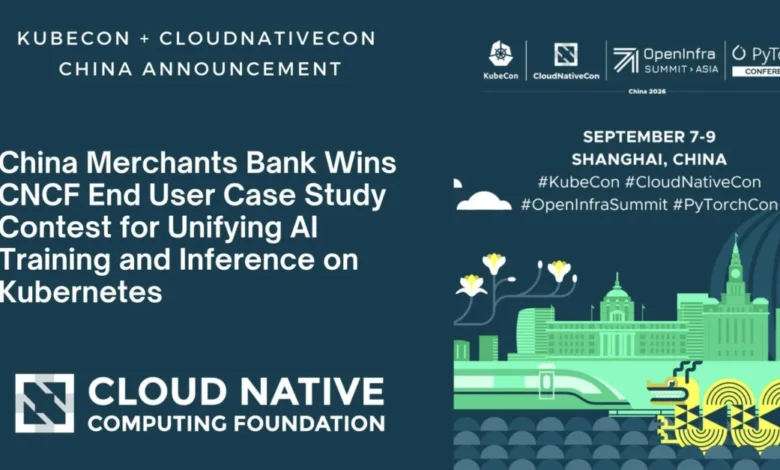
The Cloud Native Computing Foundation (CNCF) has officially recognized China Merchants Bank (CMB) as the winner of the prestigious End User Case Study Contest at the 2026 KubeCon + CloudNativeCon + OpenInfra Summit + PyTorch Conference China. This accolade, presented in Shanghai on September 8, 2026, honors the financial institution for its groundbreaking deployment of a unified, cloud-native control plane that has fundamentally transformed how AI workloads are managed, scaled, and optimized across nearly 10,000 heterogeneous accelerator cards.
The transition to AI-driven banking services has placed immense pressure on legacy infrastructure. For a major commercial entity like China Merchants Bank, the challenge was not merely the acquisition of high-performance hardware, but the effective orchestration of that hardware to support diverse and often competing AI demands—ranging from large-scale model training and fine-tuning to real-time, low-latency online inference. By leveraging an open-source, vendor-neutral stack, the bank has successfully bridged the gap between raw compute power and operational efficiency.
Chronology of the Infrastructure Evolution
The journey to this achievement began years prior, as CMB recognized that traditional siloed infrastructure models were insufficient for the demands of modern artificial intelligence. In previous years, the bank collaborated with the CNCF to document its initial efforts, which focused on creating a Kubernetes and HAMi-based scheduling platform. That early initiative, which allowed for 100% hardware pool utilization through topology-aware scheduling, set the stage for the more ambitious, holistic framework unveiled at the 2026 summit.
By 2025, the bank’s AI infrastructure team began the process of integrating a broader ecosystem of cloud-native tools. Throughout the first three quarters of 2026, the team synchronized its data center operations with its software engineering pipelines to bring 99% of its massive accelerator pool under a single, unified management framework. This period of rapid integration culminated in the data results showcased at this year’s conference, proving that the synergy between software-defined infrastructure and specialized hardware is the key to sustainable AI growth in the financial sector.
Technical Architecture and Operational Breakthroughs
The core of China Merchants Bank’s success lies in its sophisticated, composable architecture. Rather than relying on rigid, monolithic systems, the bank utilized a combination of CNCF-hosted projects to create a modular environment.
Kubernetes serves as the foundational orchestrator, providing the stability and extensibility required for large-scale operations. However, the intelligence of the platform is distributed across several specialized components:
- Kueue: This component handles the complex task of admission control, job queuing, and quota management. It ensures that training jobs do not reserve hardware capacity prematurely, which previously led to significant idle time.
- KEDA (Kubernetes Event-driven Autoscaling): In tandem with Prometheus, which provides real-time observability, KEDA allows the bank to scale its online inference workloads dynamically based on actual, live demand signals.
- HAMi: As a critical layer for resource virtualization, HAMi allows for the fine-grained allocation of shared accelerator capacity, enabling multiple tasks to utilize the same physical hardware without compromising security or performance.
- Fluid: To address the bottleneck of data movement, Fluid accelerates access to datasets, model weights, and checkpoints. By ensuring that data is local to the compute environment, the bank has significantly reduced the latency that once kept expensive accelerators waiting for information.
Additionally, the bank’s internal development of the "Twinkle" training framework has introduced a new standard for efficiency in multi-tenant environments. By allowing multiple LoRA (Low-Rank Adaptation) tenants to share a single base-model instance, the bank has successfully reduced the requirement for base-model replicas from five to one, resulting in an 80% reduction in accelerator resource usage for that specific setup and a fivefold increase in training density.
Quantifiable Gains and Efficiency Metrics
The statistical impact of this implementation is substantial. Before the integration of this unified platform, the bank’s average accelerator compute utilization hovered at approximately 35%. Following the rollout of the new architecture, that figure surged to over 60%.
More critically for the financial bottom line, the cost of processing 1 million tokens—the industry-standard metric for measuring LLM (Large Language Model) inference costs—has been reduced by more than 60%. These results were achieved under comparable model and service conditions, indicating that the gains are directly attributable to the software-defined infrastructure improvements rather than hardware upgrades or model size reduction.
Official Perspectives and Industry Significance
Chris Aniszczyk, Chief Technology Officer at the CNCF, underscored the broader implications of the bank’s work during his keynote address at the Shanghai conference. "As AI workloads continue to expand to critical infrastructure sectors such as finance, the core technology supporting it has to work harder without multiplying cost," Aniszczyk noted. He emphasized that China Merchants Bank’s strategy represents the gold standard for how organizations can achieve measurable, scalable efficiency by avoiding vendor lock-in and embracing composable, open-source infrastructure.
PeiXiang Tan, AI Infrastructure Architect at China Merchants Bank, noted that the platform’s success is rooted in a fundamental shift in philosophy. "At China Merchants Bank, we unlock the potential of hardware through software innovation," Tan stated. "Our platform brings together heterogeneous compute pooling, training job scheduling, elastic inference scaling, and end-to-end observability. This allows training and inference to follow workload-specific paths while working in close coordination—helping every unit of compute deliver greater value over time."
Implications for the Financial and Cloud-Native Sectors
The success of China Merchants Bank sends a strong signal to the global financial services industry: cloud-native infrastructure is no longer a peripheral concern but a competitive necessity for AI adoption. Financial institutions are characterized by their extreme requirements for security, compliance, and predictable performance. By proving that open-source cloud-native tools can meet these requirements while simultaneously lowering costs and increasing utilization, CMB has provided a roadmap for other banks and large enterprises to follow.
The implications for the broader cloud-native ecosystem are equally significant. As organizations move beyond the initial phase of AI experimentation, the focus is shifting toward "AI maturity"—a state where the focus is on lifecycle management, cost-per-inference, and operational sustainability. The integration of projects like Kueue, KEDA, and Fluid into a production environment of this magnitude validates the robustness of the CNCF landscape for high-stakes, real-world AI applications.
Looking Ahead: The Future of AI Infrastructure at CMB
Despite the significant progress made, China Merchants Bank is not resting on its achievements. The bank has already outlined its next phase of infrastructure evolution, which focuses on four strategic pillars:
- Dynamic Multi-tenant Concurrency: Adjusting the concurrency levels of training jobs in real-time to maximize hardware throughput.
- Unit-Cost Capacity Management: Integrating utilization metrics, queue states, and latency signals into a comprehensive cost-per-unit framework to drive data-informed infrastructure decisions.
- Serverless Inference: Extending the capabilities of KEDA to enable true serverless inference, which would allow the system to scale down to zero during periods of no traffic, further eliminating waste.
- Heterogeneous Expansion: Broadening HAMi’s support to incorporate a wider array of heterogeneous accelerators and adding support for a diverse range of training and inference backends.
As China Merchants Bank continues to refine its stack, the broader industry will be watching closely. The success of this case study reinforces the belief that the future of enterprise AI lies not in proprietary, black-box solutions, but in the collaborative, transparent, and modular world of open-source cloud-native computing. By treating infrastructure as a living, evolving organism, the bank has not only solved the immediate challenge of compute efficiency but has established a resilient foundation for the next decade of AI-driven financial services.
Related posts: