Building a Passwordless Infrastructure Secrets Engine with OpenBao and CloudNativePG on Kubernetes

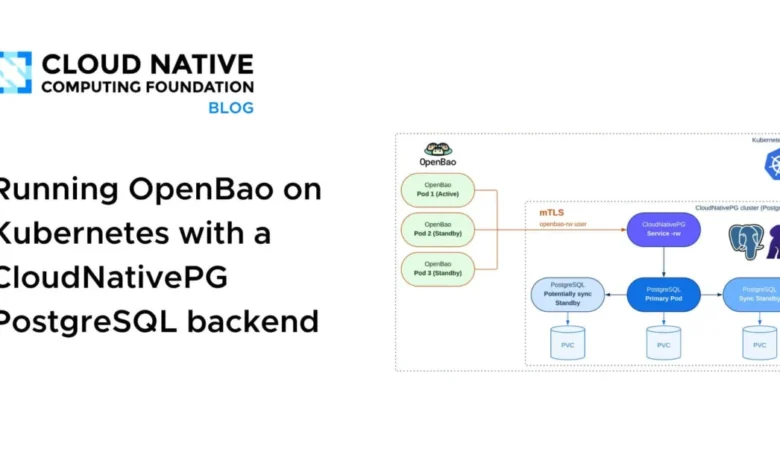
Managing infrastructure secrets on Kubernetes requires a backend that is both self-healing and immune to vendor lock-in, a challenge that has led to a significant shift toward open-source architectural patterns. A newly developed integration between OpenBao—the Linux Foundation’s open-source fork of HashiCorp Vault—and CloudNativePG (CNPG) provides a robust, entirely open-source stack. By leveraging the graduation-status maturity of Kubernetes alongside the rapid evolution of the CNPG project, currently under evaluation for incubation by the CNCF Technical Oversight Committee, engineers can now deploy a database-backed secrets engine that eliminates traditional password-based authentication in favor of certificate-based security.
The core of this architecture transforms any PostgreSQL cluster into an encrypted key-value store. By utilizing CNPG to manage the PostgreSQL instance, organizations gain a self-healing, synchronously replicated, and certificate-authenticated database environment that functions independently of proprietary cloud-provider managed database services. This transition marks a departure from legacy configurations that often rely on static credentials, which are frequently the weakest link in a security chain.
The Architectural Blueprint and Security Posture
The fundamental innovation in this configuration is the removal of password-based authentication for database connectivity. Instead, the system relies on TLS client certificates issued via CNPG’s DatabaseRole object. Both the schema-owning role and the application role utilized by OpenBao authenticate through these certificates. Security is enforced at the database level through explicit pg_hba.conf rules, which act as the final arbiter for connection requests. By rejecting non-SSL connections and requiring valid certificates for the specific roles involved, the system establishes a "zero-trust" approach to internal database communication.
This approach addresses a persistent issue in cloud-native infrastructure: the lifecycle management of secrets. By removing passwords from the connection strings, administrators eliminate the risk of credential leakage within configuration files, environment variables, or Kubernetes Secret manifests that might be inadvertently exposed.
Deployment Chronology and Implementation Steps
To achieve this, the deployment follows a structured sequence. Initially, a local test environment is provisioned using the cnpg-playground repository, which provides a conformant Kubernetes environment capable of modeling complex production scenarios, including multi-region disaster recovery simulations.
The first technical phase involves deploying the CNPG cluster. By utilizing a ClusterImageCatalog, the configuration remains decoupled from specific image tags, allowing the system to automatically adopt patched PostgreSQL 18 releases as they are released. The deployment specifies synchronous replication, ensuring a Recovery Point Objective (RPO) of zero, meaning no data is lost during a failover event.
Following the cluster deployment, a one-time Kubernetes Job handles schema initialization. Because the CNPG DatabaseRole feature is currently evolving to include declarative table-level permissions, this job manually creates the necessary tables for OpenBao—specifically openbao_kv_store and openbao_ha_locks—and configures restrictive privileges. By revoking CONNECT and USAGE rights from the public schema and limiting them exclusively to the openbao-rw role, the implementation adheres to the principle of least privilege.
Operational Data and Performance Implications
The performance profile of this stack is dictated by the synchronous replication strategy. With the method: any configuration, the system requires at least one standby to acknowledge writes, ensuring data durability before a transaction is confirmed. In testing, this provides a highly available environment where the primary instance can fail over to a standby without manual intervention, and without the risk of data inconsistency.

Furthermore, the integration of OpenBao’s storage backend with PostgreSQL allows the secrets engine to leverage the underlying database’s ACID compliance. As OpenBao writes encrypted payloads to the database, the data remains opaque even to those with direct access to the database layer, as the encryption occurs at the application level before the data is persisted to the table rows.
Challenges in Lifecycle Management: Certificate Renewal
While the security benefits are substantial, the operational lifecycle of this architecture introduces specific maintenance requirements. CNPG automatically manages the renewal of client certificates, typically 90 days before expiration. However, the current implementation of the OpenBao PostgreSQL storage backend does not natively support dynamic reloading of TLS credentials.
Consequently, when a certificate is renewed by the CNPG operator, the OpenBao pods must undergo a rolling restart to pick up the updated material. Operational teams must account for this by scheduling rolling updates within the renewal window to ensure continuous service availability. This highlights a broader trend in cloud-native systems: as security protocols become more automated, the integration points between different software layers (in this case, the secrets engine and the database driver) become the primary focus for operational refinement.
Broader Implications for Cloud-Native Security
The shift toward this open-source stack has significant implications for organizations looking to exit vendor-specific ecosystems. Traditional secrets management often ties an organization to a specific cloud provider’s KMS or managed vault service, creating significant technical debt. By standardizing on OpenBao and CNPG, enterprises gain the flexibility to run their secrets infrastructure on any conformant Kubernetes cluster—whether on-premises, in a public cloud, or in a hybrid configuration.
Moreover, the use of CRDs (Custom Resource Definitions) for both the database and the secrets engine brings "Infrastructure as Code" (IaC) to a new level of maturity. Because the database roles and certificates are treated as Kubernetes objects, they can be managed, audited, and versioned using standard GitOps workflows. This reduces human error and provides a clear audit trail for security compliance, which is increasingly critical in regulated industries.
Future Outlook and Community Development
The development of this recipe underscores the strength of the CNCF ecosystem. As the CNPG project nears its incubation milestone, the community is actively addressing the remaining gaps, such as the declarative permissions stanza for DatabaseRole, which will eventually simplify the schema initialization process significantly.
For organizations evaluating this architecture, the path forward involves rigorous testing of failover scenarios and disaster recovery protocols. While this setup provides high availability within a cluster, production environments will require additional layers of protection, such as off-site backups using tools like Barman Cloud, which integrates natively with CNPG to provide continuous archiving to object storage.
Ultimately, the combination of OpenBao and CloudNativePG represents a maturing of cloud-native infrastructure. By replacing brittle, password-reliant systems with robust, certificate-based, and declarative architectures, the industry is moving toward a more secure, portable, and manageable future for infrastructure secrets. This approach does not merely solve a configuration problem; it establishes a standard for how modern, self-healing systems should be built in the Kubernetes era.
Related posts: