Overcoming the Digital Touch Deficit: How Innovative E-Commerce Brands Use Photography to Simulate Physical Interaction

When a consumer walks down the aisle of a brick-and-mortar retail establishment, their purchasing decision is rarely guided by sight alone. The retail experience is inherently multisensory. Shoppers pick up items, testing their weight, assessing their flexibility, rubbing surfaces to evaluate grain and smoothness, and gauging ease of handling. A physical label provides baseline information, but the final verdict is frequently delivered by the fingertips.
In the digital landscape, however, this tactile feedback loop is entirely severed. Online shoppers touch nothing. For decades, the standard e-commerce playbook has relied on sterile, floating product shots against stark white backgrounds. While these clean images efficiently communicate color and shape, they fail to answer fundamental tactile questions. Consequently, shoppers are forced to guess about material quality, consistency, and functionality, leading to higher cart abandonment rates and costly product returns.

Yet a growing cohort of forward-thinking e-commerce merchants is engineering a visual revolution. By strategically deploying advanced photographic techniques, these brands are effectively bridging the gap between sight and touch, demonstrating that the right image can articulate what a product feels like before it ever arrives at a customer’s doorstep.
The Psychology of Digital Tactility and the Return Problem
To understand why visual tactile simulation is transforming conversion rates, one must look at consumer psychology. Research in sensory marketing indicates that consumers form psychological ownership of an item when they can mentally simulate interacting with it. When a website denies them both physical contact and effective visual proxies, cognitive friction increases.
According to retail analytics data, sizing and material dissatisfaction account for nearly 40% of all online retail returns. When a customer orders a home decor item, a cosmetic, or a building material based solely on a flat digital swatch, the margin for expectation mismatch is exceptionally wide.

Industry analysts note that merchants investing in high-fidelity, texture-forward product imagery routinely see a measurable reduction in return rates alongside an increase in conversion metrics. By translating physical properties into visual cues, brands reduce the uncertainty that paralyzes digital buyers.
Letting Light Do the Touching: Capturing Texture Through Contrast
One of the most effective methods for replicating touch on a flat screen involves the manipulation of light and shadow across uneven surfaces. Color alone provides incomplete data; a flat green swatch tells a buyer nothing about whether a tile is glassy and smooth or porous and rustic. However, a photograph that captures light glancing across an irregular surface reveals grain, pitting, and depth that would normally require a human hand to detect.
California-based paint brand Backdrop has structured its entire digital user experience around this principle. Rather than displaying sterile, digital color chips that bear little resemblance to real-world application, Backdrop features immersive, full-bleed photography of actual painted walls as its hero product images. These photographs capture the authentic imperfections of the medium: subtle roller marks, micro-pitting, and the organic way light diffuses across a matte or satin finish.

When digital shoppers scroll down a Backdrop product page, they encounter images of a wall caught mid-application—half painted in a rich terracotta hue and half bare drywall, separated by a distinct roller-stroke edge. This deliberate framing shifts the psychological perception of the product from an abstract color code to a tangible, physical building material.
A similar methodology is employed by Fireclay Tile, another California-based manufacturer specializing in architectural ceramics. Fireclay’s digital catalog avoids flat, uniform representations of its tile collections. Instead, product pages utilize tight, macro-style grid photography. These images capture the complex glaze chemistry of the tiles, showing surfaces that catch light unevenly—glossy and pooling in micro-cracks while remaining matte and satin in adjacent areas. By exposing these minute variations in texture and finish online, Fireclay provides digital buyers with the visual equivalent of running a thumb over the ceramic surface.
Demonstrating Dynamic Functionality: Moving Beyond Static Packaging
While light and macro-photography excel at conveying static textures, an entirely different photographic challenge arises when selling goods whose primary value lies in transformation. Products such as bath bombs, exfoliating scrubs, facial cleansers, and melting balms do not exist in a vacuum; their utility is defined by what they do when activated.

Lush Cosmetics, a global pioneer in ethical beauty retail, has redefined how dynamic products are marketed online. Historically, beauty brands photographed items neatly stacked inside cardboard packaging or sitting idly on a shelf. Lush countered this by focusing its product galleries on kinetic transformation.
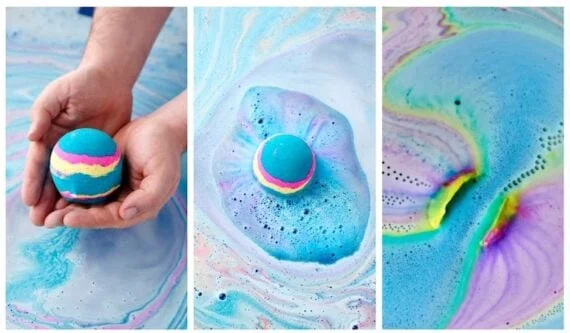
For products like the Intergalactic bath bomb, Lush’s product page gallery features a sequence of active engagement: two hands gently cupping the dry sphere, immediately followed by macro-shots of the item actively fizzing, dissolving, and swirling into a rich, marbled aquatic tapestry of blue, pink, and yellow. Rather than forcing the customer to imagine how a dry ball of ingredients functions in a bath, the photography explicitly demonstrates the sensory payoff.
Lush extends this strategy directly into its category grid architecture. When browsing the company’s shower and body scrub selections, shoppers are not greeted by rows of identical amber jars with varying label text. Instead, category thumbnails showcase rich, organic smears of the product itself. These visual swatches expose the actual consistency, viscosity, and particulate density of the scrub—whether it features coarse sugar crystals, smooth moisturizing oils, or dense, whipped foaming agents.

Industry experts point out that this level of transparency drastically alters buyer behavior. By removing the guesswork regarding product consistency, brands build a higher level of consumer trust prior to checkout.
Implementation Strategies for E-Commerce Merchants
As consumer expectations continue to evolve, static product photography is increasingly viewed as an operational deficit. Retail strategists recommend a systematic overhaul of digital asset creation, centered on two core directives.
First, merchants must prioritize tactile storytelling by placing texture-focused imagery at the very beginning of the product-page gallery. The primary hero image should establish material reality—utilizing side-lighting, macro-lenses, and contextual environments to highlight grain, weight, and finish before the user even scrolls.

Second, for goods that undergo physical transformation, visual assets must capture action. Whether an item melts, dissolves, fizzes, foams, changes color, or crumbles, dynamic photography and short-form visual loops should be integrated directly into the core shopping journey to simulate the tactile experience of use.
Broader Implications and Future Outlook
The shift toward tactile visual merchandising represents a broader maturation of the e-commerce sector. As acquisition costs rise and digital advertising becomes increasingly crowded, conversion rate optimization is no longer just about traffic acquisition—it is about sensory immersion.
By recognizing that online shoppers process digital imagery through the lens of physical memory, innovative brands are successfully dismantling the barriers of the screen. As photographic technology, lighting control, and high-definition macro-display capabilities become more accessible to merchants of all sizes, the tactile gap in digital retail will continue to narrow, setting a new baseline standard for the future of online commerce.