Meta Wins CNCF End User Case Study Contest for GitOps Transformation of AI Infrastructure

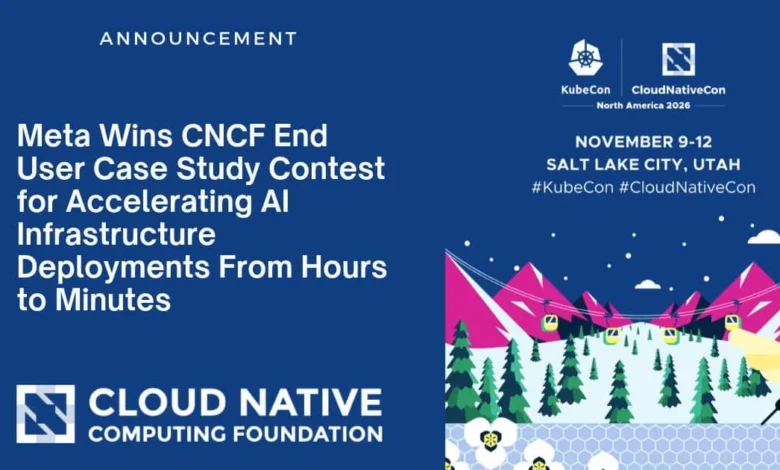
At the 2026 KubeCon + CloudNativeCon North America conference held in Salt Lake City, the Cloud Native Computing Foundation (CNCF) officially recognized Meta as the recipient of its prestigious End User Case Study Contest. This accolade underscores the social media and technology giant’s successful transition to a sophisticated GitOps-driven deployment model, which has fundamentally redefined how the company manages application delivery across its sprawling AI research and inference infrastructure. By leveraging open-source powerhouses Argo CD and Kargo, Meta’s Cloud Foundation team has successfully modernized its operational workflow, collapsing deployment timelines from multi-hour manual processes into seamless, automated operations that take only minutes.
The Operational Challenge: Moving Beyond Terraform
For years, Meta’s internal infrastructure management relied heavily on Terraform, a tool primarily designed for infrastructure provisioning. While Terraform remains an industry standard for defining "Infrastructure as Code," Meta’s engineering team encountered significant bottlenecks when attempting to force-fit it into the role of an application deployment engine. The reliance on a monolithic deployment model created a fragile ecosystem where routine application updates were tethered to the broader, more complex infrastructure release cycle.
The implications of this legacy approach were severe. Because infrastructure and application state were tightly coupled, a stalled rollout in one area could cascade, blocking unrelated releases across the fleet. Furthermore, the absence of native, automated health checks meant that the team had to rely on manual verification or brittle scripts to ensure that applications were functioning correctly after a deployment. For a team of just over 15 engineers tasked with supporting approximately 100 Kubernetes clusters across heterogeneous environments—spanning various cloud providers and diverse hardware accelerator families—this level of operational friction was unsustainable.
Chronology of the Transformation
The shift toward a modern GitOps framework began as the company recognized that the rapid evolution of its AI research infrastructure necessitated a higher degree of agility. By early 2026, the Cloud Foundation team initiated a transition to decouple application delivery from infrastructure provisioning.
The new architecture maintains Terraform as the primary tool for initial infrastructure provisioning, ensuring the underlying hardware and network layers remain consistent. However, for the application layer, Meta introduced Argo CD to act as a declarative reconciliation engine. By storing application configurations in Git, the team ensured that the actual state of the Kubernetes clusters could be continuously monitored and aligned with the desired state defined in the repository.
To solve the complexity of multi-environment management, the team integrated Kargo. This tool serves as the orchestrator for release promotion, allowing Meta to move application versions across various stages—from testing and staging to production—with granular control. The integration of Kargo provided the missing link for "deployment traceability," enabling the team to maintain versioned records that simplified both auditing and, crucially, disaster recovery.
Quantifying the Impact
The results of this architectural shift are statistically significant. Prior to the adoption of the Argo CD and Kargo stack, the standard deployment cadence was often measured in hours, with some processes extending beyond four hours due to the complexity of the shared deployment model. In the new, automated GitOps environment, these same operations are completed in mere minutes.
This efficiency gain is not merely a matter of speed; it represents a drastic reduction in the "mean time to recovery" (MTTR). In the context of AI research, where researchers rely on high-availability compute resources to train large-scale models, downtime for deployment purposes is a direct cost to innovation. By enabling independent rollouts, the platform ensures that a failure in one application deployment no longer triggers a site-wide blockage. The automation of health checks has also reduced the manual labor required by the 15-person team, allowing them to pivot from reactive firefighting to proactive platform development.
Official Perspectives and Industry Recognition
Chris Aniszczyk, Chief Technology Officer of the CNCF, highlighted the strategic importance of Meta’s achievement. "AI infrastructure is causing organizations to rethink how they manage applications across distributed environments," Aniszczyk noted during the awards ceremony. "Meta’s approach demonstrates how open-source technologies like Argo can help teams automate their application delivery, reduce operational complexity, and scale infrastructure without adding unnecessary overhead. It’s a powerful example of how cloud native technologies are supporting the operational demands of AI at scale."
Phong Nguyen, a Production Engineer at Meta, emphasized that the success of the project was rooted in community collaboration. "GitOps and Argo CD give our small team a great foundation, shaped by years of community experience in Kubernetes delivery," Nguyen stated. He noted that the team’s primary focus has been on "connecting it to Meta’s systems" while simultaneously documenting lessons learned to benefit the broader CNCF community.
Broader Implications for the Cloud Native Ecosystem
The case study of Meta serves as a bellwether for the broader industry. As AI and machine learning workloads become the dominant drivers of data center expansion, the traditional manual methods of cluster management are becoming obsolete. The "Meta model"—which prioritizes developer experience by allowing engineers to specify requirements through simple, standardized application definitions—is expected to become a blueprint for other large-scale enterprises.
By automating the generation of Argo CD and Kargo configurations, Meta has effectively abstracted the complexity of Kubernetes away from the application developers. Developers no longer need to be experts in the intricacies of cluster-level networking or storage; they simply define their requirements, and the platform handles the orchestration. This shift promotes "deployment consistency," a critical factor when managing a fleet of 100 clusters where configuration drift is the primary enemy of stability.
Future Roadmap: Scaling and Upstream Contributions
The victory at the CNCF contest does not mark the end of Meta’s internal evolution. The engineering team has outlined a clear roadmap for the coming year, which includes transitioning toward a centrally managed Argo CD service. This centralized approach is designed to further minimize maintenance overhead, allowing the team to manage the "control plane" of its fleet more effectively.
Furthermore, Meta has expressed a commitment to giving back to the open-source community that facilitated this transformation. The team is currently exploring upstream contributions to Argo CD, specifically targeting improvements in container registry authentication and performance tuning for "large cluster" scenarios. These contributions are expected to benefit thousands of other organizations that utilize Argo CD to manage massive Kubernetes footprints.
The Role of the CNCF in the AI Era
The Cloud Native Computing Foundation continues to act as the central hub for this technological transition. As the host of Kubernetes, Prometheus, and Envoy, the CNCF provides the foundational layers upon which companies like Meta are building their AI futures. With nearly 800 member organizations, the foundation serves as a bridge between the rapid pace of open-source innovation and the stringent requirements of enterprise-grade production environments.
The recognition of Meta’s case study reinforces the CNCF’s mission to support sustainable ecosystems. As the industry moves toward a future where AI research and inference represent the primary workload for cloud-native platforms, the success of Meta’s GitOps transition provides a clear, actionable roadmap for others to follow. Through the adoption of standardized, declarative, and automated workflows, organizations can ensure that their infrastructure remains an enabler of progress rather than a barrier to scale.
The full details of this transformation, titled "GitOps at Meta: How We Went From Terraform on Cron to GitOps for AI Infra," have been published by the CNCF, providing technical teams worldwide with a deep dive into the specific configurations and strategies employed during this successful migration. As the technology sector continues to grapple with the operational demands of the AI boom, Meta’s journey stands as a testament to the power of open-source collaboration and the maturity of modern cloud-native tools.