Meet the Startup Automating the Backbone of Industrial Infrastructure Through Robotic Precision

Industrial infrastructure relies on a vast, intricate network of pipes to transport everything from crude oil and natural gas to municipal water and food products. Yet, the maintenance of this critical network depends heavily on grueling manual labor. For decades, pipefitters have wrestled with heavy tools in cramped, hazardous environments to loosen and tighten millions of bolted flange joints—the mechanical connections sealing pipeline sections together. Now, a new wave of industrial automation is poised to transform this physically demanding sector.
Enter Nexterity, an early-stage robotics startup founded by former ExxonMobil engineer and planner Lindsey Elliott. Selected as one of the Startup Battlefield 200 participants for TechCrunch Disrupt, Nexterity has developed a specialized, remote-controlled robotic system designed to shoulder the physical burden of bolting pipes. By combining mechanical engineering with portable automation, the startup aims to address chronic labor shortages, enhance worker safety, and elevate notoriously low productivity levels across North America’s industrial trades.
The Human and Economic Toll of Industrial Bolting
The routine maintenance of industrial piping requires immense physical exertion. Pipefitters frequently operate in grueling conditions, often working twelve-hour shifts for months at a time during facility turnarounds and maintenance cycles. The repetitive nature of manual bolting—turning heavy wrenches in tight spaces—contributes significantly to workplace injuries, ranging from musculoskeletal disorders to acute trauma from slipping tools.
Compounding the physical toll is a deepening labor shortage. Across the United States and Canada, the skilled trades face an aging workforce and an acute deficit of incoming talent. According to Elliott, these pressures have resulted in stagnating or declining productivity metrics across the North American pipefitting sector.
"Those people get really tired when they’re asked to work 12 hours a day for three months in a row," Elliott explained. "I’ve talked to pipefitters across the U.S. and across Canada, and just repeatedly have been told North American pipefitting productivity is notoriously low."
For industrial operators, low productivity translates directly into extended downtime. When a refinery, chemical plant, or water treatment facility must halt operations for maintenance, every hour of delay costs tens of thousands—sometimes millions—of dollars in lost output. Accelerating the bolting process without compromising safety or structural integrity represents a major economic opportunity for facility owners.
From the Bolting Symposium to Startup Battlefield: The Chronology of Nexterity
The genesis of Nexterity did not happen overnight; it was the result of years of immersion in heavy industry, rigorous data gathering, and targeted engineering research.
The timeline of Nexterity’s development reflects a methodical approach to identifying and solving a hyper-specific industrial bottleneck:
- Industry Experience (Pre-2022): While working as an engineer and planner at ExxonMobil, Lindsey Elliott observed firsthand the operational inefficiencies, safety hazards, and labor bottlenecks associated with pipeline maintenance and assembly.
- Industry Engagement (2022–2023): Elliott began actively researching bolting standards, attending specialized events such as the annual Bolting Symposium—where she participated in the event’s signature "Bolting Bingo" alongside self-described engineering enthusiasts—and consulting with members of the Pressure Vessels & Piping Division of the American Society of Mechanical Engineers (ASME).
- Market Discovery: Through extensive consultations with industry experts, colloquially known in the sector as "torque dorks," Elliott discovered a crucial standardization metric: approximately 80% of industrial piping falls within a diameter range of two to eight inches (NPS2 to NPS8). This high degree of dimensional repeatability made the application a prime candidate for scalable robotics.
- Founding and Prototyping (2023–2024): Armed with clear specifications, Elliott founded Nexterity and spearheaded the design of a modular, battery-powered robotic tool specifically tailored for standard pipe diameters.
- TechCrunch Disrupt Selection (2024): Nexterity was selected as one of the Startup Battlefield 200 companies, thrusting the industrial robotics firm onto the international technology stage.
Anatomy of the Nexterity Solution: More Dork, Less Torque
The hardware architecture of Nexterity’s solution prioritizes field deployability and operational simplicity. Rather than building a massive, fixed gantry system or a complex humanoid robot, the startup focused on a modular, task-specific machine.
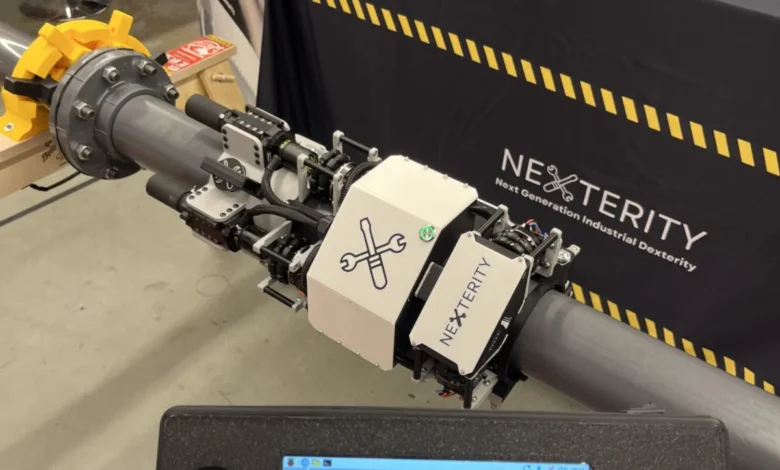
The robot is engineered in two main components that latch securely around a targeted pipe section. Once secured, the battery-powered device utilizes an integrated drive mechanism to slide smoothly along the exterior of the pipe. As it positions itself over a bolted flange joint, the onboard automation system simultaneously loosens or tightens four bolts with precise torque calibration.
Mobility and ease of deployment are central to Nexterity’s go-to-market strategy. The entire robotic assembly is compact enough to fit inside a standard Pelican protective case, allowing a single worker to transport the equipment to remote or confined work sites without specialized lifting gear.
This portability aligns seamlessly with Nexterity’s intended business model: operating as a Hardware-as-a-Service (HaaS) provider or equipment rental supplier. By treating the robots like specialized rental construction equipment, industrial contractors can easily integrate the technology into existing project workflows without incurring prohibitive capital expenditure costs.
The Broad Horizon of Industrial Piping Infrastructure
While oil, gas, and petrochemical refineries served as the initial proving ground for Elliott’s concept, the addressable market for automated bolting extends far beyond the fossil fuel sector.
"I think it would shock a lot of people just how big this market is," Elliott noted. "I mean, day to day, most of us don’t think about piping infrastructure, but even water, wastewater, water treatment, food and beverage, mining, nuclear, any kind of green and sustainable manufacturing facility—they all use the same kind of piping."
Every industry that relies on fluid transport systems faces similar maintenance challenges. Nuclear power plants must adhere to stringent regulatory compliance regarding joint integrity; food and beverage manufacturing facilities require rapid sanitation turnarounds; and municipal water treatment plants operate under tight budgetary constraints while managing aging municipal networks. A standardized, portable robotic tool capable of servicing NPS2 to NPS8 piping offers cross-industry utility.
Implications for the Future of Blue-Collar Work
The introduction of automation into traditional blue-collar trades frequently sparks debates regarding workforce displacement. However, industry advocates and startup founders argue that tools like Nexterity’s bolting robot act as force multipliers rather than outright replacements for human labor.
Given the persistent shortage of skilled trade workers, automation offers a way to retain existing personnel by eliminating the most physically punishing aspects of the job. By delegating repetitive, high-torque physical labor to machines, employers can transition pipefitters into higher-level supervisory, technical, and diagnostic roles. This shift not only improves job satisfaction and worker retention but also enhances overall project safety by reducing human exposure to high-pressure lines and ergonomic strain.
As Nexterity prepares for broader commercial deployment following its showcase at TechCrunch Disrupt, the startup exemplifies a growing trend in venture capital and industrial technology: solving unglamorous, foundational problems through targeted, practical robotics. By focusing on the mechanics of industrial joints, Nexterity demonstrates that the future of heavy industry may well be forged not by replacing human expertise, but by removing the physical toll of the trade.