Announcing the Developer Preview of Transfer Manager for Amazon S3 in the JavaScript SDK

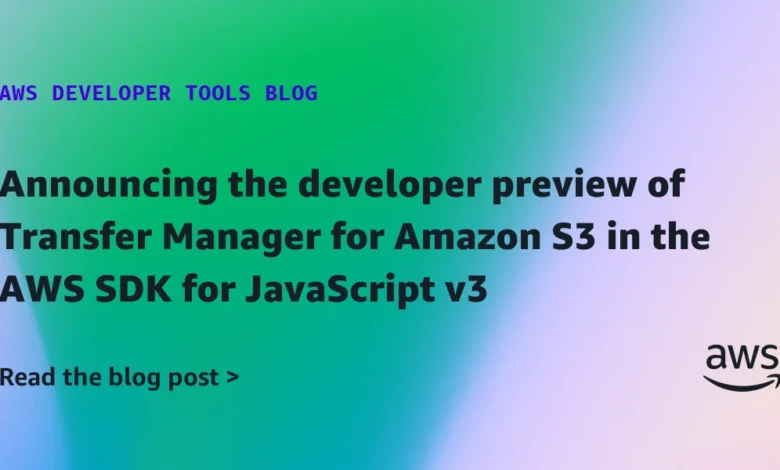
On October 15, 2026, Amazon Web Services (AWS) officially introduced the developer preview of Transfer Manager, a significant new addition to the AWS SDK for JavaScript. Available as the @aws-sdk/lib-transfer-manager package on npm, this tool represents a strategic effort by AWS to streamline the complexities associated with high-throughput data movement for developers working within Node.js and browser-based environments. By abstracting the intricate mechanics of multipart uploads, concurrency management, and checksum verification, Transfer Manager aims to lower the barrier to entry for building data-intensive applications that interact with Amazon Simple Storage Service (S3).
The Evolution of Data Transfer in JavaScript
Historically, JavaScript developers tasked with moving large datasets to or from cloud storage faced a non-trivial engineering challenge. Implementing efficient transfers required manually orchestrating multipart requests, managing concurrent connections to prevent socket exhaustion, and implementing robust error handling and progress tracking. While existing tools like @aws-sdk/lib-storage provided basic utility, they often lacked the granular performance optimizations necessary for enterprise-scale workloads or high-performance computing tasks.
The introduction of Transfer Manager is a direct response to feedback from the developer community, which has increasingly relied on JavaScript—particularly through Node.js—for backend services and data processing pipelines. By providing high-level operations that encapsulate low-level data movement logic, AWS is moving to standardize how JavaScript applications interact with S3, potentially reducing the development time required to build scalable storage-integrated software.
Technical Architecture and Operational Capabilities
Transfer Manager is designed to function as an orchestration layer. It leverages worker threads to parallelize file and in-memory transfers, allowing applications to maximize the utilization of underlying compute, network, and storage resources. This multi-threaded approach is particularly advantageous in Node.js environments where I/O-bound tasks can quickly become bottlenecks if not handled with precise concurrency control.
The library supports a robust set of operations:
- Object Uploads and Downloads: Full support for multipart transfers with configurable concurrency settings.
- Directory-Level Operations: In Node.js environments, developers can leverage specialized
uploadDirectoryanddownloadDirectoryfunctions, which simplify the migration of complex file structures. - Enhanced Flow Control: The library provides built-in mechanisms for cancellation and progress reporting, essential features for user-facing applications that require real-time feedback during long-running data transfers.
- Memory Efficiency: By utilizing worker threads, the tool effectively isolates heavy I/O tasks from the main event loop, ensuring that the application remains responsive even during massive data transfers.
It is important to note that this release is currently in the developer preview phase. AWS has explicitly cautioned against utilizing the library in production environments. According to the AWS SDKs and Tools maintenance policy, developer previews are intended for early access, testing, and gathering community feedback to refine the API before it reaches general availability (GA).
Benchmarking Performance and Throughput
To validate the efficacy of Transfer Manager, AWS conducted a series of rigorous benchmarks using an Amazon EC2 m8ib.48xlarge instance. The testing methodology focused on two primary metrics: absolute throughput for downloads and a performance comparison against the existing @aws-sdk/lib-storage library for uploads.
In the upload tests, the results were striking. Depending on the specific workload and data profile, Transfer Manager demonstrated between 8 and 40 times higher throughput compared to the existing @aws-sdk/lib-storage. These gains are attributed to the refined management of multipart concurrency and the library’s ability to saturate the available network interface more efficiently.
For download operations, where no comparable high-level utility previously existed in the JavaScript SDK, the benchmarks highlighted the library’s ability to maintain sustained high-throughput, utilizing a significant percentage of the system’s total available bandwidth. The benchmark configuration for these tests involved specific tuning, such as setting useODirect: true for file operations and increasing the UV_THREADPOOL_SIZE to 128 to accommodate the demands of parallel file I/O. AWS noted that these settings are workload-specific and serve as a starting point for developers looking to optimize their own environments rather than serving as universal, out-of-the-box defaults.
Implications for the Developer Ecosystem
The implications of this release are twofold. First, for the individual developer, the complexity of implementing "best practice" data movement is significantly reduced. By offloading the logic of multipart chunking and retry strategies to a managed library, developers can focus on application-level business logic rather than the plumbing of cloud storage interactions.
Second, the broader AWS ecosystem benefits from increased consistency. As developers adopt standardized tools like Transfer Manager, the performance profile of applications built on AWS becomes more predictable. This is particularly relevant for industries dealing with "Big Data," such as media processing, genomics, and large-scale log aggregation, where efficient data ingestion and retrieval are critical components of the total cost of ownership.
Future Roadmap and Community Engagement
AWS has signaled that the current developer preview is merely the first step. The roadmap for the library, as detailed in the GitHub announcement, includes several planned improvements. These focus on expanding the library’s feature set, refining cross-platform compatibility, and addressing potential edge cases identified during the feedback period.
The development team is actively soliciting input from the community. Through the GitHub repository and the AWS SDK for JavaScript issue tracker, users are encouraged to report bugs, request features, and share their experiences with different workload profiles. This collaborative approach is a hallmark of the modern AWS development philosophy, which prioritizes transparency and developer-led refinement over rigid, top-down implementation.
Conclusion
The release of the Transfer Manager for Amazon S3 marks a transition point for JavaScript developers in the cloud era. As applications grow in complexity and the volume of data generated by modern services continues to climb, tools that abstract the "heavy lifting" of cloud storage interactions become indispensable. While it remains in the preview phase and requires careful testing, the performance gains and operational simplifications offered by Transfer Manager suggest that it will become a foundational component of the AWS SDK for JavaScript.
For organizations currently struggling with the performance overhead of custom-built upload and download managers, this library offers a clear path toward modernization. By aligning with the official AWS tooling, teams can ensure their data pipelines are not only faster but also more maintainable and better integrated with the broader AWS ecosystem. As the industry looks toward the general availability of this package, the combination of improved throughput and simplified developer experience stands to benefit a wide range of cloud-native projects.