How TUI Scaled Enterprise Security From a Four-Person Team to Over 100 Digital Product Teams Using Generative AI


In the fast-paced world of modern travel and digital commerce, tourism giant TUI operates a vast, multi-faceted enterprise spanning airlines, hotels, cruise ships, and bespoke local travel experiences. Behind this sprawling consumer-facing infrastructure lies a massive digital footprint managed by more than 100 autonomous digital product teams. However, keeping this infrastructure secure historically collided with a severe operational bottleneck: a dedicated security engineering division consisting of just four professionals.
For years, performing comprehensive security threat modeling for every new digital service was a grueling, manual endeavor. Each individual assessment required between four and six hours of intensive human labor. Security engineers had to meticulously review complex architecture diagrams, cross-reference identified vulnerabilities against a maze of internal corporate standards, research emerging security flaws, and document their findings across Confluence pages and Jira tickets. Consequently, the team could only complete a meager three to four threat modeling sessions per month. This created a persistent, ever-growing backlog that forced leadership to treat security reviews as a luxury reserved exclusively for the highest-priority projects, leaving dozens of other services exposed to potential vulnerabilities before launch.
The Imperative for Automated Scale
Faced with mounting regulatory pressures, expanding digital operations, and the clear necessity to shift security left in the software development lifecycle, TUI leadership recognized that manual threat modeling was unsustainable. The organization needed a paradigm shift: threat modeling could no longer be a discretionary hurdle; it had to become a mandatory, frictionless requirement for every new service deployed across the entire enterprise.
To solve this daunting scaling challenge, TUI embarked on a collaborative journey with the AWS Generative AI Innovation Center. Over a focused 10-week proof of concept (PoC), the cross-functional team developed, tested, and validated an advanced generative AI architecture designed to automate the heavy lifting of security assessments. By leveraging Amazon Bedrock—a fully managed service for building enterprise-grade generative applications—and Anthropic’s advanced Claude Sonnet 4.5 foundation model, TUI engineered a system capable of bridging the chasm between a four-person security team and more than 100 product teams.
Following the successful conclusion of the PoC, TUI transitioned the architecture from a prototype into a fully functioning production environment in a remarkably swift 30 days. The resulting system, officially designated as TUI Threat Designer, fundamentally transformed how the organization approaches software security, establishing a new benchmark for automated enterprise compliance and threat mitigation.
Overcoming Early Architectural Hurdles
The path to a fully autonomous, reliable threat modeling agent was not without its obstacles. TUI’s engineering team iterated through several distinct architectural phases before arriving at their final production-ready design, encountering and solving significant technical hurdles along the way.
In their initial attempt, the team attempted a brute-force approach: loading all 192 of TUI’s internal security standards—amounting to roughly 338 kilobytes of dense technical text—directly into the foundation model’s prompt context. This approach failed almost instantaneously. Certain internal compliance documents spanned upwards of 20 pages, and the cumulative text volume frequently exceeded the foundation model’s context window limits before the AI could even begin evaluating the target architecture.
Even when smaller subsets of standards were tested, the model struggled to process the sheer volume of contradictory or overlapping directives. When instructed to recommend exclusively TUI-approved internal software tools for threat mitigations, the model would frequently hallucinate and suggest generic industry alternatives, overwhelmed by the conflicting guidelines found across disparate compliance documents.
The breakthrough arrived when TUI shifted its strategy from a brute-force prompt-loading exercise to an intelligent metadata-driven search and selection framework. Instead of feeding raw documents into the model, the team pre-generated lightweight metadata profiles for every security standard, capturing essential keywords, relevant component types, STRIDE threat categories, and dynamic relevance scores.
At runtime, the Claude Sonnet 4.5 model reviews this concise metadata index—totaling a mere 61 kilobytes—and intelligently selects only the 16 most pertinent security standards for the specific architecture under review. This innovation slashed context consumption by 94%, dropping it from 338 KB to 21 KB while preserving absolute fidelity to corporate compliance mandates. By treating the knowledge base as a searchable corpus rather than a static prompt text, TUI achieved a predictable, highly debuggable system tailored to the organization’s unique governance structure.
The Mechanics of an Agentic, Self-Correcting Workflow
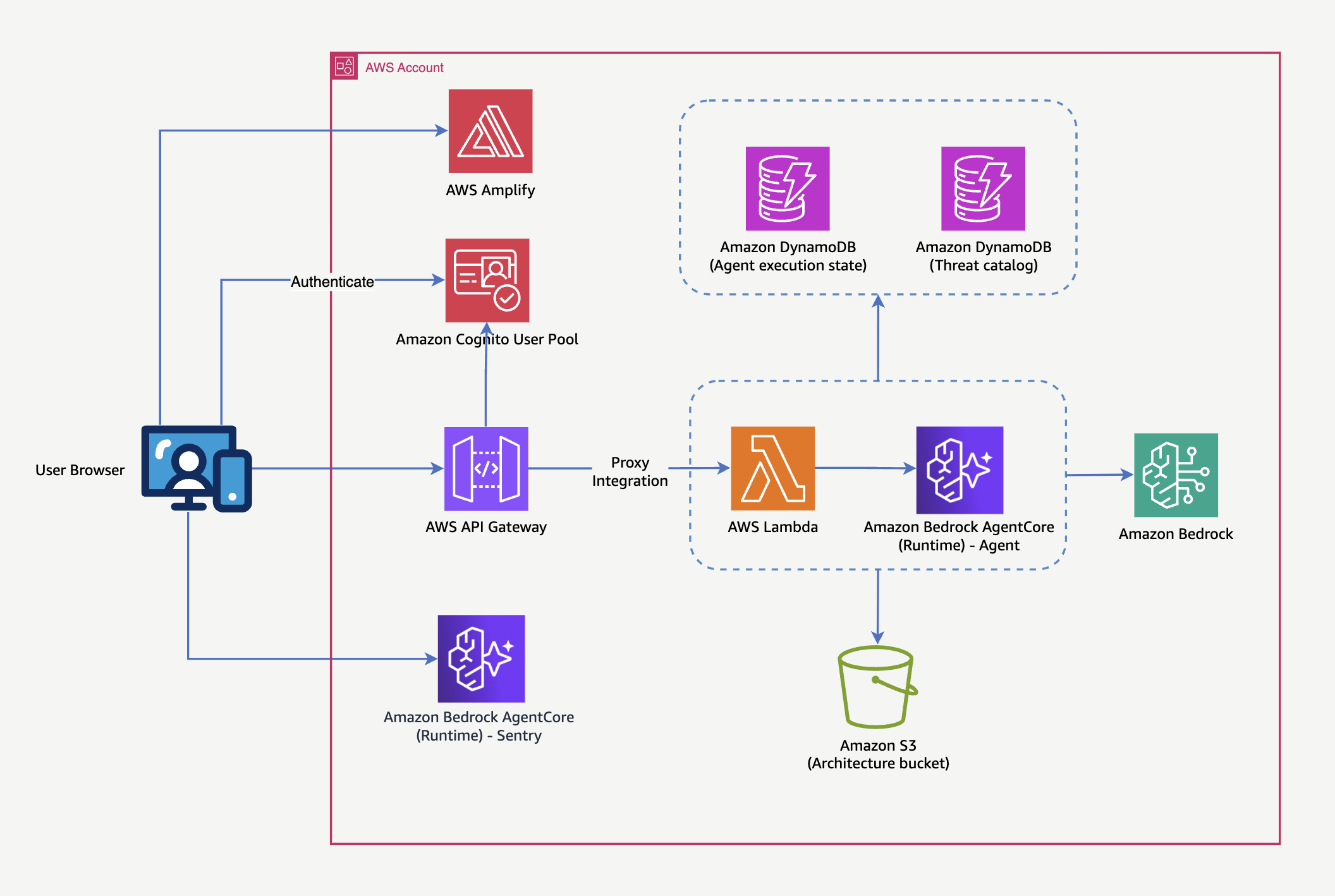
At the heart of TUI Threat Designer lies an advanced agentic workflow orchestrated via LangGraph, deployed on the Amazon Bedrock AgentCore runtime within the eu-central-1 AWS Region in Frankfurt. This serverless infrastructure ensures seamless scalability, robust data encryption at rest via AWS KMS, and secure transit through TLS, satisfying stringent European data residency and compliance requirements.
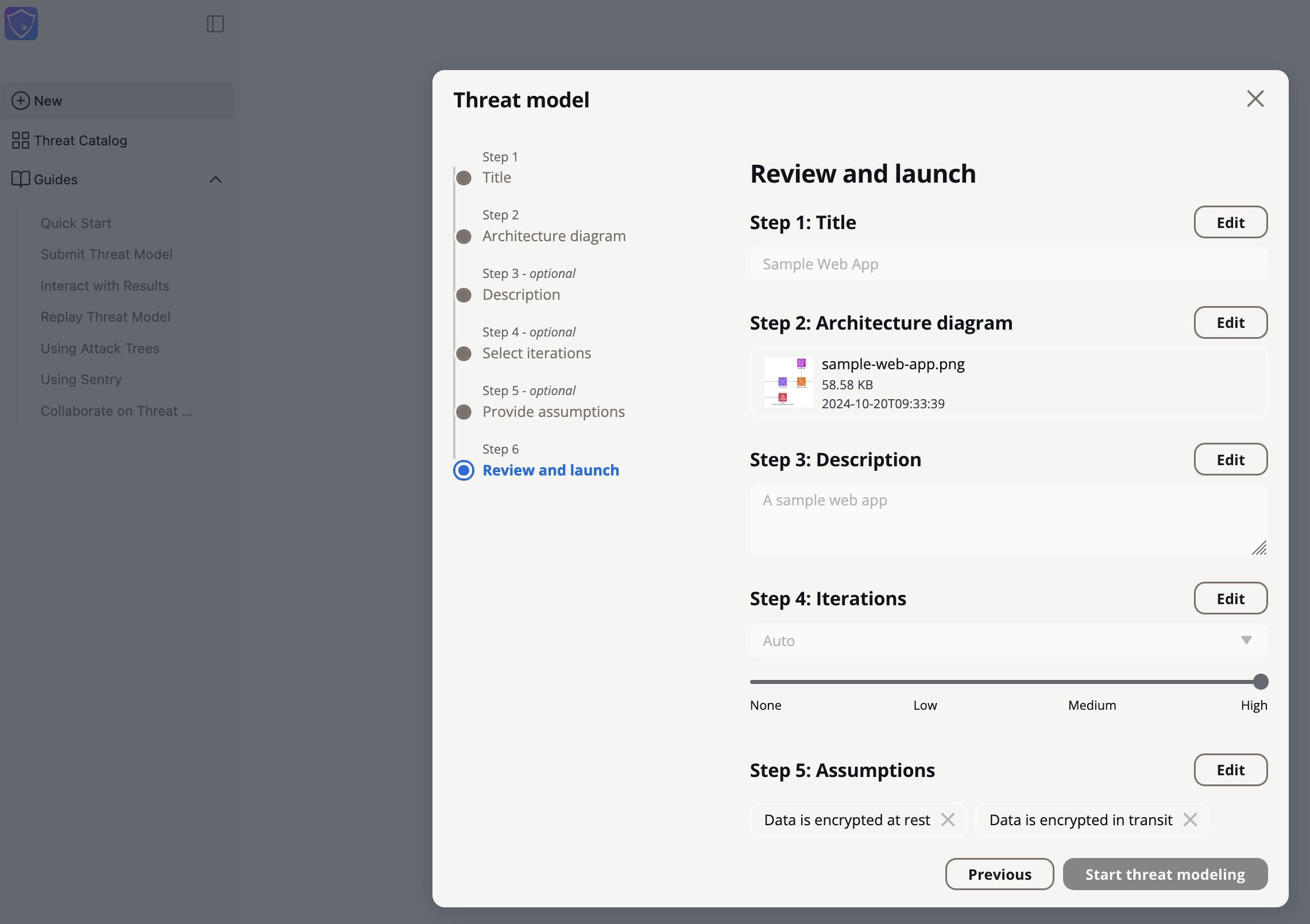
When a digital product team initiates a security review, they interact with a React front-end hosted on AWS Amplify, authenticating securely through Amazon Cognito. The submission wizard is designed for extreme simplicity, requiring approximately two minutes to complete. Engineers provide a project title, upload one or more architecture diagrams—such as a high-level overview paired with a detailed network topology—add optional contextual assumptions, and select a reasoning depth slider based on system complexity.
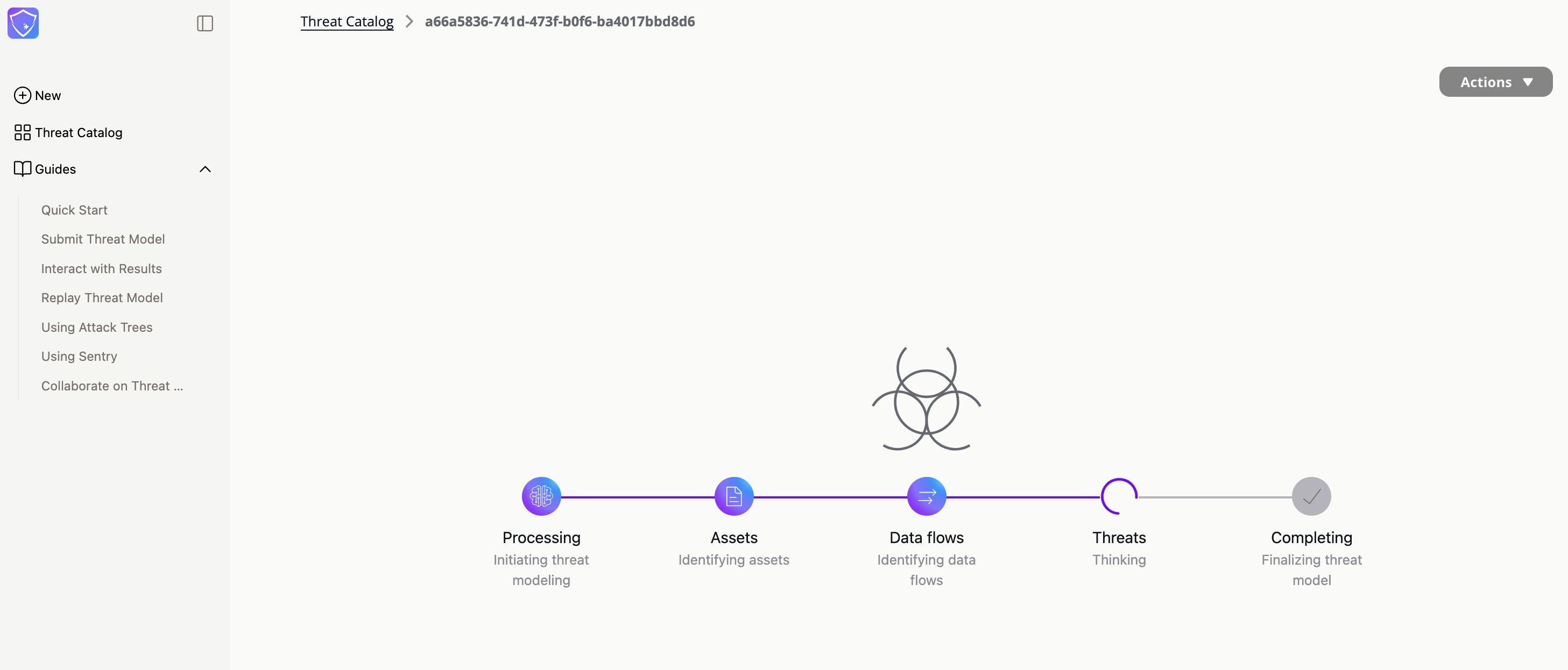
Once submitted, the system converts the diagrams into base64 format to identify distinct components and data flows. Rather than generating threats in a single, error-prone pass, the system deploys a Reason and Act (ReAct) agentic subgraph equipped with four specialized tools: adding threats, deleting threats, reading the active threat catalog, and executing formal gap analyses.
The agent operates in iterative cycles, closely mirroring the cognitive workflow of a human security expert. It generates an initial threat baseline using the STRIDE methodology—covering spoofing, tampering, repudiation, information disclosure, denial of service, and elevation of privilege—and then critically evaluates its own output against the loaded TUI standards.
To prevent infinite processing loops, TUI implemented a rigorous tool budget mechanism. After exactly three threat-generation cycles, the workflow forcibly triggers a gap analysis node. The agent must step back, evaluate what vulnerabilities or architectural components have been overlooked, and address those deficiencies before generating further outputs. Furthermore, a strict validation node ensures that the final threat catalog is non-empty, covers all six STRIDE categories, and has successfully passed gap analysis.
Based on production data, this iterative loop typically yields between 40 and 60 comprehensive threats per architecture, complete with risk likelihood and impact scores derived from TUI’s internal risk matrix, mapped ISO 27001 controls, and concrete mitigation strategies utilizing approved internal tools. Depending on the complexity of the architecture, the system dynamically scales its reasoning token budget from 24,000 tokens for standard systems up to 64,000 tokens for highly intricate topologies.
Integrating Real-Time Threat Intelligence and Human Validation
Because security vulnerabilities evolve at a relentless pace, static internal standards alone are insufficient to protect modern cloud architectures. To bridge this gap, TUI’s workflow integrates automated external web searches targeting authoritative databases such as OWASP, NIST, and the Common Weakness Enumeration (CWE) repository.
Whenever the system identifies standard technology components—such as Keycloak, Kong, or Redis—within an architecture diagram, it formulates targeted queries focusing strictly on known vulnerabilities and hardening best practices. To optimize performance and control API costs, these external queries pass through an Amazon S3-based caching layer featuring a 7-day time-to-live (TTL). By hashing sorted component names while deliberately omitting variable AI-generated descriptions, the cache achieves an impressive 70% to 80% hit rate across TUI’s standardized technology stack. Cache hits return actionable intelligence in under 100 milliseconds, compared to several seconds for live web queries.
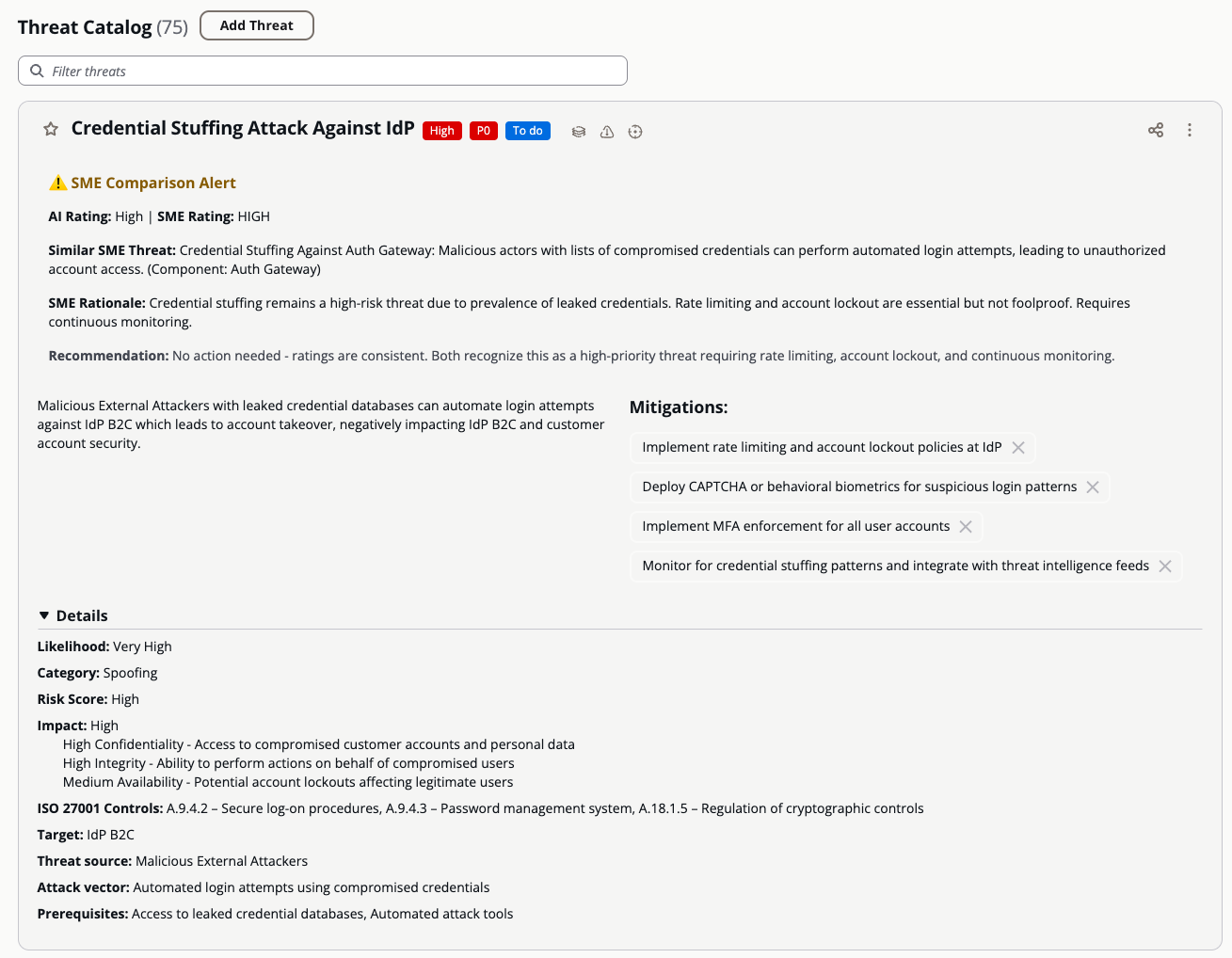
Despite the autonomy of the generative AI, human expertise remains central to the platform’s long-term accuracy through a sophisticated Human-in-the-Loop (HITL) validation mechanism. Engineers can optionally upload legacy, manually produced threat assessments in PDF format. The system extracts these historical threats using Claude, normalizes risk ratings across a standardized scale, and compares them against AI-generated findings using semantic similarity metrics.
When discrepancies arise—such as the AI rating a potential credential stuffing attack as high risk while a human subject matter expert (SME) rates it medium—the platform flags the conflict, displaying both rationales side-by-side. These comparative audits continuously calibrate the AI’s risk-scoring algorithms, minimizing false positives and ensuring the system adapts to nuanced enterprise risk tolerances over time.
Measurable Business Impact and Future Horizons
The deployment of TUI Threat Designer has yielded profound operational improvements across the enterprise. By automating the heavy lifting of security reviews, TUI reduced the time required per assessment by up to 70%, shrinking a process that once took weeks into an on-demand service accessible in minutes. Monthly threat modeling capacity skyrocketed by 300%, jumping from a bottlenecked 3–4 sessions per month to 10–12 active reviews initially, paving the way for widespread adoption.
As of October 2026, enterprise adoption has surged dramatically. The platform now boasts 255 registered users, 86 completed threat models, and 43 active creators across the organization. Marvin Jordan, Head of Technology for Security Platform and Practices at TUI, highlighted the cultural shift catalyzed by the tool, noting that what once demanded weeks of tedious coordination is now seamlessly integrated into the daily workflows of engineering teams.
Looking toward the future, TUI plans to extend the capabilities of Threat Designer even further. Upcoming roadmap items include automated Jira ticket generation for tracking threat mitigations and deep integrations into CI/CD deployment pipelines to execute pre-flight security checks before code ever reaches production. By successfully coupling Amazon Bedrock with advanced agentic workflows, TUI has demonstrated that enterprise security no longer needs to be a reactive administrative bottleneck, but can instead serve as an agile, scalable engine of innovation in the digital travel space.
Related posts: