From Book Design to Code: How Traditional Creatives Are Utilizing AI to Bridge the Gap Between Concept and Deployment


The intersection of graphic design and software engineering has historically been demarcated by a rigid handoff process, requiring traditional visual artists to rely
heavily on development teams to bring static interfaces to life. However, recent advancements in artificial intelligence are beginning to dissolve these traditional silos. A prominent example of this shift is the successful design, development, and deployment of a custom skin for the Video.js v10 media player by a non-developer brand designer, illustrating a growing trend where creative professionals use AI coding assistants to execute production-ready code independently.
Background Context of the AI Integration in Design and Engineering
Over the past several years, generative artificial intelligence has transitioned from a novelty—famously characterized by early, erratic outputs such as synthetic depictions of historical figures struggling with everyday tasks—to an integrated utility within software engineering. By 2025 and into 2026, engineering workflows across the technology sector had widely adopted large language models for code generation, debugging, and rapid prototyping.
While engineering teams quickly integrated these efficiencies, the design sector experienced a slower, more cautious adoption curve. Traditional graphic designers, whose workflows rely on tactile experimentation, spatial awareness, and manual layout refinement in tools like Adobe InDesign and Figma, initially viewed generative tools with skepticism. Many feared that automated systems would produce standardized, context-free "slop" that failed to honor the nuanced requirements of bespoke brand identities.
However, as text-to-code interfaces and agentic development environments matured, the barrier to entry for executing functional code dropped significantly. Tools capable of translating natural language descriptions and design assets into operational code began to alter the division of labor within creative agencies and technology firms.
Chronology of the Video.js v10 Custom Skin Project

The journey from traditional graphic arts to autonomous deployment unfolded across a distinct timeline marked by incremental experimentation and eventual technical execution.
Early 2026: The initial skepticism began to erode within many creative studios as technical teams demonstrated how conversational coding assistants could implement minor layout adjustments without requiring exhaustive engineering tickets. Designers who previously relied on manual markup documents found they could iterate directly in browser environments.
Mid-2026: The defining test arrived with the general availability (GA) of Video.js v10. Digital infrastructure teams at media technology companies began migrating legacy marketing and documentation platforms to the new player architecture. Rather than utilizing the default player configuration, design departments were tasked with creating a bespoke skin that aligned with specific corporate branding guidelines—specifically incorporating minimalist, brutalist aesthetics characterized by sharp angles, deliberate spacing, and deceptive simplicity.
Execution Phase: Utilizing standardized development documentation alongside specialized AI integration tutorials, the designer initiated the build process without prior software engineering experience. Using an environment configured with Node.js and AI-assisted deployment pipelines on platforms like Vercel, the primary prompt was issued: to construct a Video.js skin reflecting specific corporate design languages. Within thirty minutes, a fully interactive, production-ready media player was deployed and hosted live for cross-browser evaluation.
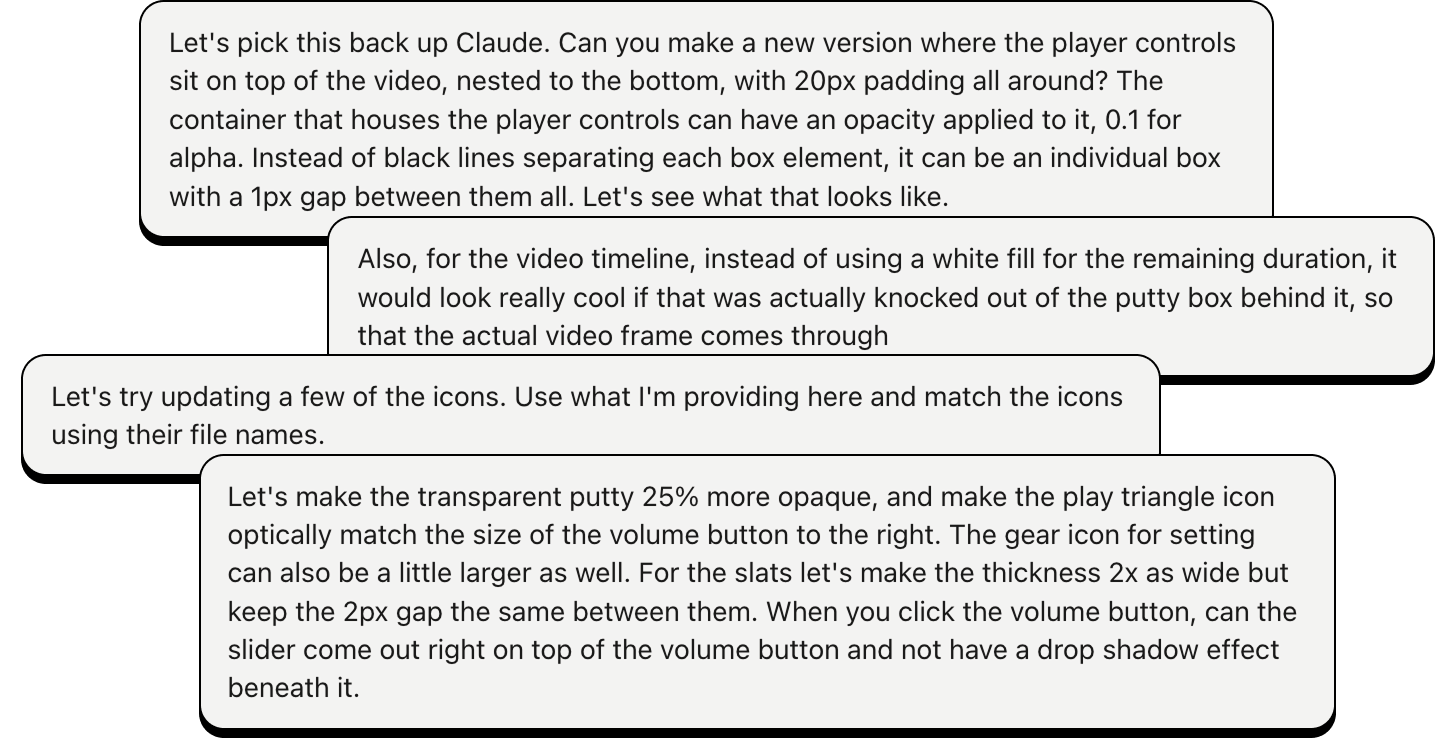
Iterative Refinement Loop: Following the initial deployment, a fluid triad of tools emerged: Figma for conceptual exploration, AI coding environments for translating visual adjustments into cascading style sheets and functional logic, and the web browser for objective validation. Adjustments—ranging from translucent container padding and pixel-accurate spacing to custom icon mapping and timeline transparency—were executed through iterative prompt engineering rather than manual code modification.
Industry Data and Technological Implications
The emergence of "design-engineers" empowered by artificial intelligence carries substantial implications for the broader technology and media sectors. According to industry analyses on productivity tools, the inclusion of natural-language coding assistants reduces prototyping cycles by upwards of 40% to 60% for non-traditional developers.
By eliminating the translation loss that frequently occurs when handing off static vector files to engineering teams, organizations can accelerate product timelines and reduce communication overhead. Data from platform deployments indicate an increasing volume of frontend components being initiated by UX and brand designers rather than backend or full-stack engineers.
Furthermore, this shift redefines the skill sets required in modern product development. Rather than replacing the foundational principles of color theory, typography, and human-computer interaction, AI elevates the importance of design judgment. Because generative models rely heavily on precise instructions and contextual constraints, the quality of the final output remains directly tethered to the aesthetic expertise and critical eye of the human creator.
Statements and Industry Reactions
While formal statements from software foundations emphasize the democratization of software development, industry observers note a broader cultural shift within creative agencies.
"The traditional boundary between ideation and implementation is disappearing," notes a digital media analyst tracking workflow evolution. "We are moving into an era where the fluency of an idea is measured not by how well it is documented on paper, but by how rapidly it can be summoned into a functional environment for users to experience."
Engineering counterparts have similarly reported positive shifts in resource allocation. By empowering designers to handle surface-level styling, custom component skins, and frontend layout tweaks autonomously, engineering teams are freed to focus on core system architecture, performance optimization, and complex backend logic.
Broader Impact on Creative Professions
The successful deployment of production-grade software by a practitioner whose career began in manual book layout signals a broader democratization of technical creation. As interfaces between human intent and machine execution become increasingly conversational, the traditional constraints of specialized syntax begin to dissolve.
For the design community, the implications are profound. Professionals who previously operated solely in the conceptual realm now possess the operational range to shepherd an idea from a blank digital canvas to a globally accessible URL without intermediary bottlenecks. As AI coding tools continue to integrate into creative suites, the defining competitive advantage for designers will not be technical proficiency in programming languages, but the clarity of their vision, the rigor of their craft, and the precision of their aesthetic judgment.