Spain Triumphs Over Argentina as 2026 World Cup Final Shatters US Viewership Records With Over 60 Million Viewers

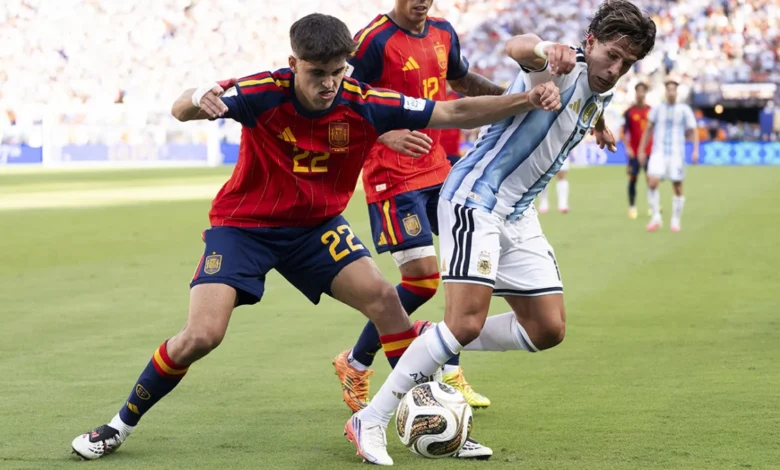
The 2026 FIFA World Cup reached its historic conclusion on Sunday at the New York New Jersey Stadium in East Rutherford, as Spain secured a 1-0 victory over Argentina in a match that not only defined a new era of global football but also shattered every existing television viewership record in the United States. The final, decided in the 106th minute of extra time by a strike from Ferran Torres, drew a staggering combined audience of more than 60 million viewers across Fox, Telemundo, and Peacock. This figure represents a watershed moment for the sport in North America, more than doubling the audience of the 2022 final and firmly establishing soccer as a top-tier media property in the American market.
The magnitude of the viewership reflects the success of the first-ever 48-team tournament, hosted jointly by the United States, Mexico, and Canada. Industry analysts had predicted a significant surge in interest due to favorable time zones and the "home-field advantage" of the host nation’s infrastructure, but the final numbers exceeded even the most optimistic projections from FIFA and its broadcasting partners. The 60 million viewer threshold cements the 2026 final as the most-watched soccer match in United States history, surpassing the previous record of 45.99 million set earlier in the tournament during the U.S. National Team’s round-of-16 departure against Belgium.
A Tactical Battle in East Rutherford
The match itself was a masterclass in tactical discipline and high-stakes tension. Played before a capacity crowd of over 82,500, the final pitted the defending champions, Argentina, against a rejuvenated Spanish side led by a new generation of talent. From the opening whistle, the contest was defined by a midfield stalemate. Argentina, looking to secure a second consecutive title and a fairy-tale ending for their aging core, relied on the creative spark of Giuliano Simeone and the veteran leadership of their defensive line.
Spain, however, showcased the depth of their developmental system. Young defender Pau Cubarsi, just 19 years old, delivered a standout performance, neutralizing several Argentinian counter-attacks and demonstrating a composure that belied his age. The two sides traded opportunities throughout the regulation 90 minutes, with Spain dominating possession while Argentina remained lethal on the break. Despite several near-misses, the match remained scoreless at the end of regulation, forcing 30 minutes of extra time.
The breakthrough finally arrived in the 106th minute. Following a rapid sequence of passes through the center of the pitch, Ferran Torres found space on the right flank, cutting inside to fire a low, driven shot past the Argentinian goalkeeper. The goal ignited celebrations across Spain and among the thousands of Spanish supporters in the stadium, while effectively silencing the vocal Argentinian contingent. Spain’s defense held firm for the remaining 14 minutes, securing their second World Cup trophy and their first since 2010.
Breaking Down the Record-Breaking Ratings
The broadcasting data released following the match highlights a massive shift in American sports consumption habits. Fox Sports, the English-language rights holder, reported an average of 38.9 million viewers for its broadcast. This figure includes pre-game programming; when isolating the match window itself, the audience climbed to 42.5 million. The broadcast reached a fever pitch between 5:45 p.m. and 6:00 p.m. ET, peaking at 51.7 million viewers as Spain closed in on the victory.
On the Spanish-language side, Telemundo and the streaming platform Peacock combined for a preliminary audience of 22.6 million viewers. While slightly shy of the all-time Spanish-language record of 23.2 million set during the Mexico-England round-of-16 clash, executives expect the final tally to rise once Out-of-Home (OOH) viewing and final digital metrics are fully integrated. The combined 60 million total is a 133% increase over the 25.78 million viewers who tuned in for the Argentina-France final in 2022, which was held in Qatar and aired during the early morning hours in the United States.
The success of the 2026 tournament was not limited to the final. The semifinal round also produced massive engagement. Argentina’s dramatic comeback victory over England drew 28.3 million combined viewers, while Spain’s clinical shutout of France attracted 22.91 million. These figures consistently outperformed traditional mid-summer sports staples, including the MLB All-Star Game and early-season regular-season matchups in other major leagues.
The Path to the Final: A Tournament of Upsets and Milestones
The road to the New York New Jersey Stadium was characterized by the expanded format, which saw 48 teams competing across 16 host cities. The tournament began on June 11, 2026, at the Estadio Azteca in Mexico City, and quickly delivered a series of high-profile narratives. For the United States, the tournament was a bittersweet journey. The "Yanks" topped their group and ignited a national frenzy, culminating in the record-breaking viewership for their round-of-16 match against Belgium. Although the U.S. fell 2-1 in that contest, the momentum they generated served as a catalyst for the high ratings seen in the later stages.
Argentina’s path to the final was fueled by emotion and a sense of destiny. After a shaky start in the group stages, the Albiceleste found their rhythm in the knockout rounds, defeating perennial powerhouses Brazil and England in back-to-back thrillers. Spain, conversely, was the most consistent team of the tournament. Under the guidance of their technical staff, they utilized a high-press system that exhausted opponents, conceding only three goals throughout the entire competition.
The tournament also marked a significant milestone for infrastructure and logistics. The 2026 World Cup was the first to feature 104 matches, up from the 64 matches in the previous 32-team format. This increase in inventory provided broadcasters with a wealth of content, allowing for a "round-the-clock" coverage model that kept the sport at the forefront of the cultural conversation for over 40 days.
Official Reactions and Industry Impact
Following the final whistle, FIFA President Gianni Infantino praised the host nations for delivering what he termed "the greatest show on earth." In a statement, Infantino noted, "The United States, Mexico, and Canada have not only hosted a tournament; they have transformed the global perception of football. To see 60 million people in one country tuning in for a final match is a testament to the passion and the potential of this region."
Executives at Fox Sports and NBCUniversal (Telemundo’s parent company) also expressed satisfaction with the results. "We knew the 2026 World Cup would be a massive event, but these numbers are transformative," said a spokesperson for Fox Sports. "The engagement levels we saw across all platforms—linear television, streaming, and social media—indicate that soccer has moved from a niche interest to a mainstream pillar of the American sports landscape."
The economic implications are equally significant. The record viewership is expected to drive a surge in advertising rates for future soccer properties, including Major League Soccer (MLS) and the 2027 FIFA Women’s World Cup. Brands that invested heavily in the 2026 tournament saw unprecedented reach, particularly among the coveted 18-34 demographic, where soccer continues to outpace traditional American sports in terms of growth.
Broader Implications for the Future of Soccer in the U.S.
The legacy of the 2026 World Cup will likely be measured by the long-term growth of the sport domestically. With the 2028 Summer Olympics in Los Angeles on the horizon, the United States is entering a decade of unprecedented sports visibility. The success of the final’s broadcast suggests that the infrastructure for a "soccer nation" is now firmly in place.
Furthermore, the integration of streaming services like Peacock into the primary viewing experience has set a new standard for how major sporting events are delivered. Digital viewership accounted for a significant portion of the Spanish-language audience, proving that younger, mobile-first audiences are willing to engage with full-length matches if the accessibility and production quality are high.
As Spain begins its four-year reign as world champions, the United States sports industry is left to process a tournament that changed the math of domestic broadcasting. The 60 million viewers who watched Ferran Torres lift the trophy in New Jersey did more than just watch a game; they signaled the arrival of soccer as a permanent, dominant force in the American cultural fabric. With the 2030 World Cup centennial on the horizon, the bar has been set at an all-time high, both on the pitch and on the screen.