Country Road Group Cuts Middleware Costs by 80 Percent Through Cloud-Native AWS Integration Overhaul

Enterprise integration architectures have long been tethered to legacy middleware suites that demand steep licensing fees, specialized infrastructure, and dwindling pools of administrative talent. For decades, platforms like Microsoft BizTalk Server, TIBCO, MuleSoft, and Boomi acted as the digital glue connecting disparate retail systems, point-of-sale terminals, and inventory databases. Yet, as organizations scale into the cloud era, this centralized dependency has increasingly translated into a source of architectural friction, operational drag, and mounting financial overhead.
Country Road Group (CRG), a premier Australian fashion retailer housing five distinct brands—Country Road, Mimco, Witchery, Politix, and Trenery—across a footprint exceeding 600 retail storefronts, confronted this exact dilemma. Operating 21 mission-critical integration interfaces through an aging Microsoft BizTalk Server deployment hosted on VMware, the enterprise faced an impending end-of-support deadline for BizTalk. Compounding the urgency, escalating VMware licensing costs following Broadcom’s acquisition and a severe market shortage of qualified BizTalk systems engineers threatened both operational stability and digital growth velocity.
Rather than upgrading to another costly commercial middleware platform, CRG engineered a fundamental architectural pivot. Collaborating with cloud architects, the retailer dismantled its legacy middleware dependencies and instituted a pattern-driven, cloud-native Strategic Integration Platform (SIP) on Amazon Web Services (AWS). The transformation not only decommissioned the legacy technical debt entirely but also slashed annual integration service expenditures from approximately $300,000 down to $60,000—delivering a staggering 80 percent cost reduction.
The Evolution of Enterprise Integration and the Cost of Tool Sprawl
To understand the magnitude of CRG’s operational transition, one must examine the historical evolution of enterprise application integration (EAI). When commercial middleware engines emerged in the late 1990s and 2000s, they solved acute interoperability problems by introducing proprietary adapters, orchestrations, and specialized message formats. However, this convenience introduced a severe trade-off: deep, rigid coupling between enterprise applications and the middleware runtime itself.
Over time, many organizations found themselves paying hundreds of thousands of dollars annually in software licenses, hosting fees, and maintenance overhead for middleware systems that delivered zero incremental business capabilities. Furthermore, the fundamental communication patterns required to move data between systems—such as publish-subscribe, content-based routing, request-reply, and scatter-gather—have remained constant. Modern cloud-native services are now natively equipped to implement these canonical patterns directly, rendering expensive, standalone middleware runtimes obsolete.
Prior to its modernization initiative, CRG’s technology ecosystem suffered from fragmented tool sprawl. The enterprise juggled multiple overlapping integration solutions, including BizTalk, Workato, Apollo, and Apache Kafka. This multiplicity fractured engineering skill sets, increased maintenance overhead, and introduced systemic production instabilities.
CRG established four primary value drivers to guide its transformation initiative:
- Legacy Debt Elimination: Completely decommission BizTalk 2013 and its expensive, unsupported VMware infrastructure.
- Tool Consolidation: Rationalize fragmented middleware tools into a unified, cohesive integration ecosystem supported by a single, standard engineering skill set.
- Velocity Acceleration: Embrace API-first design principles and modern continuous integration and continuous delivery (CI/CD) pipelines to accelerate the onboarding of new retail and B2B partners.
- Resiliency and Security Standardization: Enforce uniform authentication, authorization, and data encryption practices across all enterprise interfaces, treating dead-letter queues (DLQs) as secure data stores compliant with strict retail data privacy regulations.
Anatomy of the Strategic Integration Platform (SIP) Architecture
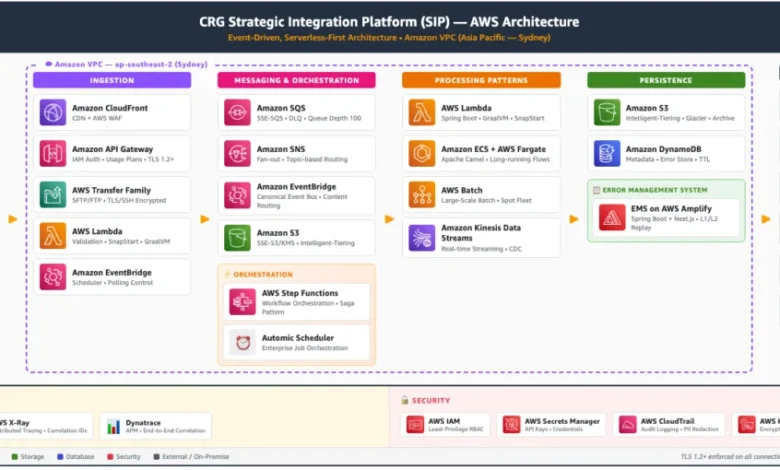
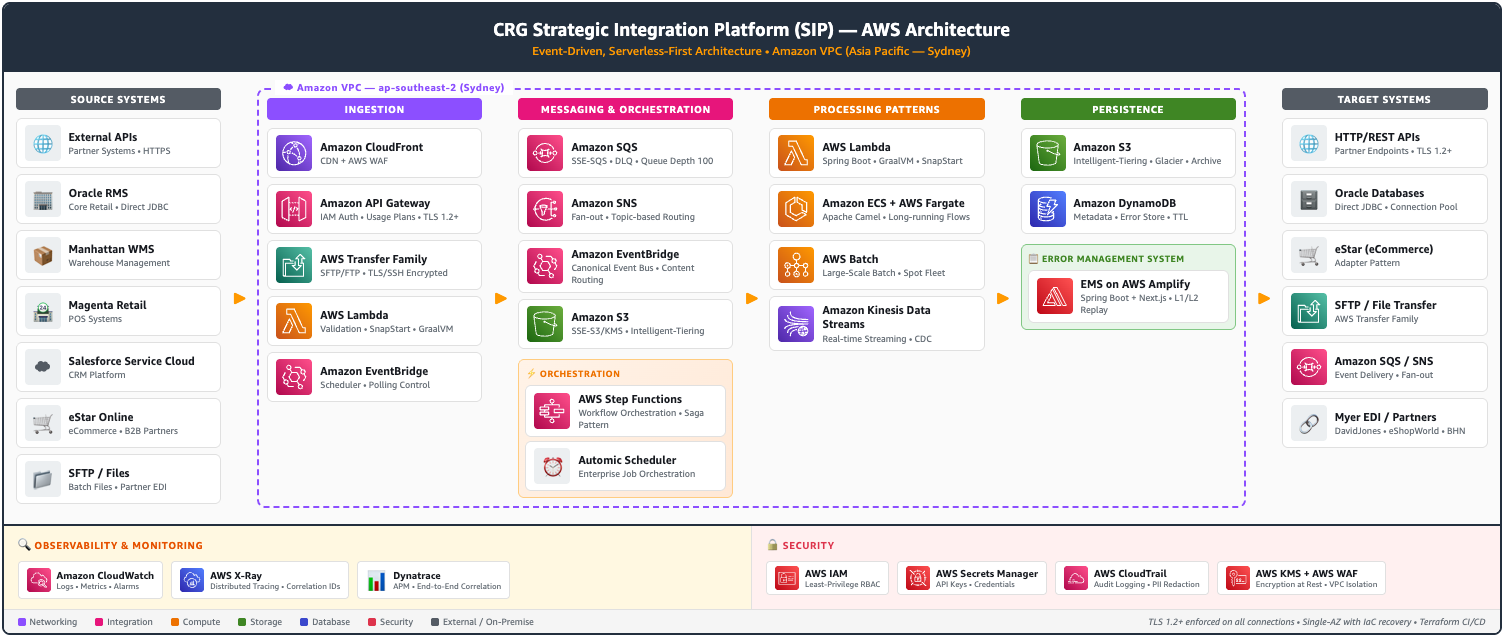
The core of CRG’s modernization strategy rests upon a "Compose on Cloud-Native" architectural paradigm. The resulting Strategic Integration Platform leverages a hybrid serverless and containerized approach. Short-duration event processing is managed via serverless components including Spring Boot running on AWS Lambda, AWS Step Functions, and Amazon EventBridge. Meanwhile, long-running, stateful, and heavy batch data flows are processed by Apache Camel instances hosted on Amazon Elastic Container Service (Amazon ECS) utilizing AWS Fargate.
The platform architecture is structured into three distinct layers:
- The Pattern Layer: Where individual integration interfaces are composed by declaring standardized design patterns rather than writing custom orchestration scripts from scratch.
- The AWS Service Layer: Where infrastructure-as-code (IaC) templates using Terraform automatically provision, govern, and scale the underlying cloud resources.
- The Source-and-Target Connectivity Layer: Which bridges traditional on-premises enterprise systems, modern cloud environments, and external B2B partner endpoints.
Crucially, the SIP architecture inverts traditional data ingestion mechanics. Rather than allowing disparate source systems to push unbounded volumes of data into the integration bus—which frequently causes downstream throttling and processing bottlenecks—SIP actively pulls data from source systems according to a controlled, predictable schedule. For immutable push-only endpoints, such as third-party Software-as-a-Service (SaaS) webhooks, SIP securely captures incoming payloads into a managed queue, buffering the data so that downstream processing occurs entirely at the platform’s controlled pace.
Multi-Lane Service Bus and Unified Error Management
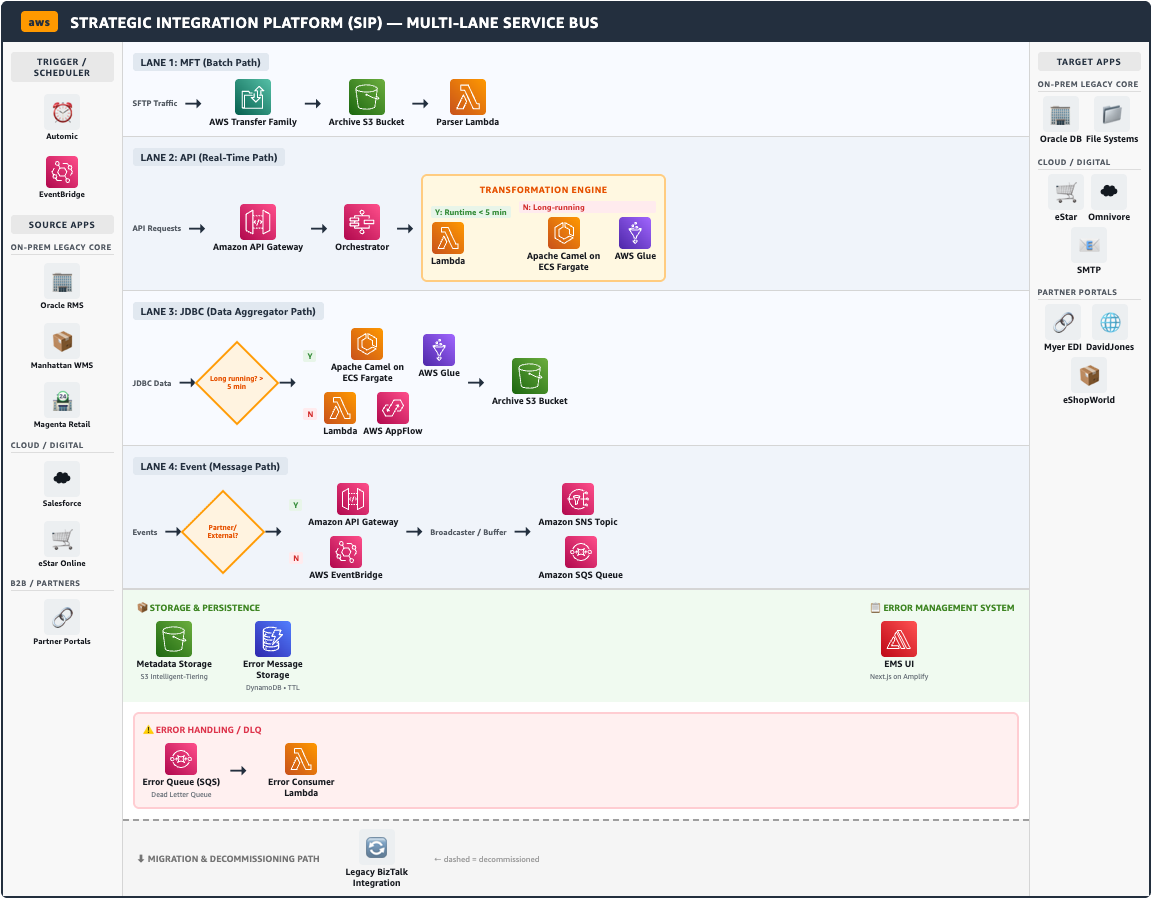
Traffic flowing through the Strategic Integration Platform is dynamically routed across a four-lane, pattern-led service bus. Each lane aligns compute runtimes with specific payload characteristics and duration profiles:
- Batch Lane: Handles large-scale, scheduled file movements and bulk database synchronizations.
- API Lane: Manages synchronous, high-frequency request-reply interactions.
- JDBC Lane: Orchestrates direct database queries and transactional data persistence.
- Event Lane: Processes asynchronous, event-driven publish-subscribe messages.
Across all four processing lanes, governance and reliability are enforced by a custom-built Error Management System (EMS). When transactional anomalies occur, failed messages are automatically diverted to a secure dead-letter queue hosted on Amazon Simple Queue Service (SQS). The EMS captures granular error metadata within Amazon DynamoDB while securely persisting the raw payload within Amazon S3. Every failure is assigned a unique correlation ID and evaluated against a standardized JSON error contract.
Built using Spring Boot on AWS Lambda with a responsive Next.js front-end hosted on AWS Amplify, the EMS dashboard transformed CRG’s operational support model. Previously, error resolution required direct engineering intervention (Tier 4 support). Under the new platform, Tier 1 and Tier 2 operations teams utilize the EMS interface to inspect, modify, and idempotently resubmit failed transactions without developer involvement. New system interfaces automatically inherit EMS integration upon assignment of a unique interface ID.
Rigorous Security and Infrastructure Reproducibility
Enterprise security formed a non-negotiable pillar of the migration strategy. CRG instituted a five-layer security model encompassing:
- Least-privilege role-based access control (RBAC) enforced via AWS Identity and Access Management (IAM).
- Network perimeter defense through AWS WAF and strict Virtual Private Cloud (VPC) isolation.
- Granular data classification protocols ranging from public data to restricted customer information.
- End-to-end encryption in transit utilizing TLS 1.2 or higher, paired with encryption at rest managed through AWS Key Management Service (AWS KMS).
- Comprehensive, structured audit logging equipped with automated personally identifiable information (PII) redaction routines.
Furthermore, the platform’s infrastructure is fully reproducible. Every AWS resource is codified using Terraform, ensuring that environments can be recreated reliably from scratch. This eliminates configuration drift, mitigates human error, and provides rapid disaster recovery capabilities. State files are securely managed within versioned, access-controlled S3 buckets, while data persistence layers utilize point-in-time recovery and automated object versioning. Because underlying services like Lambda, SQS, DynamoDB, and Step Functions are inherently multi-region and multi-Availability Zone native, localized infrastructure disruptions require zero manual redeployment.
Democratizing Integration Patterns via Open-Source Tooling
To assist the broader engineering community in adopting similar cloud-native architectural patterns, AWS and collaborating technologists released the open-source Enterprise Integration Patterns AWS Cloud Development Kit (AWS CDK) Library. This publicly available repository codifies 29 canonical integration patterns into reusable, high-level infrastructure constructs.
A single declaration within the CDK framework automatically provisions the necessary messaging infrastructure, IAM security policies, dead-letter queues, and error-handling logic. To maximize flexibility, specific operational thresholds and notification targets—such as Amazon CloudWatch alarms—are intentionally left open for engineering teams to tailor to their specific environmental requirements.
The release also introduces advanced agentic capabilities tailored for modern AI-assisted development environments like Kiro and Claude Code. Utilizing specialized agent skills, developers can articulate integration requirements in natural language. The integrated AI agents automatically select the appropriate pattern construct from the library, configure the required properties, validate the syntax through automated testing suites, and synthesize the infrastructure code. Final deployment authorization remains strictly under human control, ensuring that automated tooling cannot push changes directly to production accounts without explicit engineering approval.
Phased Migration Chronology and Measurable Business Results
The transition from legacy middleware to the Strategic Integration Platform was executed in methodical waves grouped by core business functions. This phased rollout ensured minimal disruption to retail operations across Country Road Group’s physical store network and digital properties. Crucially, the architecture supported service-group rollbacks, allowing any migration wave experiencing anomalies to revert independently while maintaining overall system integrity.
The operational and financial dividends achieved by CRG underscore the viability of pattern-driven cloud migrations:
- Financial Savings: Annual integration licensing and operational service costs plummeted from approximately $300,000 to $60,000, achieving an immediate 80 percent reduction.
- Tool Consolidation: Four disparate legacy tools (Microsoft BizTalk, Workato, Apollo, and Apache Kafka) were successfully rationalized into a single, standardized architecture.
- Delivery Velocity: Onboarding new business partners and deploying new retail interfaces transformed from a multi-week engineering ordeal into a matter of hours, accelerated by automated Terraform modules and CI/CD pipelines.
- Operational Efficiency: Shifting error resolution mechanics from high-tier software engineers to front-line operations personnel dramatically lowered ongoing support costs and shortened incident resolution times.
- Observability: Distributed tracing powered by Amazon CloudWatch, AWS X-Ray, and Dynatrace provides end-to-end transaction visibility with persistent correlation IDs across every integration hop.
Industry Implications and Future Outlook
CRG’s successful modernization blueprint offers a compelling, replicable playbook for enterprises currently grappling with legacy technical debt, escalating middleware licensing costs, and retiring technical skill sets. Whether an organization relies on BizTalk, TIBCO, MuleSoft, or Boomi, the underlying data integration patterns remain fundamentally identical; only the execution runtime requires modernization.
By decoupling the pattern layer from the underlying cloud infrastructure, CRG has future-proofed its retail technology stack. As new cloud services emerge, they can be seamlessly incorporated as discrete processing steps within existing pattern compositions without necessitating a wholesale platform re-architecture. For enterprise architects and platform leads evaluating their own infrastructure lifecycles, the retail sector’s latest migration proves that escaping legacy middleware captivity is not only achievable, but economically transformative.