AWS Unveils Enhanced Custom Event Bus for Amazon EventBridge to Revolutionize Enterprise Serverless Architectures

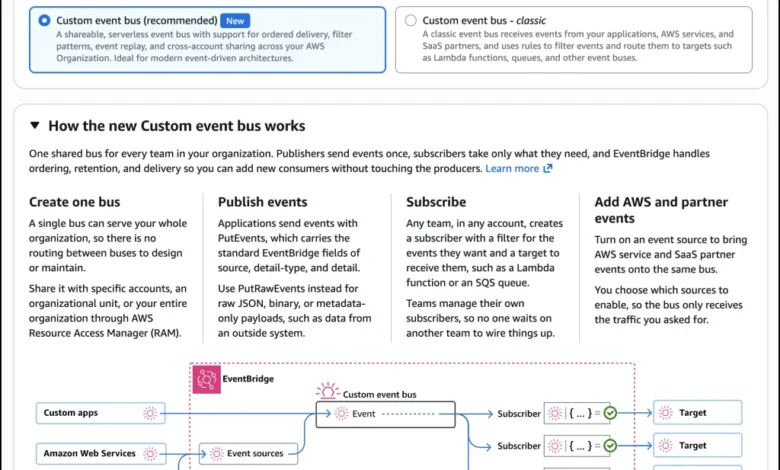
The landscape of cloud-native development is undergoing a significant transformation as Amazon Web Services (AWS) officially introduces the enhanced custom event bus for Amazon EventBridge. Designed to address the mounting operational friction associated with scaling event-driven architectures across complex, multi-account enterprise environments, this new offering promises to centralize event management while simultaneously introducing sophisticated features like ordered event delivery and streamlined subscription modeling. By shifting from a decentralized web of cross-account rules to a unified, scalable backbone, AWS is aiming to reduce the administrative overhead that has historically burdened platform engineering teams managing large-scale serverless deployments.
The Evolution of Event-Driven Complexity
In the early stages of cloud adoption, organizations typically utilize a single, custom event bus within a solitary AWS account. This model provides simplicity and ease of observability. However, as organizational adoption matures, the industry-standard "best practice" of isolating workloads into multiple AWS accounts—for security, compliance, and billing purposes—creates a paradoxical problem. Traditionally, to facilitate communication between these isolated accounts, developers have been forced to implement intricate "bus-to-bus" routing configurations or complex cross-account rule sets.
This legacy approach has consistently introduced three primary pain points: operational overhead, obscured visibility, and ballooning costs. When event routing relies on a mesh of individual rules, platform teams lose the ability to easily audit who is consuming specific data streams. Furthermore, the compounding charges associated with multiple hops between buses have often resulted in unpredictable monthly expenditures. Until now, teams requiring strict event ordering—essential for industries like logistics, fintech, and supply chain management—were often compelled to integrate third-party technologies or build custom, fragile workarounds that negate the primary benefits of a serverless paradigm.
Chronology and Development
The introduction of the enhanced custom event bus represents the culmination of feedback gathered from enterprise customers over the last several years. Following the initial launch of EventBridge, which revolutionized how services communicate via the EventBridge bus, AWS observed a clear pattern: customers were hitting the architectural limits of the "classic" bus model as they transitioned from experimental projects to enterprise-wide infrastructure backbones.

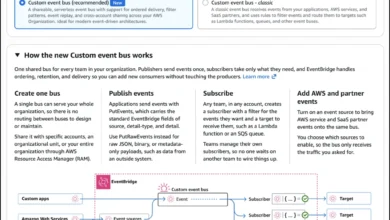
The internal development of this enhanced bus focused on three pillars: scalability, ordering, and simplified consumption. By integrating AWS Resource Access Manager (AWS RAM) directly into the creation flow, AWS has effectively bypassed the need for manual IAM permission management, a process that previously accounted for significant developer time. With this launch, the "classic" bus remains a supported resource for legacy applications, while the enhanced bus becomes the new recommended standard for organizations looking to future-proof their event-driven architectures.
Architectural Breakthroughs: Ordering and Subscriptions
One of the most consequential features of the enhanced custom event bus is the introduction of native event ordering. By utilizing an EventGroupId attribute, publishers can now ensure that related events are processed in strict sequence. This is a critical development for high-stakes applications where the arrival of stale data could trigger incorrect automated responses.
Alongside ordering, the "Subscriber" resource model fundamentally changes how consumers interact with the bus. Previously, developers had to manage a disparate collection of rules, targets, and retry policies. The new Subscriber resource aggregates these into a single, cohesive unit. This unified resource simplifies the developer experience by providing:
- Integrated Filtering: Sophisticated event routing logic defined within the subscriber scope.
- Dead-Letter Destinations: Centralized error handling that allows for rapid debugging.
- Retry Policy Management: Configurable back-off and retry strategies that are no longer dispersed across multiple configuration files.
Furthermore, the introduction of JSONata expressions for event transformation provides developers with a powerful tool to reshape data payloads at the bus level. This capability effectively removes the requirement for intermediary "transformation" functions, which previously added latency and complexity to the data path.
Economic Implications and Cost Structure
The transition to a new pricing model is perhaps the most direct indicator of AWS’s commitment to making large-scale event-driven architectures more economically viable. The legacy per-event cost structure, while straightforward for small deployments, became inefficient in a multi-bus architecture due to the compounding nature of cross-account routing fees.

The new ingress and egress throughput model is designed to provide clarity for both publishers and subscribers. Publishers are charged for the volume of data ingested into the bus, while subscribers incur costs based on the volume of data delivered to their specific endpoints. This granular approach allows organizations to perform precise cost allocation, enabling financial operations (FinOps) teams to map event traffic directly to the business units or teams responsible for the consumption of those events. Industry analysts suggest that this shift will likely lower the "barrier to entry" for organizations attempting to move away from legacy message queues toward more flexible, serverless event buses.
Addressing Data Integrity and Idempotency
To mitigate the risks inherent in distributed systems, such as network timeouts or partial failures, the enhanced bus introduces content-based deduplication. By hashing the payload of incoming events, the bus can automatically detect and discard duplicate transmissions that arrive within a five-minute window. This provides "exactly-once" delivery semantics for the most critical data points, a feature that significantly reduces the burden on application developers who previously had to implement their own deduplication logic at the code level.
Moreover, the support for native deserialization of Apache Avro and Protocol Buffers (Protobuf) signals a shift toward better support for structured data schemas within the event bus. This capability allows the EventBridge bus to act as a more intelligent broker, capable of performing deep inspection and filtering on binary payloads without requiring the consumer to first perform complex deserialization tasks.
Broader Impact on Enterprise Architecture
The impact of this update on the broader AWS ecosystem cannot be understated. By providing a centralized event backbone that scales to 10,000 subscribers per bus, AWS is effectively enabling the "Event-Driven Enterprise." Organizations can now establish a single source of truth for organizational events, breaking down the silos created by multi-account structures.
For platform engineers, the implications are profound. The ability to maintain visibility across the entire organizational event flow from a single console interface allows for improved security postures and easier compliance auditing. For developers, the reduced reliance on complex infrastructure "glue" means that they can spend more time focusing on business logic and less time troubleshooting the underlying transport layer.
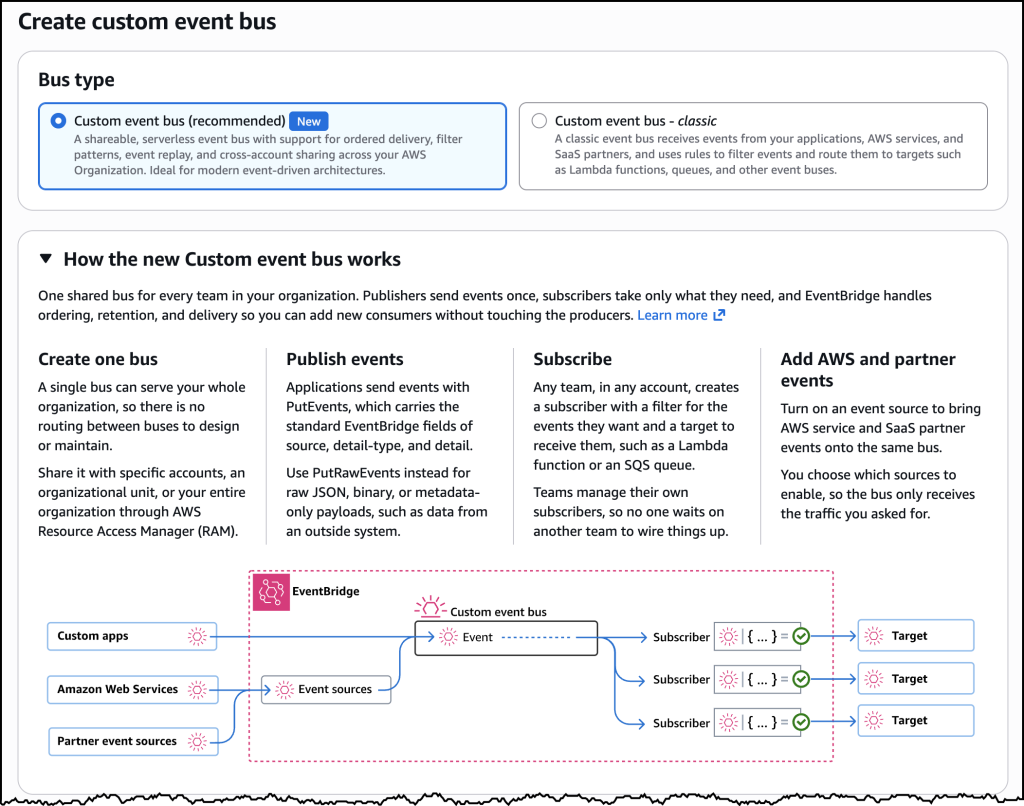
While the enhanced custom event bus is currently rolling out in key global regions—including US East (N. Virginia, Ohio), US West (Oregon), and major hubs across Europe and Asia Pacific—it is expected that the rapid adoption of this technology will force a shift in industry standards for serverless integration. As organizations move away from the "one bus per team" model toward a "shared backbone" architecture, the overall maturity of event-driven systems is poised for a significant increase in both reliability and performance.
Conclusion and Future Outlook
The launch of the enhanced custom event bus marks a turning point for Amazon EventBridge. By addressing the technical debt that has historically plagued multi-account AWS environments, the company has provided a clear path for organizations to scale their serverless infrastructure without sacrificing order, reliability, or cost-efficiency. As cloud architects begin to migrate their workloads to this new model, the industry will likely see a reduction in the complexity of microservices communication, signaling a more robust and efficient future for event-driven computing. Interested users are encouraged to review the updated AWS documentation and explore the new configuration options within the AWS Management Console to assess how these features can be integrated into their existing serverless pipelines.
Related posts: