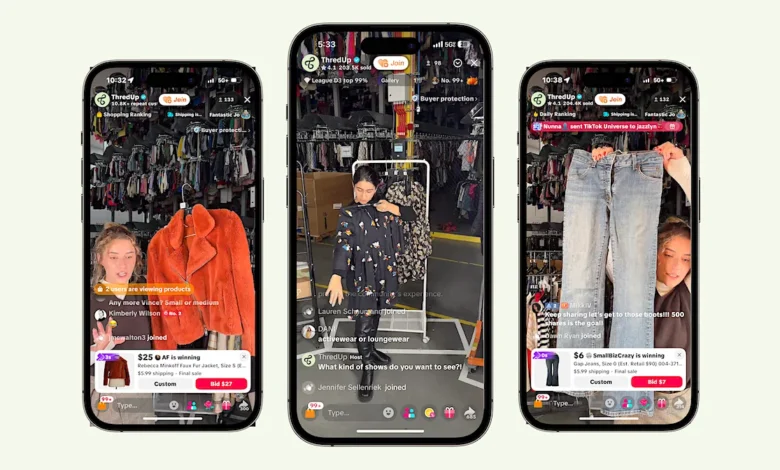
The landscape of online thrift retail is undergoing a profound structural transformation as leading platforms integrate interactive, real-time video shopping into traditional inventory models. ThredUp, one of the world’s largest online resale platforms for apparel, shoes, and accessories, has officially committed to scaling its live-selling operations following a successful initial trial phase. The company is aggressively expanding its footprint on TikTok Shop, ramping up its broadcast schedule from an initial series of trial events to 10 livestreams per week, with concrete plans to double output to 20 weekly broadcasts in the immediate future.
This strategic maneuver represents a departure from traditional, passive e-commerce shopping habits. Rather than forcing consumers to independently navigate search bars, category filters, and digital catalog pages, ThredUp is bringing the thrift store experience directly to consumer screens. By broadcasting live from its sprawling distribution centers in Atlanta and Dallas, the company is bridging the gap between massive warehouse inventory logistics and the personalized, high-energy engagement characteristic of modern social commerce.
A Chronological Timeline of ThredUp’s Live Commerce Evolution
ThredUp’s foray into live-stream shopping is the result of a deliberate, phased strategy designed to capture evolving consumer habits and test alternative digital sales channels. The timeline of this expansion highlights the rapid acceleration of the platform’s social commerce initiatives:
Late September: ThredUp officially enters the live commerce arena by launching operations on the Whatnot platform. Initial data reveals that three out of every four buyers participating in these inaugural shows are completely new to the ThredUp ecosystem. Furthermore, items sold via live channels command a median selling price 52 percent higher than comparable goods listed on the core marketplace.
November 11: ThredUp executes its first-ever TikTok Shop livestream. The broadcast, filmed directly inside an operational distribution center, spans an intensive four hours and sets the foundation for subsequent scheduling commitments.
Mid-November: Data aggregation from the first six TikTok broadcasts indicates that top-performing brands by units sold include Madewell, Frame, Free People, and Good American. Significantly, 75 percent of participating shoppers during this phase represent new customer acquisitions for the platform.
November 17: During a four-hour broadcast, a single designated host successfully showcases and sells 250 individual SKUs, demonstrating the high-velocity potential of warehouse-based live selling.
Upcoming Holiday Season: ThredUp prepares to launch a series of themed broadcasts timed precisely to coincide with TikTok Shop’s prominent Black Friday and Cyber Monday promotional events, aiming to capture peak seasonal demand for sustainable and affordable gifts.
Operational Mechanics: From Warehouse Shelves to Live Feeds
Executing high-frequency livestreams from active distribution centers requires complex logistical orchestration. ThredUp maintains a massive digital inventory comprising approximately 5 million active items at any given time. To support its live-selling operations, logistics teams curate specific selections of stock—ranging from category-specific lots like sweaters and denim to branded collections featuring labels such as Anthropologie—and physically isolate these items within the warehouse. This merchandise is temporarily removed from the standard ThredUp e-commerce marketplace to prevent inventory overlap, double-selling, or logistical bottlenecks.
The broadcasts themselves are driven by a roster of more than 20 professional hosts spanning various platforms. This talent pool is a hybrid model consisting of internal ThredUp employees alongside external content creators and professional live-streaming salespeople. During a broadcast, hosts present items dynamically, field real-time questions from viewers regarding sizing, condition, and fit, and guide prospective buyers through the transactional mechanics embedded directly within the TikTok application.
Pricing structures are intentionally experimental. Shows frequently feature starting bids or fixed price points as low as $1 or $5, spanning a wide array of accessible price points where many items remain under $20. Once a viewer makes a purchase within the app, fulfillment is executed seamlessly, with merchandise shipping directly from the Atlanta or Dallas distribution facilities. Executive teams closely monitor audience engagement metrics, noting specific consumer demands—such as repeat requests for brands like Paige or categories like outerwear—to refine future inventory curation.
Data-Driven Insights and Shifting Consumer Demographics
The financial and operational rationale behind ThredUp’s pivot to live video is grounded in measurable performance metrics and shifting macroeconomic trends. Financially, the company reported a third-quarter revenue of $88.2 million, representing a 7-year-over-year increase of 7 percent. This steady baseline growth is now being supercharged by social commerce acquisition channels.
User acquisition data from both Whatnot and TikTok Shop consistently indicates that live streaming functions as a powerful top-of-funnel customer acquisition tool. With 75 percent of participants on TikTok Shop representing first-time ThredUp users, live commerce is successfully reaching demographics that may not have engaged with traditional web-based or app-based secondhand shopping.
This shift aligns with broader generational trends identified in the ThredUp 2026 Holiday Resale Report. The study reveals that 62 percent of American consumers intend to purchase at least one secondhand item during the holiday season. The enthusiasm is particularly pronounced among younger demographics, with 70 percent of Gen Z and 78 percent of millennials planning to buy pre-owned gifts. Furthermore, consumers participating in holiday resale expect to allocate roughly 37 percent of their total holiday gift budgets toward secondhand merchandise.
Industry-Wide Momentum and the Social Commerce Boom
ThredUp is not operating in a vacuum; its expansion mirrors a broader retail migration toward live-stream shopping, particularly within the resale and luxury sectors. Platforms such as MyGemma and Fashionphile have established consistent live-streaming schedules on TikTok Shop, capitalizing on high consumer demand for verified pre-owned goods. Market data underscores the efficacy of this format, showing that nearly all luxury resale transactions executed on TikTok Shop U.S. now originate directly from live broadcasts.
For general apparel resale, however, the challenge lies in scaling lower-priced inventory efficiently. While luxury items command high margins per unit, platforms like ThredUp must process high volumes of lower-priced garments rapidly. The success of warehouse-filmed livestreams suggests that the visual, conversational nature of live video successfully overcomes the traditional friction associated with browsing thousands of individual, unique secondhand listings.
Corporate Perspectives and Strategic Implications
Danielle Vermeer, ThredUp’s head of product and the founder of the social-commerce thrifting app Teleport who joined ThredUp in 2024, acknowledges that her initial perspective on live selling was characterized by skepticism. As an experienced online thrifter accustomed to utilizing specific search parameters and digital curation techniques, she initially questioned whether the rapid, unstructured format of live video would resonate with seasoned thrifters.
However, empirical performance data quickly dispelled these reservations. Vermeer notes that the format has exceeded internal expectations, transforming the user experience from an isolated, solitary search-and-filter exercise into an interactive, community-driven dialogue.
“We wanted to test out live, because we’re really seeing that this is where customers are spending more and more of their time,” Vermeer explained. “I’m always thinking about where shoppers are going next, particularly for secondhand. What’s interesting to them? What’s engaging? What are new ways they are thinking about thrifting online or in person? Live was something that kept coming up as we were exploring other innovations and investments.”
Describing the long-term vision for the initiative, Vermeer characterizes the strategy as the establishment of a dedicated media network for pre-owned fashion. “We really think of it like ThredUp TV, where you hop on, and at any given time, we will probably have a show that you can tune into,” she stated. “Given that we have 5 million items, it’s a lot of fun mixing and matching that merchandise.”
The broader implications of ThredUp’s expansion point toward a permanent integration of social commerce into the circular fashion economy. By converting distribution centers into broadcast studios, resale platforms are blurring the lines between fulfillment logistics and entertainment media. As consumer demand for sustainable shopping intersects with the ubiquity of short-form video platforms, ThredUp’s scaling of TikTok Shop livestreams serves as a bellwether for the future of digital retail—proving that the mechanics of secondhand shopping can be successfully reimagined for the real-time, interactive digital age.