University of Technology Sydney Transforms Institutional Data Architecture with AWS to Streamline Student and Staff Digital Experiences

For students and staff navigating the modern higher education landscape, the University of Technology Sydney (UTS) functions as a singular, cohesive institution rather than a fragmented collection of separate administrative applications, curriculum platforms, and student management portals. Users naturally expect that the information underpinning teaching, learning, course design, and institutional decision-making will remain accurate, timely, and coherent, regardless of its underlying data source. However, maintaining this seamless outward-facing experience requires complex technological choreography behind the scenes. In recent years, UTS reached a critical inflection point in its enterprise integration landscape, prompting a comprehensive modernization of its digital infrastructure.
Background Context and Enterprise Evolution
Historically, critical teaching and learning capabilities across the university relied heavily on established commercial vendor platforms. While these systems performed essential operational functions—such as tracking student admissions, managing course catalogs, and recording grades—they frequently operated on disparate data models, rigid interfaces, varying stability profiles, and mismatched scaling characteristics. Over time, integrating and operating this sprawling legacy estate had become progressively more intricate and costly for the university’s internal technology groups.
The core mission of UTS has remained constant throughout its history: pursuing excellence in teaching, learning, and the overall student experience. University leadership firmly believes that technology exists to advance that foundational purpose rather than to supplant it. Consequently, the UTS Information Technology Unit (ITU) sought to systematically remove technological impediments standing between authoritative institutional data and the people, processes, and digital services that depend upon it every day. To achieve this transformation, UTS partnered with Amazon Web Services (AWS) to implement a managed, elastic, and serverless architecture. This strategic shift drastically reduced undifferentiated operational effort, improved fault tolerance, and established a sustainable, governed model for enterprise data services, beginning with the university’s curriculum domain.
The Architecture Challenge and Domain-Driven Design
Before the modernization initiative, the university faced distinct architectural hurdles. The primary challenge involved designing a scalable framework that could ingest high-volume curriculum updates from Software-as-a-Service (SaaS) platforms without violating strict domain boundaries. In enterprise architecture, domain boundaries are non-negotiable. At UTS, curriculum data explicitly describes what the institution teaches, remaining under the strict governance of the centralized Curriculum Management System. Preserving this bounded context prevents data ownership, validation logic, and governance from migrating into non-authoritative downstream services.
To address these challenges, the UTS ITU organized its new capabilities according to domain-driven design principles. Rather than aligning data services rigidly with the applications that produce or consume data, engineers aligned them directly with core business concepts. Under this model, every enterprise data product possesses explicit ownership, clearly defined consumers, stringent quality expectations, explicit interface contracts, and comprehensive lifecycle management. Institutional information is no longer treated as an incidental application byproduct; instead, it functions as a governed, strategic asset designed for widespread reuse across the campus ecosystem.
Furthermore, the implementation leveraged a declarative architecture-as-code methodology, establishing a reproducible source of truth where configuration is cleanly separated from implementation logic. By prioritizing managed AWS services over bespoke infrastructure software, engineering efforts focused entirely on building differentiated domain logic—the unique business rules essential to higher education—rather than managing undifferentiated servers. Stateless execution, asynchronous communication, purpose-built persistence models, and independently recoverable components successfully eliminated tightly coupled failure domains, aligning ongoing infrastructure expenditures directly with actual workload demand.
A Five-Layered Technical Solution
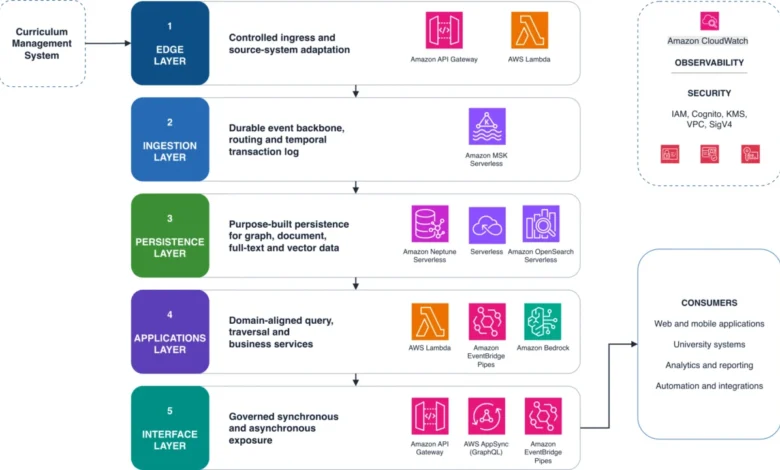
The realized UTS curriculum architecture is structured across five distinct operational layers: edge, ingestion, persistence, application and business logic, and interface. Enterprise-wide standards for identity management, data encryption, network security, observability, and operational governance span seamlessly across the entire stack.
The edge layer serves as the controlled ingress boundary between the external SaaS Curriculum Management System and the internal curriculum domain. Operating with a deliberately narrow remit, this layer receives complete curriculum modifications, establishes internal event contracts, and submits data to the ingestion tier with minimal initial processing. Because no standard commercial connector could natively satisfy the proprietary API contracts and payload formats of the vendor system, engineers deployed an Amazon API Gateway HTTP API coupled with an AWS Lambda function acting as a specialized technical adapter. This adapter encapsulates vendor payloads within a standardized CloudEvent envelope, appends operational metadata, and publishes the payload directly to Amazon Managed Streaming for Apache Kafka (Amazon MSK) Serverless topics.
At the ingestion layer, Amazon MSK Serverless forms a durable, append-only event backbone. Curriculum changes are segregated into domain-aligned topics grouped by academic item type. This structure retains complete source event histories while enabling independent downstream consumers to process data, execute retries, and recover from failures without obstructing other university systems. The serverless nature of MSK allows the infrastructure to scale seamlessly on demand, expanding effortlessly during massive domain reloads and contracting efficiently afterward.
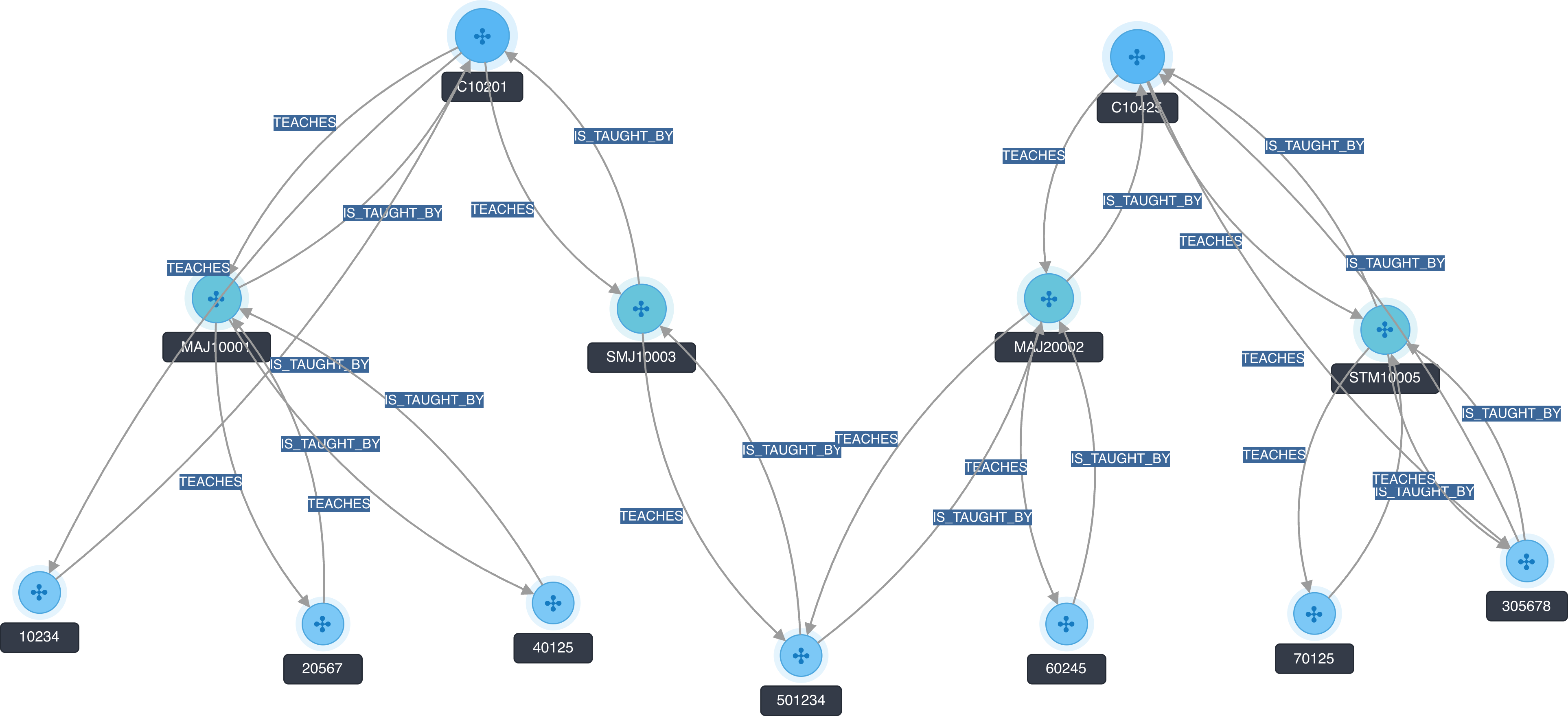
For persistence, UTS rejected monolithic databases in favor of purpose-built data services tailored specifically to distinct access patterns. Amazon Neptune Serverless was deployed to store complex curriculum structures and inverse relationships as a property graph, allowing consumers to seamlessly traverse academic hierarchies. Concurrently, Amazon OpenSearch Service manages exact-match lookups, full-text document searches, and advanced vector retrieval. Selected data processors implemented via AWS Lambda invoke embedding models through Amazon Bedrock, appending vector representations of curriculum text prior to persistence. This enables semantic discovery, allowing staff and students to search course offerings by conceptual proximity rather than exact keyword matches. Both data stores function as disposable projections rather than competing systems of record, meaning they can be entirely reconstructed from the primary Curriculum Management System at any time.
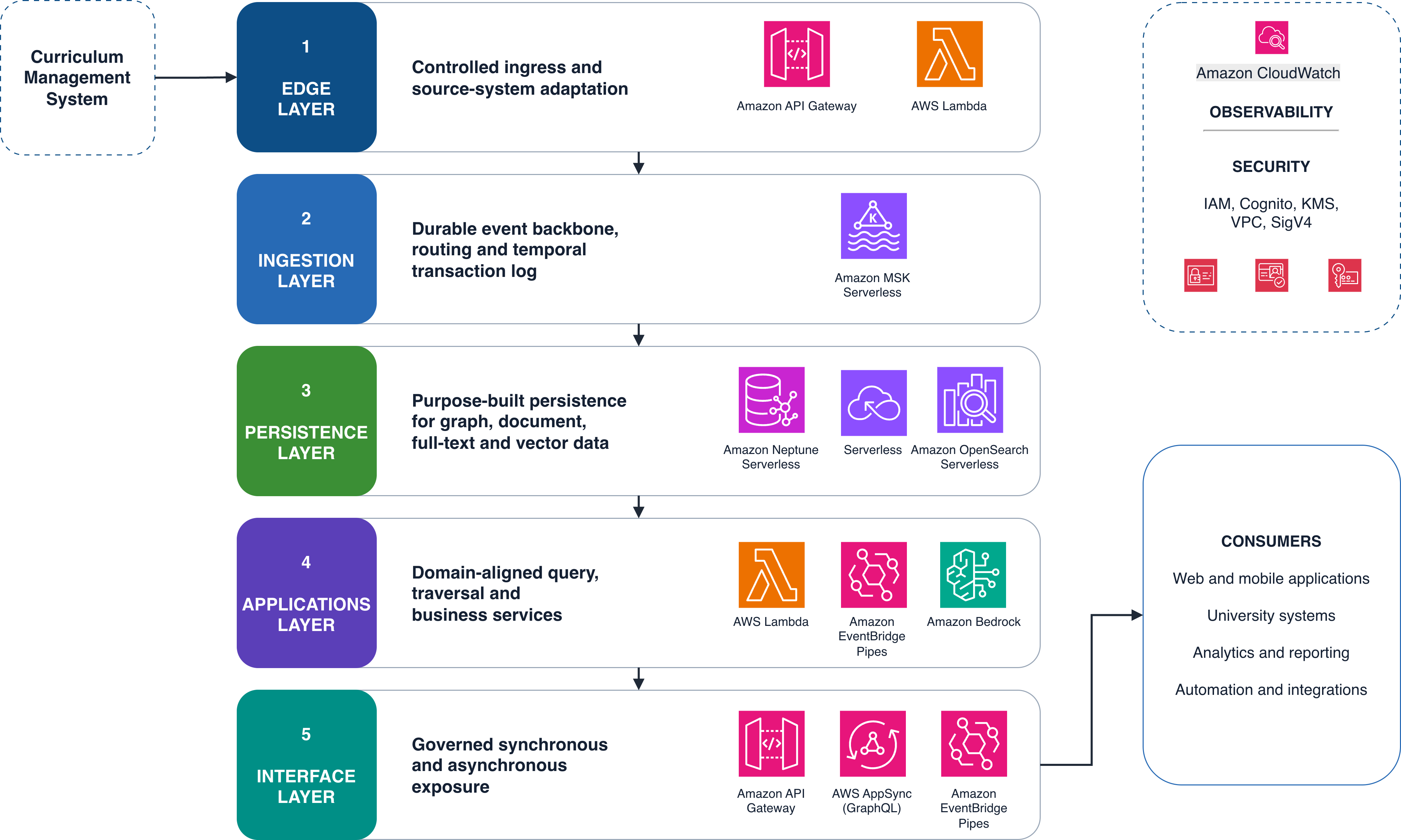
The application layer converts these materializations into reusable domain capabilities, utilizing dozens of narrowly scoped Lambda-backed services that query Neptune or OpenSearch behind secure, private boundaries. Amazon EventBridge Pipes acts as a streamlined transport adapter between MSK Serverless and the processing functions, ensuring that routing occurs without forcing validation logic into the transport layer. Finally, the interface layer provides flexible consumption options, offering RESTful APIs via Amazon API Gateway and GraphQL endpoints via AWS AppSync equipped with attribute-based access control. External consumers authenticate securely via Amazon Cognito using OAuth 2.0 and OpenID Connect, while internal workloads leverage AWS Identity and Access Management (IAM) roles.
Timeline and Chronology of Implementation
The modernization journey began as university leadership evaluated the accumulating complexity of legacy administrative systems. Following extensive architectural planning and collaborative design workshops with cloud engineering specialists, the UTS ITU established the foundational AWS-based data framework throughout 2023 and early 2024.
The milestone deployment occurred in November 2024, when the curriculum data services domain officially launched into production. The smooth rollout proved the viability of the serverless, event-driven architecture under real-world operational loads. Building upon this foundational success, UTS immediately initiated subsequent phases of its enterprise roadmap. The student data domain followed shortly thereafter, establishing a single governed point of access for comprehensive student profiles, admissions records, enrollment statuses, and academic offers. As of mid-2026, the university is actively preparing the deployment of its next major capability: the learning activities domain. This expansive tier is built around a sophisticated lifelong learner graph utilizing Amazon Neptune and Amazon Neptune Analytics, extending the established domain-driven pattern across the broader teaching and learning landscape.
Measurable Outcomes and Operational Impact
Since the initial production launch in November 2024, the curriculum data domain has recorded a flawless operational record with zero production incidents. By shifting from a brittle, tightly coupled integration model to a modern, event-driven data foundation, UTS has achieved remarkable efficiency gains.
Institutional analysts note that the new architecture has dramatically accelerated the delivery of new digital services to students and faculty. Engineering teams are no longer bogged down by routine infrastructure maintenance, database provisioning, or emergency patching. Instead, development efforts remain strictly focused on delivering high-value academic capabilities. Furthermore, consumption-based pricing models have successfully aligned cloud expenditures with actual institutional demand, avoiding the perpetual waste associated with maintaining over-provisioned legacy hardware estates during academic holiday periods.
Industry Implications and Future Outlook
The transformation executed at UTS offers a compelling case study for higher education institutions globally grappling with similar digital debt. Many universities worldwide face the dilemma of balancing legacy enterprise resource planning (ERP) platforms with the modern, agile digital experiences demanded by contemporary students. By demonstrating that an institution can successfully wrap legacy systems of record in governed, domain-driven data fabrics without undertaking catastrophic and risky core ERP replacements, UTS has charted a viable blueprint for the tertiary education sector.
Commenting on the broader implications of enterprise data modernization, academic technology observers emphasize that treating institutional data as a strategic, reusable asset rather than an application byproduct is critical for long-term institutional agility. As universities increasingly adopt artificial intelligence, personalized learning pathways, and data-driven administrative decision-making, robust underlying architectures like the one deployed at UTS will become a mandatory baseline rather than a competitive advantage.
Conclusion
The technological evolution undertaken by the University of Technology Sydney demonstrates a profound commitment to educational excellence through strategic innovation. By leveraging modern cloud capabilities to dismantle traditional silos, UTS has successfully removed the barriers separating authoritative institutional data from the students and staff who rely upon it. Through the implementation of domain-driven design principles, serverless event streaming, purpose-built persistence layers, and robust security frameworks, the university has created a resilient, scalable, and operationally sustainable digital foundation. As UTS continues to expand this architectural pattern into student profiles and lifelong learning activities, the institution ensures that its technological footprint remains invisible to its users, allowing the true focus of the university to remain fixed where it belongs: on teaching, learning, and the empowerment of the academic community.